
Fire
Fire is a chemical reaction.
Wood is an organic material. Its molecules are mostly made of
Carbon C Hydrogen H Oxygen O
Wood molecules are high-energy molecules. They can react with molecular Oxygen O2, contained in air, forming low-energy molecules of Carbon dioxide CO2 and Water H2O. The excess energy in wood molecules is then released in form of Heat and Light.
The reaction between organic molecules and Oxygen is very slow and wood can stay in contact with air for an indefinite time without burning. For the reaction to happen, two conditions must be met:
High temperature Free radicals
We can light a combustible material with a lighted match. The small fire from the match provides heat and radicals to initiate the reaction. Then the fire from the burning material produces additional heat and free radicals, so combustion can propagate further and expand. The reaction is self-sustaining or, in chemical terms, autocatalytic.
A small fire can thus grow to a giant burning and destroy buildings and forests. Great care is required in handling this most powerful chemical phenomenon.
You can learn more on the ability of Chemistry to understand phenomena at atomic scale by browsing the pages of Chemistry as a Science.
https://en.wikipedia.org/wiki/Combustion


Combustion


Combustion, or burning,[1] is a high-temperature exothermic redox chemical reaction between a fuel (the reductant) and an oxidant, usually atmospheric oxygen, that produces oxidized, often gaseous products, in a mixture termed as smoke. Combustion does not always result in fire, but when it does, a flame is a characteristic indicator of the reaction. While the activation energy must be overcome to initiate combustion (e.g., using a lit match to light a fire), the heat from a flame may provide enough energy to make the reaction self-sustaining. Combustion is often a complicated sequence of elementary radical reactions. Solid fuels, such as wood and coal, first undergo endothermic pyrolysis to produce gaseous fuels whose combustion then supplies the heat required to produce more of them. Combustion is often hot enough that incandescent light in the form of either glowing or a flame is produced. A simple example can be seen in the combustion of hydrogen and oxygen into water vapor, a reaction commonly used to fuel rocket engines. This reaction releases 242 kJ/mol of heat and reduces the enthalpy accordingly (at constant temperature and pressure):
Pyrolysis
Description
https://www.explainthatstuff.com/fireextinguisher.html
- Water extinguishers, which are the most common, are essentially tanks full of water, often with nitrogen or carbon dioxide as the propellant to make them come out. Water extinguishers work mainly by removing heat from the fire, though they also help to cut off a fire's oxygen supply.
- Dry powder extinguishers are tanks of dry powder with compressed nitrogen as the propellant. In extinguishers like this, it's the composition of the chemical (rather than the mechanical design of the extinguisher) that really counts The powder is a specially designed mixture that absorbs heat, melts, and coats the fuel, stopping it from making flammable vapors and blocking out oxygen, so it's helping to tackle two sides of the fire triangle at once. The most widely used powder in extinguishers is monoammonium phosphate; other powder ingredients include the metal alkali salts sodium bicarbonate (baking soda) and potassium bicarbonate (similar to sodium bicarbonate), though these are less effective on things like wood and paper fires.
- Foam extinguishers are tanks of water and foam with compressed nitrogen as the propellant. They work by smothering the fire: when you spread a thin layer of foam over a fire, you cut the fuel off from the oxygen around it. Foam extinguishers also help to absorb heat, since the cool foam they release contains a lot of water.
- Carbon dioxide (CO2) extinguishers contain a mixture of liquid and gaseous carbon dioxide (a nonflammable gas). CO2 is normally a gas at room temperature and pressure. It has to be stored under high pressure to make it a liquid. When you release the pressure, the gas expands enormously and makes a huge white jet. CO2 attacks the fire triangle in two ways: it smothers the oxygen and, when it turns from a liquid back to a gas, it "sucks" in a massive amount of heat from its surroundings (the latent heat of vaporization), which cools whatever you spray it on by removing heat.
Superoxide produces hydroxyl radicals that break down dissolved organic matter in water

IMAGE: SUPEROXIDE CAN DRIVE AUTOCATALYTIC PRODUCTION OF HYDROXYL RADICALS IN THE PRESENCE OF COMPLEXES OF NATURAL DISSOLVED ORGANIC MATTER AND IRON. IN THE AUTOCATALYSIS, HYDROXYL RADICALS POSSIBLY TRANSFORM AROMATIC MOIETIES TO... view more
CREDIT: LUCA CARENA/THE UNIVERSITY OF TORINO
According to a study published in Water Research in April 2020, superoxide produces hydroxyl radicals in lake water. Hydroxyl radicals break down poorly biodegradable organic matter such as humic substances and anthropogenic pollutants.
In the aquatic environment, microbes, light and reduced compounds produce superoxide. Superoxide is a reactive oxygen species but relatively unreactive against organic compounds in water despite the prefix 'super' in its name.
Superoxide however can initiate a pathway of redox reactions. It can reduce ferric iron to ferrous one or be reduced itself to hydrogen peroxide. The Fenton reaction between ferrous iron and hydrogen peroxide produces hydroxyl radicals, very effective oxidants of organic matter. According the above mentioned reaction pathway, the production of one hydroxyl radical requires three superoxide ions.
"Superoxide is ubiquitously produced in lake water and thus a potential source of hydroxyl radicals." says Dr. Anssi Vähätalo from University of Jyväskylä, "We tested the reactivity of superoxide with the ferric iron complexed with dissolved organic matter."
A recent work published on Water Research shows that the introduction of superoxide triggered the formation of hydroxyl radical in lake water. A big surprise was that the amount of hydroxyl radicals produced was 24-times larger than expected from the introduced amount of superoxide. The hydroxyl radicals reacted with dissolved organic matter and broke it down extensively. These reactions likely regenerated superoxide and were responsible for the autocatalytic production of hydroxyl radicals.
"Superoxide has a hidden superpower, as it can initiate autocatalytic production of hydroxyl radicals in lake water. Hydroxyl radicals are the nature's own cleansing agent that can remove persistent natural and anthropogenic organic matter from the environment. Superoxide earns its prefix "super" when it produces hydroxyl radicals in an autocatalytic manner", Vähätalo concludes.
Recent studies have shown that nearly all microbes produce extracellular superoxide. Because microbes are ubiquitous so is superoxide too. In surface waters, iron is associated with dissolved organic matter and can catalyze production of hydroxyl radicals from superoxide. Superoxide-driven production of hydroxyl radicals is likely an important part of self-cleaning mechanisms that breaks down refractory organic matters in lakes.
The extreme reactivity of hydroxyl radicals is beneficial in the advance oxidation techniques that aim for the breakdown of anthropogenic pollutants.
"In our study, the produced amount of hydroxyl radical was several times larger than the amount of superoxide introduced into the solution of iron associated with humic substances. This type of autocatalysis of hydroxyl radicals from superoxide is naturally a high desirable property in advance oxidation techniques and worth of further studies", Vähätalo explains.
Search Results
Featured snippet from the web


Hydroxyl radical
Description
Reducing the risk of transmission of COVID-19 and other diseases using a new device that attacks pathogens in the air and on surfaces
May 18, 2020, 09:11 ET
NEW YORK, May 18, 2020 /PRNewswire/ -- PA Consulting and Hydroxyl Technologies Ltd seek commercial partners to rapidly manufacture a powerful device that uses hydroxyl radicals to neutralize coronaviruses and other pathogens in indoor spaces, protecting people as they go about their daily lives.

PA Consulting (PA), the global innovation and transformation consultancy, and Hydroxyl Technologies Ltd (HTL) have partnered to develop Airora Professional, a patented decontamination technology based on hydroxyl radicals that actively combats airborne and surface virus and bacterial infections, including Coronaviruses, Influenza, Norovirus, e-Coli and MRSA.
The technology uses hydroxyl radicals, often called 'nature's detergent,' which occur naturally in the open air but are absent indoors. These hydroxyls rapidly react with viruses and bacteria, destroying their cell walls and genetic material to neutralize them, without harming humans and animals.
Airora Professional uses a patented process that is unique in air decontamination. Unlike filter-based systems, which can only clean the air that passes through them, Airora creates a continual supply of hydroxyls, which sanitize the air and surfaces within an entire room 24/7. The hydroxyls neutralize all types of virus and bacteria, significantly reducing the risk of both air and surface borne infections.
PA and HTL's vision is that with the right partners, within a few months they could launch a scaled solution applicable to many areas like hospitals, care homes, other medical care and veterinary facilities, business offices, schools & universities, restaurants & bars, public transport and private homes. The technology could play an important role in reducing danger from airborne and surface-adhering viruses and bacteria in these areas – both during the current pandemic and for any potential future outbreaks.
HTL's Airora technology has been extensively tested by numerous accredited laboratories around the world, including the UK Health Protection Agency (HPA) at Porton Down. The HPA tested the technology on a tough-to-kill laboratory virus used by microbiologists as a testing model. The technology has been proven effective at killing up to 99.9999% of highly concentrated aerosolized virus. Scientific research is published here.
The device can be wall, ceiling or desk-top mounted in any indoor environment and works 24/7 to suppress pathogens, allowing normal life to continue without disruption.
Hydroxyl Technologies has been developing the technology for over 15 years and proven it through a number of working models, but it is amid the current pandemic that its potential is being realized.
PA is a specialist in innovation and rapid product development. The PA team is currently finishing the final production design.
With a history of bringing ingenuity to life since 1943, PA has developed numerous innovations over the years, including the invention of new pulmonary drug delivery devices, a self-monitoring device for blood glucose measurement, and an award-winning remote control IED detector. PA is currently helping coordinate the UK Government's call for manufacturers to rapidly build and dispatch life-saving ventilators for the NHS.
Lorraine Baldry, Co-Founder and Chair of HTL, said: "PA is an expert in combining ingenious innovation with rapid product development. To support our fight against COVID-19 and protect lives, we have a mutual goal of getting this technology into the world as soon as possible."
Wil Schoenmakers, head of PA Consulting's global consumer and manufacturing practice, said: "HTL has unrivalled expertise in hydroxyl radical solutions. Their patented technology is several orders of magnitude more effective than other decontamination solutions in indoor environments, and it works without people having to vacate the space. This technology can help people be and feel safer indoors."
But imagine we had inter-planetary travel, you went to a planet where NOBODY had ever learned that fire is something you can put out YOURSELF, very quickly and easily. What if we were all taught, that in every single instance of fire, you HAD to call the fire department, and there was nothing you could do, on your own, to stop the rapid oxidation of a small fire in your home, or a fire you saw outdoors, that could turn into a forest fire?
Imagine being at a dinner table, and someone knocked a candle to the floor, and you could see it lighting up some newspapers that were on the ground.
Imagine rushing over to the fire, to put it out, but as you did, people stopped you and said, NO! Don't touch it! Just call 911! You have to wait for the firemenn arrive, and let them handle it!
You'd look at them like, you're crazy, right? You'd be like, are you nuts? We need to put this fire out, RIGHT NOW, before your damn house burns down!
Well that's how I feel, in the middle of this COVID crisis. I feel like we're all just standing around, waiting for the experts to handle things we should be able to handle ourselves, quickly, and easily and safely.
But we're being taught, basically, that there's nothing we can do, to protect ourselves, besides STAYING FAR, FAR AWAY FROM FIRE.
In my opinion, being told that we have to limit human contact is about as ridiculous as us being told we can never touch fire again, until the Fire Industry comes up with a drug that could somehow prevent fire from ever burning any one of us. Yes, it might require having to get some kind of injection that makes us somehow "fire retardant," and yes it comes with side effects, and yes it's all still kind of experimental, and ok so yeah maybe you will h ave to get a new injection every year, but.... that's what we're all being told, and everyone believes it.
I am NOT saying we don't need to protect ourselves, or each other. What I am saying is, we are using the WRONG KIND of protection.
The best kind of protection is to make sure that the Potential Problem never gets to turn INTO a problem.
If your house catches on fire, then yes, you can endanger the lives of not only yourself, but everyone around you. But if you are able to put it out very quickly and easily, there's no damage done, and you don't affect anyone else around you.
It's the same thing with the Coronavirus. If you catch it early enough, it just doesn't BECOME a problem.
But the problem is, there is ZERO education about how to keep the COVID problem from becoming a HUGE problem, ONCE it's inside our bodies.
ALL THE EFFORT I'm seeing is about making sure we avoid each other so that we don't get covid AT ALL.
In my opinion, this is absurd. What if our approach to preventing house fires, was to build huge brick walls between every house, to be sure a fire can't jump from house to house? Yes, that would stop a fire from spreading, but the problem is that we are LETTING IT GET TO THAT POINT.
Heat Transfer - Conduction, Convection, and Radiation
Thermal conduction, convection, and radiation | Thermodynamics | Physics | Khan Academy
What is Fire? Here's a Clear Explanation:
What Is Fire?
What Exactly Is Fire?


- Light your Candle. Candle should be at least 1 inch high and freestanding. ...
- Lick your Fingers. ...
- Place your hand about 1 inch away from the flame/wick.
- Quickly grab the wick and then let go. ...
- Eventually with practice you can do this without licking your fingers, but you must master the timing first.
3 Ways to Hold Fire - wikiHow

Squeeze in 1-2 ounces of liquid soap and stir until the soap is dissolved in the water. You don't need to use a lot of soap—just enough to create a mild solution. The soap and water will form a protective layer on your skin to keep you from being burned. Any regular liquid dish soap will do the trick.
I just learned the definition of a "Candle Snuffer." What we need is a COVID SNUFFER!
When you discover a fire, you want to R.A.C.E. This stands for
I can't help thinking about how this should apply to people who get COVID, but we aren't taught that.
https://www.ncbi.nlm.nih.gov/pmc/articles/PMC7266475/

https://www.ncbi.nlm.nih.gov/pmc/articles/PMC3746940/
Unexpectedly high indoor hydroxyl radical concentrations associated with nitrous acid
Associated Data
The hydroxyl (OH) radical is the key species of the photooxidation cycles in the atmosphere that oxidize primary volatile organic compounds (VOCs) to form secondary oxygenated gas species and aerosols, which can be toxic and often carcinogenic (1).
Considering that people spend on average 80–90% of their time indoors, knowledge about the formation processes of OH radicals (2) and their concentration levels indoors is of crucial importance to assess the impact of human exposure to the secondary pollutants potentially derived from indoor photooxidation processes (3).
Until now, only indirect techniques have been applied to estimate OH concentrations indoors (3–5), which have determined values up to 7⋅105 molecules per cubic centimeter (molecules cm−3). These studies measure the decay of organic tracers reacting rapidly and exclusively with OH radicals. The OH concentrations determined in this way are averaged over the entire volume of the room with a time resolution in the hour range. However, local and short-term concentrations of OH radicals can be considerably higher. These considerations led Weschler to conclude in his 2011 review (6) that indirect techniques were not fully appropriate to determine OH radical concentrations and that there is a critical need for real-time OH measurements.
In addition, modeling studies (7–10) have been carried out to assess indoor air quality and OH concentrations. Carslaw (10) predicted indoor OH concentrations up to 4⋅105 molecules cm−3. Potential sources of OH radicals considered in those studies included the reaction between hydroperoxyl (HO2) and nitric oxide (NO); the reaction between ozone (O3) and alkenes; and the photolysis of O3 (λ < 320 nm), nitrous acid (HONO; λ < 400 nm), and hydrogen peroxide (λ < 360 nm). In the work of Carslaw (10), HONO photolysis was assigned a minor contribution of 12% to the total production of OH radicals in indoor environments compared with the 88% attributed to the ozonolysis of alkenes/monoterpenes. The impact of these two reactions on OH radical concentrations in indoor environments was also modeled by White et al. (5). The outcome of this model study (5) exhibited OH values on the order of ∼104 molecules cm−3.
Maisey et al. (11) carried out another modeling study on the effect of structural characteristics of buildings on the chemistry of the air indoors by changing four model variables: attenuation of photolysis rates determined by window size and glass composition and surface-to-volume ratios based on room size and air exchange rates. Much higher OH concentrations were calculated from this model (11) than previously reported. However, to perform such calculations, significantly high transmission values of visible (VIS) and UV light through glass were used [up to 0.8 in the VIS light and 0.6 in the UVA light for their high tailored (HT) model reference].
Maisey et al. (12) modeled the seasonal influence on reactive indoor air pollution chemistry. In that study, estimations on OH concentrations were in agreement with Carslaw's reported values (10). However, unrealistically low HONO concentration values (300 parts per trillion, ppt) (13) were assumed for the calculations, which in reality are more typical outdoors.
Weschler and Shields (14) assessed the effect of air exchange rates. Certain chemicals found indoors can hydrolyze under commonly occurring indoor conditions (ref. 6 and references therein). Weschler (6) stated that in the gas phase, these hydrolysis reactions tend to occur too slowly to compete with air exchange processes. However, there is ample time for such reactions to occur on surfaces, on which water adsorbs, particularly in areas of high relative humidity (RH) like the kitchen or the bathroom.
Since the study of Weschler and Shields (8), other indoor pollutants have been identified that may react with O3 to generate OH. These include terpene alcohols (e.g., terpineol, linalool) and constituents of skin oils, such as squalene and unsaturated fatty acids (15). Although O3/squalene reactions on surfaces may not be a substantial source of gas phase OH, this reaction generates 6-methyl-5-hepten-2-one and geranyl acetone in the gas phase, and O3 can react with these unsaturated gas phase products to generate OH (16).
On the other hand, depending on the fraction of UV-VIS light used as input in the model, a drastic impact on the balance of OH radicals can be predicted. Carslaw (10) recommended the determination of photolysis frequencies of key indoor species over the range of wavelengths commonly observed indoors, since the only two available (17, 18) studies show important discrepancies on the attenuation of light to the indoor environment.
In addition, indoor electric lighting, such as compact fluorescent lamps and lamps using light-emitting diodes (19), could provide sufficient light to initiate photochemistry in the indoor environment. The information on the fluxes at different wavelengths emitted by various types of indoor lighting that could have sufficient flux in the 300- to 400-nm range to photolyze HONO should be the subject of future research.
Photolysis of HONO occurring at wavelengths shorter than 405 nm (20), which are available indoors, makes HONO a good candidate for OH production through the following reaction:

In the reaction above, h is the Planck constant and ν represents light frequency.
RESULTS AND DISCUSSION
The quantification of OH radical indoors and its potential sources was carried out during a 2011 summer campaign in a secondary school classroom in Marseille, France, to verify the potential of HONO photolysis as a source of OH radicals in the indoor settings. A wide range of state-of-the-art instrumentation was deployed to obtain a deeper understanding about the concentration of OH radicals, and hence their reactivity in the indoor environments. These measurements involved the quantification of hydrogen oxide (HOx) radical, HONO, O3, nitrogen oxide (NOx), aldehydes, and VOC concentrations, as well as indoor photolysis frequencies. The effect of different parameters [nitrogen dioxide (NO2) concentration, RH conditions, or light conditions] on the formation of HONO (Reaction 2) (21, 22) and, consequently, on HOx concentrations was investigated:

The concentrations of NO2 in the room were either ambient (no NO2 externally added) or forced (NO2 externally added). RH was also varied in some of the experiments, adding some extra water vapor. Measurements were taken at different times during the day to vary the ambient light conditions.
In addition to Reaction 2, HONO can be formed in the indoor environments via light-induced heterogeneous reactions of NO2 with various indoor surfaces (22–25).
The reader is referred to Methods for more details on the experimental development of the campaign and to Table S1 for a detailed description of the experimental protocol throughout the campaign.
As stated above, with respect to HONO formation and OH production, it is essential to characterize the intensity of UV-VIS light available in the indoor environment thoroughly to assess the feasibility of indoor HONO photolysis leading to OH formation. In the present study, we measured the spectral irradiance inside the school classroom with a LiCOR Li-1800. This instrument measures spectral irradiance (i.e., photon flux through a flat surface of unity). Actinic fluxes were estimated from spectral irradiance following the procedure described in SI Methods. The degree of uncertainty in the estimation of photolysis frequencies (J) of HONO using a flat collector to determine irradiance and applying the conversion described to estimate actinic fluxes is unknown. Undoubtedly, this estimation will have an impact on the calculations of J values of HONO, NO2, O3, and formaldehyde performed thereafter.
The calculated J(HONO) values indoors spanned in the range of 1–1.5⋅10−4 s−1 when direct sunlight shone directly into the room (in the evening between 17:00 and 19:00 hours) and decreased to 2–5⋅10−5 s−1 during the rest of the day. The J values of other species (O3 and HCHO) that could potentially represent a source of OH were always below the detection limits of the spectroradiometer (10−7 s−1). with the only exception being J(NO2) (See Fig. S1, corresponding to the July 21, 2011 and July 27, 2011 experiments). This is not surprising, because NO2 is one of the very few atmospheric molecules that absorbs and photolyzes in the visible range of the solar spectrum (26).
Fig. 1 shows the comparison of the actinic fluxes in the range between 300 and 700 nm measured at different times during the day (July 21, 2011) inside the classroom (at ∼2 m from the window).

Comparison of light intensities registered indoors with the outdoor solar actinic flux obtained on July 21 at noon using the tropospheric UV and VIS (TUV) model at a solar zenith angle of 45°N at different times of the day.
Maximum actinic fluxes were determined in the afternoon in the period between 17:00 and 19:00 hours. Fig. 1 shows a comparison of the indoor actinic flux (maximum value at 18:38 hours) with the outdoor solar actinic flux obtained at noon on July 21, 2011, using the tropospheric UV and VIS model (version 5.0) (27, 28) at a solar zenith angle of 45°N.
Fig. 2 A and B shows profiles of HONO, OH radicals, NO, NO2, O3, and RH determined in the classroom on the afternoons of July 21, 2011 and July 22, 2011, including the ventilation periods. The conditions shown in Fig. 2A correspond to ambient conditions, whereas those in Fig. 2B correspond to manipulated conditions.

(A) Plots of HONO, J(HONO), OH, NO2, NO, O3, and RH(%) profiles for the afternoon experiment on July 21, 2011. The blue band corresponds to the ventilation period. The profiles of OH are given in the form of the moving or running average, with a period of 10. (B) Plots of HONO, J(HONO), OH, NO2, NO, O3, and RH(%) profiles for the afternoon experiment on July 22, 2011. The blue band corresponds to the ventilation period.
The mixing ratios of HONO during the campaign ranged between a few and 12 ppb. These values are in agreement with data reported in the literature (29, 30). It is remarkable that HONO values increased straightaway after closing windows and doors (i.e., after ventilation).
Due to the northwest orientation of the classroom and the season of the year in which the campaign took place, there was no direct irradiation until the sun came down in the evening (between 17:00 and 19:00 hours), providing corresponding peaks of J(HONO) (Fig. 2 A and B).
Laser-induced fluorescence (LIF) with a fluorescent assay by gas expansion (FAGE) (31), a technique widely used to quantify OH radicals in the atmosphere, was also used in this study to measure OH radical concentration.
The maximum concentrations of OH radicals were attained around 18:00 hours, when direct sunlight shone on the nozzle of the FAGE [hence, coinciding with J(HONO) peaks]. A certain phase lag is observed between the maxima of OH concentrations and of J(HONO) that corresponds to a slight desynchronization of the sunlight on the spectroradiometer and the LIF-FAGE nozzle even though both instruments were placed quite close to each other. This slight phase shift varied between days due to the zenith angle, passing clouds, position of the sun, or even shade from the window frame. These conditions were observed by means of video recordings during the campaign to identify the moments closest to simultaneous irradiation. Due to the fact that the phase lag varied from one couple of peaks to another, even in the same day, we did not attempt to correct for it.
The OH concentrations that we measured at low photolysis frequencies are in agreement with the findings of the modeling study performed by Weschler and Shields (8). Conversely, when direct sunlight was illuminating the room through the windows, an increase in OH concentrations was observed on the order of 106 molecules cm−3, reaching short-term values of up to 1.8⋅106 molecules cm−3. From this finding, we can conclude that the photolysis of HONO was responsible for the peaks in OH concentrations detected. This value (1.8⋅106 molecules cm−3) is on the same order of magnitude as values determined outdoors in the urban scenario (32).
Fig. 3 displays a plot of the measured values of OH radicals vs. J(HONO)⋅[HONO] during direct irradiation into the classroom (17:00–19:00 hours), demonstrating that the photolysis of HONO is indeed the main source of OH radicals indoors during this time period. For the graphical representation of measured OH radical concentrations ([OH]m), we systematically used two daily times (18:21 and 18:41 hours) for [OH] vs. J(HONO)⋅[HONO] after ascertaining from video recordings that these times corresponded to the times when the differences in the shadows were smallest.

[OH]m = 0.04 J(HONO)⋅[HONO] (r2 = 0.62) as a function of the observed product of HONO photolysis frequencies and the concentration of HONO. Data correspond to two times (18:21 and 18:41 hours) systematically selected for all the experiments. Error bars represent the uncertainty of the measurements. The main uncertainty in the determination of OH comes from the calibrations. The uncertainty on the calibration factor is estimated at 30%.
A quasiphotostationary state (quasi-PSS) model (33, 34) was also implemented to assist in our assessment of the main sources determining the production of OH radicals indoors. Fig. 4 presents a graphical plot of the results of the performed PSS model vs. measured values for the time frame (17:00–19:00 hours).

Plot of an OH PSS model vs. OH measured values. [OH]PSS is the model prediction considering the photolysis of HONO as the only source of OH radicals. [OH]PSS1 is the model prediction also considering the ozonolysis of alkenes as a source of OH radicals. [OH]PSS = 0.44 [OH]m (r2 = 0.4). [OH]PSS1 = 0.61 [OH]m (r2 = 0.4).
The black circles in Fig. 4 correspond to the modeled values of [OH]PSS, considering the photolysis of HONO as the only source of OH and the reaction of NOx with OH as a sink (Eq. 1) as a function of [OH]m:

The other plot (red circles) in Fig. 4 displays [OH]PSS1 values, also considering the ozonolysis of alkenes in the source term (Eq. 2):

According to Elshorbany et al. (33), the reaction between OH and VOC is typically OH-neutral at high NOx greater than a few hundred ppt (in this study, NOx levels were on the order of tens of ppb); that is, any OH that is consumed by a reaction with VOCs is recovered by recycling. Additionally, it has been shown that the PSS approach reproduces an accurate OH concentration at a high NOx level (above 10 ppb, as is the case in this study) in several environments and that below 10 ppb, there is overestimation of up to a factor of 4 (34). Hence, the PSS model is an appropriate tool with which to estimate the OH concentrations in the classroom under the experimental conditions in this study. Performing a detailed box model is beyond the scope of this study.
For the estimation of [OH]PSS1, representative alkenes, in terms of their concentrations indoors and their reactivity toward O3 (8), were initially considered. Fig. S2 shows a typical profile for D-limonene on the 21st July evening experiment. However, due to the limitations of the proton transfer reaction (PTR)-MS analysis technique for the measurement of alkenes, as described in the SI Results and Discussion, only d-limonene, isoprene, and styrene were considered for the estimation of OH concentrations derived from the ozonolysis of alkenes in the final PSS model. The concentration of alkenes corresponding to m/z = 137 by PTR-MS was entirely assigned to d-limonene, which was considered to be the alkene with the highest capacity to generate OH radicals in the indoor environment. It is evident (Table S2) that an increase in alkene concentration values was accompanied by a proportional decrease in O3 concentrations (1.7 ppb of d-limonene for 0.24 ppb of O3). Additionally, the O3 profiles displayed in Fig. 2 A and B show evidence of an abrupt decrease in O3 concentration on closing doors and windows after ventilation. This could be due to the activity of alkenes ozonolysis routes in the generation of OH radicals indoors as reported in the literature (5, 8, 10). However, it is most likely that the O3 reduction observed is primarily due to surface reactions (6) and the reaction of O3 with NO when it is present at a high level (Fig. 2A).
The slope of the [OH]PSS (0.44), which considers only the photolysis of HONO, showed an underestimation of the measured values. The estimation improved to 60% when the ozonolysis of alkenes was considered. Not accounting for all the alkenes could be the cause of some of the underestimation, but from the data presented in Table S2, we observe that among the OH concentrations estimated from the ozonolysis of alkenes, only the concentration of OH radicals from the ozonolysis of d-limonene represents a significant percentage of the total radical sources, one order of magnitude lower than the concentration of radicals estimated from the photolysis of HONO. The rest of the alkenes considered by Weschler and Shields (8) to be relevant indoors have a considerably smaller capacity of four orders of magnitude to generate OH radicals through ozonolysis. The underestimation of the actinic fluxes discussed above likely plays an important role in the small deviation between the modeled [OH]PSS and measured levels of OH concentrations.
Finally, OH radical concentrations during the night were within LIF-FAGE noise (Fig. S2). During the day, with higher O3 levels, OH concentrations before and after periods of direct solar irradiance are significantly lower than during sunny periods (Fig. 2). These observations provide further evidence that the main source of the peak of OH radical concentrations was the photolysis of HONO.
It is noteworthy that comparable levels of OH were observed during the ventilation period (between the morning and afternoon experiments in the time range of 14:49–15:24 hours on July 21, 2011 and 15:02–15:23 hours on July 22, 2011) (Fig. 2 A and B), during which the FAGE kept measuring with the windows opened. However, the ventilation was performed in such a way that the indoor/outdoor air exchanges were accelerated using four electric fans at full speed and by opening the windows and door. The resulting dynamic transport during this step is unrealistic for a room but is more representative of outdoor air. The aim was to ensure efficient flushing of the classroom during ventilation. Due to the short lifetime of OH radicals (τ < 1 s), the most reasonable assumption is that the increased concentration of OH radicals was generated in situ. The OH peaks observed during ventilation periods correspond to a remarkable increase in O3 concentration coming from outside (Fig. 2 A and B). A reactivation of the ozonolysis of alkenes due to the increased levels of O3 could explain this observation.
The increased concentration of OH radicals observed during ventilation could also partially be ascribed to higher NO levels, and consequently to the increased reaction of HO2 + NO as a source of OH radicals. This reaction was not considered when the windows and doors were closed because we assumed that the radicals formed from this reaction were canceled out by other simultaneous reactions, such as VOC + OH. This reaction, which could have reached a stationary state inside the room at levels of NO of ∼5 ppb, could also have reactivated when the windows were opened, because the NO levels increased by a factor of 3 or 4.
Carslaw (10) considered that the contribution of the reactions of O3 with alkenes and HONO photolysis were less significant sources of OH than radical propagation through the reaction of HO2 + NO. The study of the chemistry of HO2 is beyond the scope of this study. However, it should be noted that the measured levels of HO2 radicals were on the order of 107 molecules cm−3, which is an order of magnitude lower than those reported by Carslaw (10) for the base case scenario. In Carslaw’s study (10), the production of OH radicals was estimated at a rate of ∼4⋅105 molecules cm−3 for the reaction of HO2 + NO and at a rate of 5⋅105 molecules cm−3 when this reaction was considered as a source of OH radicals, together with the ozonolysis of alkenes.
J(HONO) did not increase during ventilation and J(O3), i.e., the photolysis frequency of ozone, experienced an increase of one order of magnitude (from 10−8 to 10−7 s−1) during ventilation, which is insufficient to justify the increased OH levels.
CONCLUDING REMARKS
In this study, we show that OH can peak indoors for certain periods of the day (i.e., when the light intensities are highest during periods of direct sunlight shining through the windows) due to photolysis of HONO. OH can also be detected at similar levels when the windows are opened during ventilation, which was also found to cause a rapid decrease of indoor pollutants, such as HONO. During ventilation, the chemistry at the source of OH is different. Despite the fact that different chemical reaction routes are active when the windows are closed than when the windows are opened, the final OH concentrations measured were very similar. Periods of clouds and rain occurred during the campaign, with more intense irradiation through the windows for a short time frame in the evening. Additionally, direct irradiation was only observed at sunset, which posed problems in synchronization of the spectrometer and LIF-FAGE measurements. In future studies, it is strongly recommended to perform campaigns during periods of favorable meteorology and with longer periods of homogeneous irradiation to observe the distribution of OH radical concentrations.
The work of Weschler and Shields (14) focused on the investigation of air exchange rates on the reactivity in the indoor environments. It concluded that the reaction rates of typical indoor pollutants should be of a higher order of magnitude than the air exchange rate in order for the processes induced by reactivity to have a significant impact indoors. We found this to be the case in our study. To illustrate this, we calculated the air removal rate of d-limonene, the alkene with the highest capacity to generate OH indoors by ozonolysis reactions according to Weschler and Shields (8). A simple calculation to compare the lifetimes of d-limonene by reactions with OH, O3, and air exchange shows that the most important removal process for d-limonene is reaction with OH at ∼54 min (at the maximum OH concentration calculated in this work of 1.8⋅106 molecules cm−3). Removal by air exchange would take 1.7 h (taking the average exchange rate calculated in this work of 1.6⋅10−4 s−1; SI Methods). Finally, removal by reactions with O3 would take 11.2 h [rate constant values for reaction with OH and O3 are taken from ref. 8 and references therein]. This calculation indicates that because the levels of concentration of OH radicals found in this study are one order of magnitude higher than predicted before, reactivity with OH becomes relevant because these reactions take place on a smaller time scale than typical air exchange rates indoors.
The conclusions drawn from this study should motivate specific actions aimed at better characterization and understanding of the chemistry of the interior atmosphere. This study’s direct measurements of significant OH radical concentrations in indoor environments should induce a change in our scientific views of indoor air quality and potentially reshape our understanding of indoor chemistry. We observed levels of OH radicals higher than had been previously predicted by modeling (8, 10) and indirect (4, 7) studies. We prove that photolysis of HONO is the primary source of OH radicals under direct sun irradiation inside the room. This finding leads to the possibility of higher chemical reactivity in the indoor environment, which has previously been neglected. Reactions of alkanes and aldehydes, which are ubiquitous indoors, and of aromatics with OH radicals thus may lead to the increased formation of potentially harmful secondary organic aerosols inside.
METHODS
The measurements were carried out between July 19 and July 30, 2011, in a classroom of the following dimensions: 7.00 m (length) × 6.50 m (width) × 3.74 (height) m (total volume of 170 m3). There were two large windows with approximate dimension of 2.5 m × 1.2 m. The classroom was oriented northwest. Acetonitrile was added as dilution tracer through the main door before the experiments to measure the air exchange rates. Four powerful fans were installed in the corners of the room to ensure homogeneity in the classroom. The effect of the following parameters on the formation of HONO indoors was tested: RH(%), light intensity, and concentration of NO2. For each of these parameters, four levels were tested. [NO2] was tested at ambient levels and at 50, 70, and 150 ppb. RH(%) was varied with the aid of a humidifier and was tested at ambient levels and at 50%, 60%, and 90%. Finally, the effect of light intensity on the production of indoor HONO was tested by injecting 50 ppb (base case) of NO2 into the classroom at ambient RH(%) and performing the experiment at three different periods during the day, corresponding to different light intensity levels: (i) (11:00 to 15:00 hours), (ii) (15:00 to 19:00 hours), and (iii) (21:00 to 00:30 hours). Each combination of parameters was repeated at least twice.
The following instruments were used: an O3 analyzer (42i; TEI), a NOx analyzer [49i trace level; TEI], a specific analyzer for the measurement of HONO (NITROMAC), a LIF-FAGE instrument for direct measurements of OH and HO2 radicals, a PTR-TOF-MS for online monitoring of VOCs, and a spectroradiometer (LiCOR) for measuring the spectral irradiance (Table S3).
https://www.oligotherapeutics.org/highly-efficient-expression-of-circular-rna-aptamers-in-cells-using-autocatalytic-transcripts/
Highly efficient expression of circular RNA aptamers in cells using autocatalytic transcripts
……………
Litke JL, Jaffrey SR.
Nat Biotechnol. 2019 Apr 8.

REVIEW BADGES

WEB OF SCIENCE (FREE ACCESS)
AUTHORS
J. Bonnet; J. Cartannaz; G. Tourcier; C. Contreras-Martel; J. P. Kleman; C. Morlot; T. Vernet; A. M. Di Guilmi
PUBLONS USERS WHO'VE CLAIMED - I AM AN AUTHOR


CONTRIBUTORS ON PUBLONS
- 4 authors
- 1 editor
FOLLOWERS ON PUBLONS
Furin: A Coronavirus Spike (S) Protein-Cleaving Enzyme
Furin is an ubiquitously-expressed enzyme that demonstrates endoprotease activity within secretory pathways and can cleave at the RX(K/R)R consensus motif. It is a single-pass type I membrane protein that shuttles between the trans-Golgi network and the cell surface. Furin is synthesized with a signal peptide of 26 amino acids and a propeptide region (aa 27-107) that inhibits its activity. The inhibition peptide plays the role of an intramolecular chaperone, is autocatalytically removed in the endoplasmic reticulum (ER) and remains non-covalently bound to furin as a potent auto-inhibitor. Propeptide cleavage is a prerequisite for exit of furin molecules from the endoplasmic reticulum. A second cleavage within the propeptide region occurs in the trans-Golgi network, followed by the release of the propeptide and the activation of furin. Its cytoplasmic domain (aa 739-794) is responsible for its trans-Golgi network localization and recycling from the cell surface.
https://www.sigmaaldrich.com/technical-documents/protocols/biology/ncov-coronavirus-proteins.html
https://www.sigmaaldrich.com/technical-documents/protocols/biology/ncov-coronavirus-proteins.html
TMPRSS2 Facilitates Coronavirus Attachment and Entry
TMPRSS2 is a single-pass type II membrane protein of the peptidase S1 family that has been shown to cleave and activate the viral spike glycoproteins, which in turn facilitate virus-cell membrane attachment. It is shown to facilitate human SARS coronavirus (SARS-CoV) infection via two independent mechanisms: 1) proteolytic cleavage of ACE2 that promotes viral uptake and 2) cleavage of coronavirus spike glycoprotein, which activates the glycoprotein for cathepsin L-independent host cell entry. TMPRSS2 is highly expressed in prostate tissue with lower expression levels observed in the epithelia of the colon, stomach, epididymis, and breast tissue. Its expression levels are significantly elevated in both neoplastic prostate and in the epithelium of prostatic hyperplasia. TMPRSS2 has a cytoplasmic domain (aa 1-84), a transmembrane domain (aa 85-105), and an extracellular domain (aa 106-492). Its peptidase S1 domain is localized to amino acids 256-489. It is reported to be proteolytically processed by an autocatalytic mechanism generating the transmembrane protease serine 2 non-catalytic chain (aa 1-255) and the transmembrane protease serine 2 catalytic chain (aa 256-492).

Figure 4. Immunohistochemistry Formalin Fixed Paraffin Embedded (FFPE) human kidney (left image) and human prostate (right image) tissue sections were prepared using heat-induced epitope retrieval. Immunostaining was performed using a 1:50 (left image) and 1:250 (right image) dilution of Cat. No. MABF2158, Anti-TMPRSS2, clone P5H9-A3.
Ivermectin: An in vitro Inhibitor of SARS-CoV-2 replication via Importin α/β1 Function
Trafficking between the nucleus and the cytoplasm occurs via the nuclear pore complexes (NPCs), which are large supramolecular assemblies of ~125 mDa and contain about 100 polypeptides embedded in the double-membrane nuclear envelope. The signal for import is provided by a polypeptide sequence in the encoded protein known as the nuclear localization signal (NLS). A number of nuclear transport receptors known as importins, transportins, and Ran-binding proteins recognize NLS and mediate “docking” at the nuclear pore.
Cargo proteins are imported by the carrier importin-β, which binds them through the adaptor protein importin-α. Importin-β interacts with the importin-β bound to the NLS and acts as a carrier of the NLS/importin-α/β trimer. Researchers have recently identified ivermectin, a macro-cyclic lactone derivative of avermectin with anti-parasitic properties, as an inhibitor of SARS-CoV-2 virus replication in vitro (IC50 = ~ 2.0 mM). Ivermectin binds to and destabilizes the importin α/β1 heterodimer, which prevents importin α/β1 from binding to the viral protein and blocks its entry into the nucleus 6-7.
https://www.jbc.org/content/early/2001/06/28/jbc.M104097200.full.pdf
The autocatalytic release of a putative RNA virus transcription factor from its polyprotein precursor involves two paralogous papain-like proteases that cleave the same peptide bond
https://www.nature.com/articles/srep38870
Characterization of Autocatalytic Reactions in Modified Cellulose/NMMO Solutions by Thermal Analysis and UV/VIS Spectroscopy
https://www.nature.com/articles/srep38870

- Open Access
- Published:
Chaos and Hyperchaos in a Model of Ribosome Autocatalytic Synthesis
Scientific Reports 6, Article number: 38870 (2016)
Abstract
Any vital activities of the cell are based on the ribosomes, which not only provide the basic machinery for the synthesis of all proteins necessary for cell functioning during growth and division, but for biogenesis itself. From this point of view, ribosomes are self-replicating and autocatalytic structures. In current work we present an elementary model in which the autocatalytic synthesis of ribosomal RNA and proteins, as well as enzymes ensuring their degradation are described with two monotonically increasing functions. For certain parameter values, the model, consisting of one differential equation with delayed argument, demonstrates both stationary and oscillatory dynamics of the ribosomal protein synthesis, which can be chaotic and hyperchaotic dependent on the value of the delayed argument. The biological interpretation of the modeling results and parameter estimation suggest the feasibility of chaotic dynamics in molecular genetic systems of eukaryotes, which depends only on the internal characteristics of functioning of the translation system.
https://www.ncbi.nlm.nih.gov/pmc/articles/PMC190021/pdf/701923.pdf
Characterization in vitro of an autocatalytic processing activity associated with the predicted 3C-like proteinase domain of the coronavirus avian infectious bronchitis virus.
FULL TEXT
The Full Text of this article is available as a PDF (358K).


Review articleOxidative stress during viral infection: A review
Keywords

https://www.ncbi.nlm.nih.gov/pmc/articles/PMC7169086/
https://academic.oup.com/jn/article/127/5/962S/4724132
Role of free radicals in viral pathogenesis and mutation

The Combustion ProcessWhat makes a fire burn? Why is one fire a roaring inferno while another barely creeps along? Fire is a chemical reaction in which energy in the form of heat is produced. When forest fuels burn, there is a chemical combination of the oxygen in the air with woody material, pitch and other burnable elements found in the forest environment. This process in known as �Combustion.� Combustion is a chain reaction chemically similar to photosynthesis in reverse. Photosynthesis requires a large amount of heat which is furnished by the sun. The Combustion process releases this heat. The tremendous amount of heat that is produced in the burning process is the major reason that the suppression of wildfires is such a difficult task and why the use of prescribed fire is a complex and exacting process requiring knowledgeable and experienced people. The combustion process or �fire� is sometimes called �rapid oxidation.� It is similar to the formation of rust on iron or the decay of dead wood in the forest, except that the process is drastically speeded up. Fire begins with ignition. The match is a common ignition device. Friction creates sufficient heat to ignite the phosphorus on the end of the match. Combustion occurs and the match flames. Heat is necessary to begin the combustion process. Once started, fire produces its own heat. Wild land fires originate from such sources of heat as matches, embers from cigarettes, cigars or pipes, campfires, trash fires, exhaust sparks from railroad locomotives, sparks from brake shoes or �hot-box� on railroad cars. lightning, spontaneous combustion, hot ashes and arson. The Fire TriangleThree things are required in proper combination before ignition and combustion can take place---Heat, Oxygen and Fuel. When a fire burns, a process called oxidation occurs, the same process that causes metal to rust. Oxidation is when oxygen atoms combine with carbon and ... https://firearrest.com/fires-how-they-start-and-how-they-spread/    http://www.auburn.edu/academic/forestry_wildlife/fire/combustion.htm |
Fire

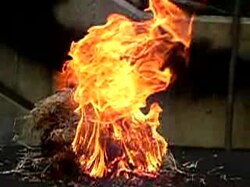
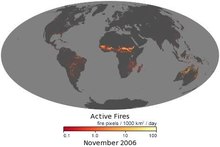
Fire is the rapid oxidation of a material in the exothermic chemical process of combustion, releasing heat, light, and various reaction products.[1][a] Fire is hot because the conversion of the weak double bond in molecular oxygen, O2, to the stronger bonds in the combustion products carbon dioxide and water releases energy (418 kJ per 32 g of O2); the bond energies of the fuel play only a minor role here.[2] At a certain point in the combustion reaction, called the ignition point, flames are produced. The flame is the visible portion of the fire. Flames consist primarily of carbon dioxide, water vapor, oxygen and nitrogen. If hot enough, the gases may become ionized to produce plasma.[3] Depending on the substances alight, and any impurities outside, the color of the flame and the fire's intensity will be different.
Fire in its most common form can result in conflagration, which has the potential to cause physical damage through burning. Fire is an important process that affects ecological systems around the globe. The positive effects of fire include stimulating growth and maintaining various ecological systems. Its negative effects include hazard to life and property, atmospheric pollution, and water contamination.[4] If fire removes protective vegetation, heavy rainfall may lead to an increase in soil erosion by water.[5] Also, when vegetation is burned, the nitrogen it contains is released into the atmosphere, unlike elements such as potassium and phosphorus which remain in the ash and are quickly recycled into the soil. This loss of nitrogen caused by a fire produces a long-term reduction in the fertility of the soil, but this fecundity can potentially be recovered as molecular nitrogen in the atmosphere is "fixed" and converted to ammonia by natural phenomena such as lightning and by leguminous plants that are "nitrogen-fixing" such as clover, peas, and green beans.
Fire has been used by humans in rituals, in agriculture for clearing land, for cooking, generating heat and light, for signaling, propulsion purposes, smelting, forging, incineration of waste, cremation, and as a weapon or mode of destruction.
Physical properties
Chemistry

Fires start when a flammable or a combustible material, in combination with a sufficient quantity of an oxidizer such as oxygen gas or another oxygen-rich compound (though non-oxygen oxidizers exist), is exposed to a source of heat or ambient temperature above the flash point for the fuel/oxidizer mix, and is able to sustain a rate of rapid oxidation that produces a chain reaction. This is commonly called the fire tetrahedron. Fire cannot exist without all of these elements in place and in the right proportions. For example, a flammable liquid will start burning only if the fuel and oxygen are in the right proportions. Some fuel-oxygen mixes may require a catalyst, a substance that is not consumed, when added, in any chemical reaction during combustion, but which enables the reactants to combust more readily.
Once ignited, a chain reaction must take place whereby fires can sustain their own heat by the further release of heat energy in the process of combustion and may propagate, provided there is a continuous supply of an oxidizer and fuel.
If the oxidizer is oxygen from the surrounding air, the presence of a force of gravity, or of some similar force caused by acceleration, is necessary to produce convection, which removes combustion products and brings a supply of oxygen to the fire. Without gravity, a fire rapidly surrounds itself with its own combustion products and non-oxidizing gases from the air, which exclude oxygen and extinguish the fire. Because of this, the risk of fire in a spacecraft is small when it is coasting in inertial flight.[6][7] This does not apply if oxygen is supplied to the fire by some process other than thermal convection.
Fire can be extinguished by removing any one of the elements of the fire tetrahedron. Consider a natural gas flame, such as from a stove-top burner. The fire can be extinguished by any of the following:
- turning off the gas supply, which removes the fuel source;
- covering the flame completely, which smothers the flame as the combustion both uses the available oxidizer (the oxygen in the air) and displaces it from the area around the flame with CO2;
- application of water, which removes heat from the fire faster than the fire can produce it (similarly, blowing hard on a flame will displace the heat of the currently burning gas from its fuel source, to the same end), or
- application of a retardant chemical such as Halon to the flame, which retards the chemical reaction itself until the rate of combustion is too slow to maintain the chain reaction.
In contrast, fire is intensified by increasing the overall rate of combustion. Methods to do this include balancing the input of fuel and oxidizer to stoichiometric proportions, increasing fuel and oxidizer input in this balanced mix, increasing the ambient temperature so the fire's own heat is better able to sustain combustion, or providing a catalyst, a non-reactant medium in which the fuel and oxidizer can more readily react.
Flame


A flame is a mixture of reacting gases and solids emitting visible, infrared, and sometimes ultraviolet light, the frequency spectrum of which depends on the chemical composition of the burning material and intermediate reaction products. In many cases, such as the burning of organic matter, for example wood, or the incomplete combustion of gas, incandescent solid particles called soot produce the familiar red-orange glow of "fire". This light has a continuous spectrum. Complete combustion of gas has a dim blue color due to the emission of single-wavelength radiation from various electron transitions in the excited molecules formed in the flame. Usually oxygen is involved, but hydrogen burning in chlorine also produces a flame, producing hydrogen chloride (HCl). Other possible combinations producing flames, amongst many, are fluorine and hydrogen, and hydrazine and nitrogen tetroxide. Hydrogen and hydrazine/UDMH flames are similarly pale blue, while burning boron and its compounds, evaluated in mid-20th century as a high energy fuel for jet and rocket engines, emits intense green flame, leading to its informal nickname of "Green Dragon".
The glow of a flame is complex. Black-body radiation is emitted from soot, gas, and fuel particles, though the soot particles are too small to behave like perfect blackbodies. There is also photon emission by de-excited atoms and molecules in the gases. Much of the radiation is emitted in the visible and infrared bands. The color depends on temperature for the black-body radiation, and on chemical makeup for the emission spectra. The dominant color in a flame changes with temperature. The photo of the forest fire in Canada is an excellent example of this variation. Near the ground, where most burning is occurring, the fire is white, the hottest color possible for organic material in general, or yellow. Above the yellow region, the color changes to orange, which is cooler, then red, which is cooler still. Above the red region, combustion no longer occurs, and the uncombusted carbon particles are visible as black smoke.
The common distribution of a flame under normal gravity conditions depends on convection, as soot tends to rise to the top of a general flame, as in a candle in normal gravity conditions, making it yellow. In micro gravity or zero gravity,[8] such as an environment in outer space, convection no longer occurs, and the flame becomes spherical, with a tendency to become more blue and more efficient (although it may go out if not moved steadily, as the CO2 from combustion does not disperse as readily in micro gravity, and tends to smother the flame). There are several possible explanations for this difference, of which the most likely is that the temperature is sufficiently evenly distributed that soot is not formed and complete combustion occurs.[9] Experiments by NASA reveal that diffusion flames in micro gravity allow more soot to be completely oxidized after they are produced than diffusion flames on Earth, because of a series of mechanisms that behave differently in micro gravity when compared to normal gravity conditions.[10] These discoveries have potential applications in applied science and industry, especially concerning fuel efficiency.
In combustion engines, various steps are taken to eliminate a flame. The method depends mainly on whether the fuel is oil, wood, or a high-energy fuel such as jet fuel.
Typical adiabatic temperatures
The adiabatic flame temperature of a given fuel and oxidizer pair is that at which the gases achieve stable combustion.
- Oxy–dicyanoacetylene 4,990 °C (9,000 °F)
- Oxy–acetylene 3,480 °C (6,300 °F)
- Oxyhydrogen 2,800 °C (5,100 °F)
- Air–acetylene 2,534 °C (4,600 °F)
- Blowtorch (air–MAPP gas) 2,200 °C (4,000 °F)
- Bunsen burner (air–natural gas) 1,300 to 1,600 °C (2,400 to 2,900 °F)[11]
- Candle (air–paraffin) 1,000 °C (1,800 °F)
Fire ecology
Every natural ecosystem has its own fire regime, and the organisms in those ecosystems are adapted to or dependent upon that fire regime. Fire creates a mosaic of different habitat patches, each at a different stage of succession.[12] Different species of plants, animals, and microbes specialize in exploiting a particular stage, and by creating these different types of patches, fire allows a greater number of species to exist within a landscape.
Fossil record
The fossil record of fire first appears with the establishment of a land-based flora in the Middle Ordovician period, 470 million years ago,[13] permitting the accumulation of oxygen in the atmosphere as never before, as the new hordes of land plants pumped it out as a waste product. When this concentration rose above 13%, it permitted the possibility of wildfire.[14] Wildfire is first recorded in the Late Silurian fossil record, 420 million years ago, by fossils of charcoalified plants.[15][16] Apart from a controversial gap in the Late Devonian, charcoal is present ever since.[16] The level of atmospheric oxygen is closely related to the prevalence of charcoal: clearly oxygen is the key factor in the abundance of wildfire.[17] Fire also became more abundant when grasses radiated and became the dominant component of many ecosystems, around 6 to 7 million years ago;[18] this kindling provided tinder which allowed for the more rapid spread of fire.[17] These widespread fires may have initiated a positive feedback process, whereby they produced a warmer, drier climate more conducive to fire.[17]
Human control


The ability to control fire was a dramatic change in the habits of early humans. Making fire to generate heat and light made it possible for people to cook food, simultaneously increasing the variety and availability of nutrients and reducing disease by killing organisms in the food.[19] The heat produced would also help people stay warm in cold weather, enabling them to live in cooler climates. Fire also kept nocturnal predators at bay. Evidence of cooked food is found from 1 million years ago,[20] although fire was probably not used in a controlled fashion until 400,000 years ago.[21] There is some evidence that fire may have been used in a controlled fashion about 1 million years ago.[22][23] Evidence becomes widespread around 50 to 100 thousand years ago, suggesting regular use from this time; interestingly, resistance to air pollution started to evolve in human populations at a similar point in time.[21] The use of fire became progressively more sophisticated, with it being used to create charcoal and to control wildlife from 'tens of thousands' of years ago.[21]
Fire has also been used for centuries as a method of torture and execution, as evidenced by death by burning as well as torture devices such as the iron boot, which could be filled with water, oil, or even lead and then heated over an open fire to the agony of the wearer.

By the Neolithic Revolution,[citation needed] during the introduction of grain-based agriculture, people all over the world used fire as a tool in landscape management. These fires were typically controlled burns or "cool fires",[citation needed] as opposed to uncontrolled "hot fires", which damage the soil. Hot fires destroy plants and animals, and endanger communities. This is especially a problem in the forests of today where traditional burning is prevented in order to encourage the growth of timber crops. Cool fires are generally conducted in the spring and autumn. They clear undergrowth, burning up biomass that could trigger a hot fire should it get too dense. They provide a greater variety of environments, which encourages game and plant diversity. For humans, they make dense, impassable forests traversable. Another human use for fire in regards to landscape management is its use to clear land for agriculture. Slash-and-burn agriculture is still common across much of tropical Africa, Asia and South America. "For small farmers, it is a convenient way to clear overgrown areas and release nutrients from standing vegetation back into the soil", said Miguel Pinedo-Vasquez, an ecologist at the Earth Institute’s Center for Environmental Research and Conservation.[24] However this useful strategy is also problematic. Growing population, fragmentation of forests and warming climate are making the earth's surface more prone to ever-larger escaped fires. These harm ecosystems and human infrastructure, cause health problems, and send up spirals of carbon and soot that may encourage even more warming of the atmosphere – and thus feed back into more fires. Globally today, as much as 5 million square kilometres – an area more than half the size of the United States – burns in a given year.[24]
There are numerous modern applications of fire. In its broadest sense, fire is used by nearly every human being on earth in a controlled setting every day. Users of internal combustion vehicles employ fire every time they drive. Thermal power stations provide electricity for a large percentage of humanity.

The use of fire in warfare has a long history. Fire was the basis of all early thermal weapons. Homer detailed the use of fire by Greek soldiers who hid in a wooden horse to burn Troy during the Trojan war. Later the Byzantine fleet used Greek fire to attack ships and men. In the First World War, the first modern flamethrowers were used by infantry, and were successfully mounted on armoured vehicles in the Second World War. In the latter war, incendiary bombs were used by Axis and Allies alike, notably on Tokyo, Rotterdam, London, Hamburg and, notoriously, at Dresden; in the latter two cases firestorms were deliberately caused in which a ring of fire surrounding each city[citation needed] was drawn inward by an updraft caused by a central cluster of fires. The United States Army Air Force also extensively used incendiaries against Japanese targets in the latter months of the war, devastating entire cities constructed primarily of wood and paper houses. The use of napalm was employed in July 1944, towards the end of the Second World War;[26] although its use did not gain public attention until the Vietnam War.[26] Molotov cocktails were also used.
Use as fuel


Setting fuel aflame releases usable energy. Wood was a prehistoric fuel, and is still viable today. The use of fossil fuels, such as petroleum, natural gas, and coal, in power plants supplies the vast majority of the world's electricity today; the International Energy Agency states that nearly 80% of the world's power came from these sources in 2002.[28] The fire in a power station is used to heat water, creating steam that drives turbines. The turbines then spin an electric generator to produce electricity. Fire is also used to provide mechanical work directly, in both external and internal combustion engines.
The unburnable solid remains of a combustible material left after a fire is called clinker if its melting point is below the flame temperature, so that it fuses and then solidifies as it cools, and ash if its melting point is above the flame temperature.
Protection and prevention
Wildfire prevention programs around the world may employ techniques such as wildland fire use and prescribed or controlled burns.[29][30] Wildland fire use refers to any fire of natural causes that is monitored but allowed to burn. Controlled burns are fires ignited by government agencies under less dangerous weather conditions.[31]
Fire fighting services are provided in most developed areas to extinguish or contain uncontrolled fires. Trained firefighters use fire apparatus, water supply resources such as water mains and fire hydrants or they might use A and B class foam depending on what is feeding the fire.
Fire prevention is intended to reduce sources of ignition. Fire prevention also includes education to teach people how to avoid causing fires.[32] Buildings, especially schools and tall buildings, often conduct fire drills to inform and prepare citizens on how to react to a building fire. Purposely starting destructive fires constitutes arson and is a crime in most jurisdictions.[33]
Model building codes require passive fire protection and active fire protection systems to minimize damage resulting from a fire. The most common form of active fire protection is fire sprinklers. To maximize passive fire protection of buildings, building materials and furnishings in most developed countries are tested for fire-resistance, combustibility and flammability. Upholstery, carpeting and plastics used in vehicles and vessels are also tested.
Where fire prevention and fire protection have failed to prevent damage, fire insurance can mitigate the financial impact.[34]
Restoration
.jpg)
Different restoration methods and measures are used depending on the type of fire damage that occurred. Restoration after fire damage can be performed by property management teams, building maintenance personnel, or by the homeowners themselves; however, contacting a certified professional fire damage restoration specialist is often regarded as the safest way to restore fire damaged property due to their training and extensive experience.[35] Most are usually listed under "Fire and Water Restoration" and they can help speed repairs, whether for individual homeowners or for the largest of institutions.[36]
Fire and Water Restoration companies are regulated by the appropriate state's Department of Consumer Affairs – usually the state contractors license board. In California, all Fire and Water Restoration companies must register with the California Contractors State License Board.[37] Presently, the California Contractors State License Board has no specific classification for "water and fire damage restoration." Hence, the Contractor's State License Board requires both an asbestos certification (ASB) as well as a demolition classification (C-21) in order to perform Fire and Water Restoration work.[38]
See also
- Aodh (given name)
- Bonfire
- The Chemical History of a Candle
- Colored fire
- Control of fire by early humans
- Deflagration
- Fire (classical element)
- Fire investigation
- Fire lookout
- Fire lookout tower
- Fire making
- Fire pit
- Fire safety
- Fire triangle
- Fire whirl
- Fire worship
- Flame test
- Life Safety Code
- List of fires
- List of light sources
- Phlogiston theory
- Piano burning
- Prometheus, the Greek mythological figure who gave mankind fire
- Pyrokinesis
- Pyrolysis
- Pyromania
- Self-immolation
References
Notes
Citations
- ^ "Glossary of Wildland Fire Terminology" (PDF). National Wildfire Coordinating Group. November 2009. Retrieved 2008-12-18.
- ^ Schmidt-Rohr, K (2015). "Why Combustions Are Always Exothermic, Yielding About 418 kJ per Mole of O2". J. Chem. Educ. 92 (12): 2094–99. Bibcode:2015JChEd..92.2094S. doi:10.1021/acs.jchemed.5b00333.
- ^ Helmenstine, Anne Marie. "What is the State of Matter of Fire or Flame? Is it a Liquid, Solid, or Gas?". About.com. Retrieved 2009-01-21.
- ^ Lentile, et al., 319
- ^ Morris, S. E.; Moses, T. A. (1987). "Forest Fire and the Natural Soil Erosion Regime in the Colorado Front Range". Annals of the Association of American Geographers. 77 (2): 245–54. doi:10.1111/j.1467-8306.1987.tb00156.x.
- ^ NASA Johnson (29 August 2008). "Ask Astronaut Greg Chamitoff: Light a Match!". Retrieved 30 December 2016 – via YouTube.
- ^ Inglis-Arkell, Esther. "How does fire behave in zero gravity?". Retrieved 30 December2016.
- ^ Spiral flames in microgravity Archived 2010-03-19 at the Wayback Machine, National Aeronautics and Space Administration, 2000.
- ^ CFM-1 experiment results Archived 2007-09-12 at the Wayback Machine, National Aeronautics and Space Administration, April 2005.
- ^ LSP-1 experiment results Archived 2007-03-12 at the Wayback Machine, National Aeronautics and Space Administration, April 2005.
- ^ "Flame Temperatures".
- ^ Begon, M., J.L. Harper and C.R. Townsend. 1996. Ecology: individuals, populations, and communities, Third Edition. Blackwell Science Ltd., Cambridge, Massachusetts, US
- ^ Wellman, C. H.; Gray, J. (2000). "The microfossil record of early land plants". Philos Trans R Soc Lond B Biol Sci. 355 (1398): 717–31, discussion 731–2. doi:10.1098/rstb.2000.0612. PMC 1692785. PMID 10905606.
- ^ Jones, Timothy P.; Chaloner, William G. (1991). "Fossil charcoal, its recognition and palaeoatmospheric significance". Palaeogeography, Palaeoclimatology, Palaeoecology. 97(1–2): 39–50. Bibcode:1991PPP....97...39J. doi:10.1016/0031-0182(91)90180-Y.
- ^ Glasspool, I.J.; Edwards, D.; Axe, L. (2004). "Charcoal in the Silurian as evidence for the earliest wildfire". Geology. 32 (5): 381–383. Bibcode:2004Geo....32..381G. doi:10.1130/G20363.1.
- ^ a b Scott, AC; Glasspool, IJ (2006). "The diversification of Paleozoic fire systems and fluctuations in atmospheric oxygen concentration". Proceedings of the National Academy of Sciences of the United States of America. 103 (29): 10861–5. Bibcode:2006PNAS..10310861S. doi:10.1073/pnas.0604090103. PMC 1544139. PMID 16832054.
- ^ a b c Bowman, D. M. J. S.; Balch, J. K.; Artaxo, P.; Bond, W. J.; Carlson, J. M.; Cochrane, M. A.; d'Antonio, C. M.; Defries, R. S.; Doyle, J. C.; Harrison, S. P.; Johnston, F. H.; Keeley, J. E.; Krawchuk, M. A.; Kull, C. A.; Marston, J. B.; Moritz, M. A.; Prentice, I. C.; Roos, C. I.; Scott, A. C.; Swetnam, T. W.; Van Der Werf, G. R.; Pyne, S. J. (2009). "Fire in the Earth system". Science. 324 (5926): 481–4. Bibcode:2009Sci...324..481B. doi:10.1126/science.1163886. PMID 19390038.
- ^ Retallack, Gregory J. (1997). "Neogene expansion of the North American prairie". PALAIOS. 12 (4): 380–90. Bibcode:1997Palai..12..380R. doi:10.2307/3515337.
- ^ J. A. J. Gowlett; R. W. Wrangham (2013). "Earliest fire in Africa: towards the convergence of archaeological evidence and the cooking hypothesis". Azania: Archaeological Research in Africa. 48:1: 5–30. doi:10.1080/0067270X.2012.756754. S2CID 163033909.
- ^ Kaplan, Matt. "Million-year-old ash hints at origins of cooking". Nature.com. Retrieved 25 August 2020.
- ^ a b c Bowman, D. M. J. S.; et al. (2009). "Fire in the Earth system". Science. 324 (5926): 481–84. Bibcode:2009Sci...324..481B. doi:10.1126/science.1163886. PMID 19390038. S2CID 22389421.
- ^ Eoin O'Carroll (Apr 5, 2012). "Were Early Humans Cooking Their Food a Million Years Ago?". abcNEWS.
Early humans harnessed fire as early as a million years ago, much earlier than previously thought, suggests evidence unearthed in a cave in South Africa.
- ^ Francesco Berna; et al. (May 15, 2012). "Microstratigraphic evidence of in situ fire in the Acheulean strata of Wonderwerk Cave, Northern Cape province, South Africa". PNAS. 109 (20): E1215–E1220. doi:10.1073/pnas.1117620109. PMC 3356665. PMID 22474385.
- ^ a b "Farmers, Flames and Climate: Are We Entering an Age of 'Mega-Fires'? – State of the Planet". Blogs.ei.columbia.edu. Retrieved 2012-05-23.
- ^ "In Pictures: German destruction". BBC News.
- ^ a b "Napalm". GlobalSecurity.org. Retrieved 8 May 2010.
- ^ "WHO Disease and injury country estimates". World Health Organization. 2009. Retrieved Nov 11, 2009.
- ^ "Share of Total Primary Energy Supply, 2002; International Energy Agency". Archived from the original on 13 January 2015.
- ^ Federal Fire and Aviation Operations Action Plan, 4.
- ^ "UK: The Role of Fire in the Ecology of Heathland in Southern Britain". International Forest Fire News. 18: 80–81. January 1998.
- ^ "Prescribed Fires". SmokeyBear.com. Archived from the original on 2008-10-20. Retrieved 2008-11-21.
- ^ Fire & Life Safety Education, Manitoba Office of the Fire Commissioner ArchivedDecember 6, 2008, at the Wayback Machine
- ^ Ward, Michael (March 2005). Fire Officer: Principles and Practice. Jones & Bartlett Learning. ISBN 9780763722470. Retrieved March 16, 2019.
- ^ Baars, Hans; Smulders, Andre; Hintzbergen, Kees; Hintzbergen, Jule (2015-04-15). Foundations of Information Security Based on ISO27001 and ISO27002 (3rd revised ed.). Van Haren. ISBN 9789401805414.
- ^ "US Department of Homeland Security, US Fire Administration Handbook". Usfa.dhs.gov. 2010-05-06. Archived from the original on 2011-08-27. Retrieved 2012-05-23.
- ^ Begal, Bill (August 23, 2007). "Restoration With a Capital E-P-A: A Case Study". Restoration & Remediation. Retrieved 2008-04-11.
- ^ "California Contractors State License Board". State of California. Retrieved 2010-08-29.
- ^ "What You Should Know About Your Water Damage Or Mold Removal Company". Rapco West Environmental Services, Inc. Archived from the original on 2011-01-07. Retrieved 2010-08-29.
The Combustion Process
What makes a fire burn? Why is one fire a roaring inferno while another barely creeps along? Fire is a chemical reaction in which energy in the form of heat is produced. When forest fuels burn, there is a chemical combination of the oxygen in the air with woody material, pitch and other burnable elements found in the forest environment. This process in known as �Combustion.� Combustion is a chain reaction chemically similar to photosynthesis in reverse.
Photosynthesis requires a large amount of heat which is furnished by the sun. The Combustion process releases this heat. The tremendous amount of heat that is produced in the burning process is the major reason that the suppression of wildfires is such a difficult task and why the use of prescribed fire is a complex and exacting process requiring knowledgeable and experienced people.
The combustion process or �fire� is sometimes called �rapid oxidation.� It is similar to the formation of rust on iron or the decay of dead wood in the forest, except that the process is drastically speeded up.
Fire begins with ignition. The match is a common ignition device. Friction creates sufficient heat to ignite the phosphorus on the end of the match. Combustion occurs and the match flames.
Heat is necessary to begin the combustion process. Once started, fire produces its own heat. Wild land fires originate from such sources of heat as matches, embers from cigarettes, cigars or pipes, campfires, trash fires, exhaust sparks from railroad locomotives, sparks from brake shoes or �hot-box� on railroad cars. lightning, spontaneous combustion, hot ashes and arson.
The Fire Triangle
Three things are required in proper combination before ignition and combustion can take place---Heat, Oxygen and Fuel.

There must be Fuel to burn.
There must be Air to supply oxygen.
There must be Heat (ignition temperature) to start and continue the combustion process.
 Fuel pre-heating |
 Pre-ignition |
 Flaming stage |
 Flaming & Residual Smoke Generation |
 Residual /Smoldering |
 Glowing |
Heat is Energy
Sources of heat are:
- Sun
- Atomic
- Volcanoes
- Fires
The Sun is the major source of heat.
Heat from the sun drives our weather.
With a continuous supply of heat (furnished by the combustion process itself), the ignition of additional fuel will continue as long as there is enough oxygen present. Thus it is obvious that these three elements must be present and satisfactorily combined before combustion can occur and continue. For the sake of simplicity we call this the �Fire Triangle.�
Remove any one of the three sides or elements and the fire will cease to burn. Weaken any one, and the fire will weaken. Increase any one or more of the elements, and the fire will increase in intensity. Armed with this knowledge the fire fighter or the prescribed burner can do much to manage a fire.
DEMONSTRATION
CAUTION: the jar gets hot! Do not touch it without protection. Young children should not attempt this exercise without adult supervision.
There are various ways in which the fire triangle can be broken or altered. One example of how the triangle can be broken can be done with a short candle and a jar. Light the candle and set it on a flat surface. After it�s burning well, place the jar upside-down over the candle. After a short time, the candle will go out. This occurs because all of the oxygen inside the jar has been used up by the burning candle and no additional oxygen can get to the candle because of the jar. Before you put the jar over the burning candle, you had all the ingredients necessary for combustion; heat from the match, fuel in the candle and oxygen from the air.
Relight the candle. This time, take a pair of scissors and cut off the wick below the flame and remove the candle. Again, the fire will go out after a short period when the rest of the wick that was left on the scissors is consumed. This time you had plenty of oxygen in the air but you removed the fuel. The same principle is used in fighting wildfires. Remove heat, oxygen or fuel and the fire goes out.
In suppression of a wildfire, the objective is to stop combustion by removing or altering one or more sides of the triangle.
Stages of combustion: flaming stages (see pictures from lab)
Pre-heating � temperature of the fuel is raised to the point where gases start to volatize
Pre-ignition � volatile materials in the fuel are vaporized
Flaming � the ignition temperature of the fuel is reached and combustion begins
Transition � fuel is partially consumed by combustion while flaming continues in portions of the fuel resulting in initiation of smoldering and smoke generation
Smoldering � combustion of the fuel is essentially complete where oxygen is available and smoldering continues resulting in smoke generation
Glowing � a stage of combustion where oxygen is limited
The four most important stages of combustion for prescribed burners are,
pre-ignition (fuel is about to burst into flame)
flaming � active combustion
transition � smoke generation begins
smoldering � residual smoke production
Suppressing fire and smoke generation (segment on Suppression)
When a wildfire has started, we try to remove the oxygen side of the triangle by smothering the fire with a fire retardant, foam, dirt or water in a fine spray or fog. They will replace the oxygen around the fuel affecting one side of the fire triangle. They also absorb heat and thus also alter the heat side of the triangle. Retardants will coat the fuel and protect it from the heat even after the water has evaporated. They also inhibit the flaming combustion by chemical action. Foams also coat the fuel and last longer than water. They reduce heat as well as supply of oxygen to the fuel. They will adhere to vertical fuel and can be easily applied by ground units.
Water absorbs vast amounts of heat, especially when applied as a fog. Each droplet absorbs a large amount of heat which turns the water into a hot gas or vapor (steam). The hot steam is then dispersed by the wind into the atmosphere. However, water is heavy and it is difficult to deliver it to the fireline in inaccessible areas. There is also the possibility of running out at the most inappropriate time and losing the fire.
In forest conditions, one of the more important approaches to suppression of wildfires is removal of the third side of the triangle--Fuel. The fuel is removed by building a fireline thus separating the fuels. When the wildfire burns up to the fireline, no more fuel is available and the fire goes out. The fire line is usually constructed with a tractor-plow unit or by hand. (In the Western part of the
Removing Fuel
Removing the fuel source is the most common method of attacking wildfires. This method does not extinguish the fire. The fire continues to burn until the fuel inside the fireline is consumed. Removal of fuel in the path of the fire prevents the fire from spreading. A slowly advancing fire burning sparse ground fuels may be checked by constructing a fireline down to mineral soil. A hot, fast-running fire may require several firelines, burning out the fuel between the firelines and the fire or a combination of both.
Good firefighting procedure is often a skillful combination of removing fuel, heat, and oxygen. Therefore, when you tackle a going fire, you should consider how best you can use personnel and equipment to remove one or all of the sides of the fire triangle.1. Fire is a2. The heat energy given off by a fire can be viewed a stored energy from3. The three legs of the fire triangle are4. Fire is a5. The fire stages of fire, the flaming stages, are6. The two most important flaming stages for prescribed burners are:7. Suppression or �holding� a prescribed fire consist of


Reporter's Guide: All about fire
What is fire?
The ancient Greeks believed that fire was one the four basic elements that composed all things in the universe. In the mythology of virtually every culture, fire is a sacred substance that gives life or power. Fire is not, in fact, a substance. When you gaze at the leaping flames of a campfire, you’re observing not an object, but a process – a chemical reaction. It’s the same chemical reaction that occurs when a cut apple left on the counter turns brown, when silver tarnishes or when an iron nail rusts.That process is oxidation: combining oxygen with another substance. The defining difference between a fire and your half-eaten apple is speed: fire is an oxidation process that happens very fast, so that light, heat and sound are released — often with enough force and majesty to justify the ancients’ reverence.The sudden release of energy causes temperatures to rise, sometimes by thousands of degrees. And it also results in smoke, the toxic waste of fire’s leftovers.
The fire triangle and the fire tetrahedron The fire triangle identifies the three needed components of fire:
- fuel (something that will burn)
- heat (enough to make the fuel burn)
- and air (oxygen)
All three components must be present to have a fire. Fire will burn until one or more of the components are removed. Traditional fire extinguishing methods involve removing the fuel, heat, or oxygen.
In more recent years, a fourth component – the uninhibited chain reaction – has been added to explain fire. This chain reaction is the feedback of heat to the fuel to produce the gaseous fuel used in the flame. In other words, the chain reaction provides the heat necessary to maintain the fire. The addition of this fourth component (which forms what is called the "fire tetrahedron ") more accurately describes the mechanism for fire suppression by clean agent halon replacements which break up the uninhibited chain reaction of combustion.
Stages of fire
- Ignition: Fuel, oxygen and heat join together in a sustained chemical reaction. At this stage, a fire extinguisher can control the fire.
- Growth: With the initial flame as a heat source, additional fuel ignites. Convection and radiation ignite more surfaces. The size of the fire increases and the plume reaches the ceiling. Hot gases collecting at the ceiling transfer heat, allowing all fuels in a room to come closer to their ignition temperature at the same time.
- Fully developed: Fire has spread over much if not all the available fuel; temperatures reach their peak, resulting in heat damage. Oxygen is consumed rapidly.
- Decay (Burnout): The fire consumes available fuel, temperatures decrease, fire gets less intense.
How fire spreads
Fire spreads by transferring the heat energy from the flames in three different ways.
- Conduction: The passage of heat energy through or within a material because of direct contact, such as a burning wastebasket heating a nearby couch, which ignites and heats the drapes hanging behind, until they too burst into flames.
- Convection: The flow of fluid or gas from hot areas to cooler areas. The heated air is less dense, and rises, while cooler air descends. A large fire in an open area produces plume or column of hot gas and smoke high into the air. But inside a room, those rising gases encounter the ceiling. They travel horizontally along the ceiling forming a thick layer of heated air, which then moves downward.
- Radiation: Heat traveling via electromagnetic waves, without objects or gases carrying it along. Radiated heat goes out in all directions, unnoticed until it strikes an object. Burning buildings can radiate heat to surrounding structures, sometimes even passing through glass windows and igniting objects inside.
Four ways to put out a fire
- Cool the burning material
- Exclude oxygen
- Remove the fuel
- Break the chemical reaction
Special circumstances
- Rollover occurs when ignited fire gases, or incompletely burned fuels, rise to the ceiling, and spread out horizontally. Then smoke appears to suddenly start burning. If nothing is done to ventilate the room or cool the air, this condition leads to flashover.
- Flashover is the sudden, simultaneous ignition of everything in a room. This is how it happens:
- Hot gases rise to the ceiling and spread out across to the walls.
- Heat radiates downward and intensifies until all combustible items reach their ignition temperatures and burst into flames.
- Temperatures soar to as much as 1,000 degrees Fahrenheit in a few seconds. Even a firefighter in full protective gear is unlikely survive a flashover.
- Firefighters are trained to recognize the signs that flashover is about to occur: dense black smoke with tightly packed curls ("black fire"); dense, black smoke that pushes out of a doorway or window opening; smoke that has accumulated as low as a doorknob, with the fire seen below.
- Backdraft is an explosion that occurs when oxygen is introduced into a room full of hot gases.
- A fire burning in a confined area consumes all the oxygen.
- Visible flames disappear. Solid fuels smolder, and hot flammable gases accumulate and fill the room.
- The temperature increases, the gases expand, and pressure builds, pulsing against doors and windows. From outside, the building may look like it is breathing or throbbing.
- If an opening is made to admit oxygen, the hot vaporized fuel bursts into flames, and the pressurized gases explode through the opening, resulting in a rolling fireball.
Classifying fire
Fire classifications based on fuel type:
- Class A: Ordinary combustible materials, such as wood, cloth, paper, rubber and many plastics. They burn with an ember and leave an ash. Extinguish by cooling the fuel to a temperature that is below the ignition temp. Water and other extinguishing agents are effective.
- Class B: Flammable liquids (burn at room temperature) and combustible liquids (require heat to ignite). Petroleum greases, tars, oils, oil-based paints, solvents, lacquers, alcohols, and flammable gases. High fire hazard; water may not extinguish. Extinguish by creating a barrier between the fuel and the oxygen, such as layer of foam.
- Class C: Fuels that would be A or B except that they involve energized electrical equipment. Special techniques and agents required to extinguish, most commonly carbon dioxide or dry chemical agents. Use of water is very dangerous because water conducts electricity.
- Class D: Combustible metals, such as magnesium, titanium, zirconium, sodium, lithium and potassium. Most cars contain numerous such metals. Because of extremely high flame temperatures, water can break down into hydrogen and oxygen, enhancing burning or exploding. Extinguish with special powders based on sodium chloride or other salts; also clean dry sand.
- Class K: Fires in cooking appliances that involve combustible cooking media (vegetable or animal oils and fats).
Reporter's Guide: All about fire
What is fire?
The ancient Greeks believed that fire was one the four basic elements that composed all things in the universe. In the mythology of virtually every culture, fire is a sacred substance that gives life or power. Fire is not, in fact, a substance. When you gaze at the leaping flames of a campfire, you’re observing not an object, but a process – a chemical reaction. It’s the same chemical reaction that occurs when a cut apple left on the counter turns brown, when silver tarnishes or when an iron nail rusts.That process is oxidation: combining oxygen with another substance. The defining difference between a fire and your half-eaten apple is speed: fire is an oxidation process that happens very fast, so that light, heat and sound are released — often with enough force and majesty to justify the ancients’ reverence.The sudden release of energy causes temperatures to rise, sometimes by thousands of degrees. And it also results in smoke, the toxic waste of fire’s leftovers.
The fire triangle and the fire tetrahedronThe fire triangle identifies the three needed components of fire:- fuel (something that will burn)
- heat (enough to make the fuel burn)
- and air (oxygen)
All three components must be present to have a fire. Fire will burn until one or more of the components are removed. Traditional fire extinguishing methods involve removing the fuel, heat, or oxygen.
In more recent years, a fourth component – the uninhibited chain reaction – has been added to explain fire. This chain reaction is the feedback of heat to the fuel to produce the gaseous fuel used in the flame. In other words, the chain reaction provides the heat necessary to maintain the fire. The addition of this fourth component (which forms what is called the "fire tetrahedron ") more accurately describes the mechanism for fire suppression by clean agent halon replacements which break up the uninhibited chain reaction of combustion.
Stages of fire
- Ignition: Fuel, oxygen and heat join together in a sustained chemical reaction. At this stage, a fire extinguisher can control the fire.
- Growth: With the initial flame as a heat source, additional fuel ignites. Convection and radiation ignite more surfaces. The size of the fire increases and the plume reaches the ceiling. Hot gases collecting at the ceiling transfer heat, allowing all fuels in a room to come closer to their ignition temperature at the same time.
- Fully developed: Fire has spread over much if not all the available fuel; temperatures reach their peak, resulting in heat damage. Oxygen is consumed rapidly.
- Decay (Burnout): The fire consumes available fuel, temperatures decrease, fire gets less intense.
How fire spreads
Fire spreads by transferring the heat energy from the flames in three different ways.
- Conduction: The passage of heat energy through or within a material because of direct contact, such as a burning wastebasket heating a nearby couch, which ignites and heats the drapes hanging behind, until they too burst into flames.
- Convection: The flow of fluid or gas from hot areas to cooler areas. The heated air is less dense, and rises, while cooler air descends. A large fire in an open area produces plume or column of hot gas and smoke high into the air. But inside a room, those rising gases encounter the ceiling. They travel horizontally along the ceiling forming a thick layer of heated air, which then moves downward.
- Radiation: Heat traveling via electromagnetic waves, without objects or gases carrying it along. Radiated heat goes out in all directions, unnoticed until it strikes an object. Burning buildings can radiate heat to surrounding structures, sometimes even passing through glass windows and igniting objects inside.
Four ways to put out a fire
- Cool the burning material
- Exclude oxygen
- Remove the fuel
- Break the chemical reaction
Special circumstances
- Rollover occurs when ignited fire gases, or incompletely burned fuels, rise to the ceiling, and spread out horizontally. Then smoke appears to suddenly start burning. If nothing is done to ventilate the room or cool the air, this condition leads to flashover.
- Flashover is the sudden, simultaneous ignition of everything in a room. This is how it happens:
- Hot gases rise to the ceiling and spread out across to the walls.
- Heat radiates downward and intensifies until all combustible items reach their ignition temperatures and burst into flames.
- Temperatures soar to as much as 1,000 degrees Fahrenheit in a few seconds. Even a firefighter in full protective gear is unlikely survive a flashover.
- Firefighters are trained to recognize the signs that flashover is about to occur: dense black smoke with tightly packed curls ("black fire"); dense, black smoke that pushes out of a doorway or window opening; smoke that has accumulated as low as a doorknob, with the fire seen below.
- Backdraft is an explosion that occurs when oxygen is introduced into a room full of hot gases.
- A fire burning in a confined area consumes all the oxygen.
- Visible flames disappear. Solid fuels smolder, and hot flammable gases accumulate and fill the room.
- The temperature increases, the gases expand, and pressure builds, pulsing against doors and windows. From outside, the building may look like it is breathing or throbbing.
- If an opening is made to admit oxygen, the hot vaporized fuel bursts into flames, and the pressurized gases explode through the opening, resulting in a rolling fireball.
Classifying fire
Fire classifications based on fuel type:
- Class A: Ordinary combustible materials, such as wood, cloth, paper, rubber and many plastics. They burn with an ember and leave an ash. Extinguish by cooling the fuel to a temperature that is below the ignition temp. Water and other extinguishing agents are effective.
- Class B: Flammable liquids (burn at room temperature) and combustible liquids (require heat to ignite). Petroleum greases, tars, oils, oil-based paints, solvents, lacquers, alcohols, and flammable gases. High fire hazard; water may not extinguish. Extinguish by creating a barrier between the fuel and the oxygen, such as layer of foam.
- Class C: Fuels that would be A or B except that they involve energized electrical equipment. Special techniques and agents required to extinguish, most commonly carbon dioxide or dry chemical agents. Use of water is very dangerous because water conducts electricity.
- Class D: Combustible metals, such as magnesium, titanium, zirconium, sodium, lithium and potassium. Most cars contain numerous such metals. Because of extremely high flame temperatures, water can break down into hydrogen and oxygen, enhancing burning or exploding. Extinguish with special powders based on sodium chloride or other salts; also clean dry sand.
- Class K: Fires in cooking appliances that involve combustible cooking media (vegetable or animal oils and fats).
Fire extinguishers

by Chris Woodford. Last updated: August 24, 2020.
Fire is one of humankind's oldest discoveries; it's also one of our biggest threats. A fire can destroy in a matter of minutes a home or business that has taken decades to establish. That's why methods of putting out fires are so important. Many buildings are equipped with fire extinguishers, but why are there so many different kinds? What do they do to a fire? And how exactly do they work?
Photo: The characteristic blast of "frozen snow" from a carbon dioxide (CO2) extinguisher. Note how the firefighter wears protective gloves and avoids touching the black end of the extinguisher horn, which gets very cold. Photo by Christopher O'Grady courtesy of US Navy.
Contents
Fire is dangerous!

Photo: Fire fighters, like this one from the US Navy, are always happy to show you how to use fire extinguishers the correct way. Photo by Rachel McMarr courtesy of US Navy.
Before we start, here's something to note: fire is extremely dangerous. Never ever play with fires or anything that can trigger a fire. You could put your life in danger and risk the lives of other people.
Never play with fire-fighting equipment like fire extinguishers and hoses. They're designed to save lives in emergencies, not to set off like toys. If you set off fire alarms as a prank, people are more likely to ignore them when they go off for real, and someone might die as a result. What if that person was a friend of yours or someone in your family?
If you want to try out a fire extinguisher, go visit your local fire department or arrange for them to come to your school. They'll often be happy to oblige. Many fire departments have open days when you can look around, peek inside a fire engine, and even slide down the fire station poles! Keep an eye out in the local media for events like this.
What is fire?

Photo: Putting out a fire caused, by a mortar attack, with a carbon dioxide (CO2) extinguisher. The white cloud coming from the horn is formed when liquid carbon dioxide stored under pressure in the extinguisher turns back to a freezing cold gas. Photo by Sgt. Jeremiah Johnson courtesy of US Army.
Ask most people what a fire is and they'll tell you it's something frightening and destructive involving flames. But to a scientist, a fire is something much more precise. A fire is actually a chemical reaction called combustion. When combustion happens, substances like wood, paper, oil, or coal (all of which are made from chemicals, even if you don't immediately think of them that way) combine with oxygen in the air to produce water, carbon dioxide, waste gases that make air pollution—and an awful lot of heat. Combustion doesn't normally happen all by itself: things don't burst into flames without help. It usually takes some activation energy (provided by a spark or a match, the heat of the sun, or an overheating machine) to kick off the reaction. Once combustion is underway, the fire seems to continue all by itself.
Breaking the fire triangle
That's not quite true. Fire happens when three things are in the same place at the same time:
- Fuel (something to burn—such as wood or coal).
- Oxygen (usually from the air).
- Heat.
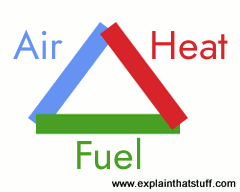
Artwork: You need to to take away one or more of heat, air (oxygen), or fuel to break the triangle and put the fire.
A fire can burn when all these things are present; it will stop when at least one of them is removed. As any fire-fighter will tell you, putting out a fire involves breaking the fire triangle—which means removing either the fuel, the heat, or the oxygen. Suppose a fire breaks out in a pan on top of your cooker, the first thing you normally do is switch off the heat. If that doesn't work, you might soak a towel with water and place it very carefully over the pan (or, better still, use a fire blanket). The towel is designed to block off the supply of oxygen to the fire (the water stops the towel from catching fire and making things worse). Every fire-fighting technique you can think of involves removing heat, oxygen, or fuel—sometimes more than one of those things at the same time. Fire extinguishers work by removing heat, air, or both.
Although professional firefighters have other, more comprehensive ways of understanding fires, the fire triangle is still probably the simplest and most useful rule of thumb for the rest of us.
Types of fire extinguishers

Artwork: The four main types of extinguishers and how they break the fire triangle. 1) Water extinguishers work mainly by cooling (removing heat), but a dense spray of water droplets also helps to cut off oxygen. 2) Dry powder extinguishers soak up heat, melt on the fuel, and cut off oxygen, but they also neutralize the fuel (cutting it off from the fire). 3) Foam extinguishers typically float a thin layer of foam over something like a burning liquid, so cutting off oxygen. They also cool a fire. 4) CO2 extinguishers mostly work by cooling a fire, but they also help to cut off its oxygen.
There are four main types of extinguishers and they work in slightly different ways:
- Water extinguishers, which are the most common, are essentially tanks full of water, often with nitrogen or carbon dioxide as the propellant to make them come out. Water extinguishers work mainly by removing heat from the fire, though they also help to cut off a fire's oxygen supply.
- Dry powder extinguishers are tanks of dry powder with compressed nitrogen as the propellant. In extinguishers like this, it's the composition of the chemical (rather than the mechanical design of the extinguisher) that really counts The powder is a specially designed mixture that absorbs heat, melts, and coats the fuel, stopping it from making flammable vapors and blocking out oxygen, so it's helping to tackle two sides of the fire triangle at once. The most widely used powder in extinguishers is monoammonium phosphate; other powder ingredients include the metal alkali salts sodium bicarbonate (baking soda) and potassium bicarbonate (similar to sodium bicarbonate), though these are less effective on things like wood and paper fires.
- Foam extinguishers are tanks of water and foam with compressed nitrogen as the propellant. They work by smothering the fire: when you spread a thin layer of foam over a fire, you cut the fuel off from the oxygen around it. Foam extinguishers also help to absorb heat, since the cool foam they release contains a lot of water.
- Carbon dioxide (CO2) extinguishers contain a mixture of liquid and gaseous carbon dioxide (a nonflammable gas). CO2 is normally a gas at room temperature and pressure. It has to be stored under high pressure to make it a liquid. When you release the pressure, the gas expands enormously and makes a huge white jet. CO2 attacks the fire triangle in two ways: it smothers the oxygen and, when it turns from a liquid back to a gas, it "sucks" in a massive amount of heat from its surroundings (the latent heat of vaporization), which cools whatever you spray it on by removing heat.
That classifies extinguishers by what they contain. You'll also find fire extinguishers classified by the types of fires you can use them on. This gives us five different kinds:
- A: Green: For wood, cloth, and paper.
- B: Red: For combustible and flammable liquids such as oil, gasoline, and paint.
- C: Blue: For electrical equipment and tools.
- D: Orange:: For flammable metals.
- K: Black: For animal or vegetable oils or cooking fats.
It's important always to use the right extinguisher for the fire. Using the wrong extinguisher can put your life in danger and make the fire worse. For example, you must never use water extinguishers on electrical fires because you could electrocute yourself and the people nearby. If you're in the slightest doubt about tackling a fire, leave it alone and get yourself to safety. Once you've done that, call the fire department.
How do fire extinguishers work?
Inside, a fire extinguisher is quite like a giant aerosol can, often with two different substances inside. One of them is a solid, liquid, or gas substance for fighting the fire. The other one is called a propellant and is a pressurized chemical that makes the fire-fighting substance come out when you press the extinguisher handle. Next time you see a fire extinguisher, take a good look. Have you noticed that fire extinguishers are always really strong steel canisters? That because the propellant is stored inside at a high pressure. Strong canisters are needed to stop the extinguishers exploding!
Water extinguishers

A water extinguisher is like a giant water pistol, but instead of using pressure from your finger to fire out the water, it uses pressure from a trapped gas (the propellant). Typically, this is nitrogen or carbon dioxide.
- A ring or pin on the handle stops the fire extinguisher from being set off by accident. It also acts as a tamper-proof seal: if the ring is broken or missing, you know the extinguisher needs to be checked.
- Inside the sturdy steel case, there's a canister containing high-pressure gas (orange with blue hashing).
- Most of the extinguisher is filled with water (blue).
- A tube runs right up the inside of the tube to a nozzle outside (gray).
- The nozzle often ends in a piece of bendy plastic so you can easily direct it toward the base of a fire.
- To operate the extinguisher, you pull the ring and press the handle.
- Pressing the handle opens a valve (shown here as a green arrow) that releases the pressurized gas from the canister.
- The gas immediately expands and fills the inside of the extinguisher, pushing the water downward
- As the water is pushed down, it rises up the tube
- A jet of water emerges from the nozzle.
Carbon dioxide extinguishers

The most noticeable difference between a water extinguisher and one that fires carbon dioxide is the large, black, cone-shaped horn, which allows the carbon dioxide gas to expand, cool, and turn into a mixture of frozen "snow" and gas. The horn has to be designed very carefully to stop two major potential problems: it has to allow the CO2 to exit at high speed, so any snow that forms doesn't block it up, and it has to mix up the gas in a fairly turbulent way to stop it firing air from the horn at the fire as well (which would effectively make the fire burn more strongly). This typical design from a patent by Brooks Equipment in the 1970s solves both problems. I've added the coloring for clarity, but followed the original numbering of the key parts:
- 10. Tank containing pressurized liquid carbon dioxide.
- 12. Valve.
- 14. Trigger.
- 16. Discharge horn made of plastic that can survive low temperatures without cracking.
- 18. Reinforcing bands wrap around horn at intervals.
- 20. Nipple with a screw thread to which the horn attaches.
As the carbon dioxide enters the horn, it swirls around in a turbulent flow (orange arrows) forming snow (orange blobs) and gas. The swirling turbulence stops dead air zones forming in the horn, which in turn prevents air being swept down the horn toward the fire.
Artwork: A typical carbon dioxide fire extinguisher. From US Patent 3,901,322: Fire Extinguisher Discharge Horn by Jack Winston, Brooks Equipment Co., Inc., August 26, 1975, courtesy of US Patent and Trademark Office.
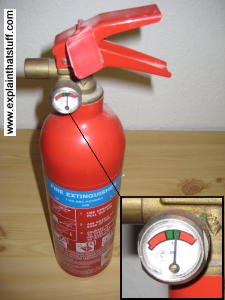
Photo: Some extinguishers have pressure gauges on top so you can check they're correctly pressurized and safe to operate. If the pressure is either too high or too low, the needle moves into the upper or lower red zone. On this dry-powder extinguisher, the needle is right in the middle: still safely in the green zone, pressurized to about 14 times atmospheric pressure (the normal pressure of the air around us).
Foam extinguishers
These are similar to water extinguishers but, instead of containing just water and a propellant, they also have a concentrated foaming solution inside them. Liquid water is almost impossible to compress, so an ordinary water extinguisher can't produce more water for fighting a fire than the volume of the extinguisher itself, which is usually no more than about 6–9 liters. A foam extinguisher, on the other hand, works a bit more like a carbon dioxide extinguisher when the nozzle is open: the water and foaming solution swirl together in the nozzle, producing a much bigger volume of foam than the volume of the can itself. Foam extinguishers are often called AFFFs (aqueous film-forming foam), which is simply a technical way of describing how they tackle a fire: they use water (aqueous) to make a foam that sits like a film over burning fuel, cutting off its air supply.

- an enzyme which breaks down proteins and peptides.


Fire
Fire is the rapid oxidation of a material in the exothermic chemical process of combustion, releasing heat, light, and various reaction products.[1][a] Fire is hot because the conversion of the weak double bond in molecular oxygen, O2, to the stronger bonds in the combustion products carbon dioxide and water releases energy (418 kJ per 32 g of O2); the bond energies of the fuel play only a minor role here.[2] At a certain point in the combustion reaction, called the ignition point, flames are produced. The flame is the visible portion of the fire. Flames consist primarily of carbon dioxide, water vapor, oxygen and nitrogen. If hot enough, the gases may become ionized to produce plasma.[3] Depending on the substances alight, and any impurities outside, the color of the flame and the fire's intensity will be different.
Fire in its most common form can result in conflagration, which has the potential to cause physical damage through burning. Fire is an important process that affects ecological systems around the globe. The positive effects of fire include stimulating growth and maintaining various ecological systems. Its negative effects include hazard to life and property, atmospheric pollution, and water contamination.[4] If fire removes protective vegetation, heavy rainfall may lead to an increase in soil erosion by water.[5] Also, when vegetation is burned, the nitrogen it contains is released into the atmosphere, unlike elements such as potassium and phosphorus which remain in the ash and are quickly recycled into the soil. This loss of nitrogen caused by a fire produces a long-term reduction in the fertility of the soil, but this fecundity can potentially be recovered as molecular nitrogen in the atmosphere is "fixed" and converted to ammonia by natural phenomena such as lightning and by leguminous plants that are "nitrogen-fixing" such as clover, peas, and green beans.
Fire has been used by humans in rituals, in agriculture for clearing land, for cooking, generating heat and light, for signaling, propulsion purposes, smelting, forging, incineration of waste, cremation, and as a weapon or mode of destruction.
Physical properties
Chemistry
Fires start when a flammable or a combustible material, in combination with a sufficient quantity of an oxidizer such as oxygen gas or another oxygen-rich compound (though non-oxygen oxidizers exist), is exposed to a source of heat or ambient temperature above the flash point for the fuel/oxidizer mix, and is able to sustain a rate of rapid oxidation that produces a chain reaction. This is commonly called the fire tetrahedron. Fire cannot exist without all of these elements in place and in the right proportions. For example, a flammable liquid will start burning only if the fuel and oxygen are in the right proportions. Some fuel-oxygen mixes may require a catalyst, a substance that is not consumed, when added, in any chemical reaction during combustion, but which enables the reactants to combust more readily.
Once ignited, a chain reaction must take place whereby fires can sustain their own heat by the further release of heat energy in the process of combustion and may propagate, provided there is a continuous supply of an oxidizer and fuel.
If the oxidizer is oxygen from the surrounding air, the presence of a force of gravity, or of some similar force caused by acceleration, is necessary to produce convection, which removes combustion products and brings a supply of oxygen to the fire. Without gravity, a fire rapidly surrounds itself with its own combustion products and non-oxidizing gases from the air, which exclude oxygen and extinguish the fire. Because of this, the risk of fire in a spacecraft is small when it is coasting in inertial flight.[6][7] This does not apply if oxygen is supplied to the fire by some process other than thermal convection.
Fire can be extinguished by removing any one of the elements of the fire tetrahedron. Consider a natural gas flame, such as from a stove-top burner. The fire can be extinguished by any of the following:
- turning off the gas supply, which removes the fuel source;
- covering the flame completely, which smothers the flame as the combustion both uses the available oxidizer (the oxygen in the air) and displaces it from the area around the flame with CO2;
- application of water, which removes heat from the fire faster than the fire can produce it (similarly, blowing hard on a flame will displace the heat of the currently burning gas from its fuel source, to the same end), or
- application of a retardant chemical such as Halon to the flame, which retards the chemical reaction itself until the rate of combustion is too slow to maintain the chain reaction.
In contrast, fire is intensified by increasing the overall rate of combustion. Methods to do this include balancing the input of fuel and oxidizer to stoichiometric proportions, increasing fuel and oxidizer input in this balanced mix, increasing the ambient temperature so the fire's own heat is better able to sustain combustion, or providing a catalyst, a non-reactant medium in which the fuel and oxidizer can more readily react.
Flame
A flame is a mixture of reacting gases and solids emitting visible, infrared, and sometimes ultraviolet light, the frequency spectrum of which depends on the chemical composition of the burning material and intermediate reaction products. In many cases, such as the burning of organic matter, for example wood, or the incomplete combustion of gas, incandescent solid particles called soot produce the familiar red-orange glow of "fire". This light has a continuous spectrum. Complete combustion of gas has a dim blue color due to the emission of single-wavelength radiation from various electron transitions in the excited molecules formed in the flame. Usually oxygen is involved, but hydrogen burning in chlorine also produces a flame, producing hydrogen chloride (HCl). Other possible combinations producing flames, amongst many, are fluorine and hydrogen, and hydrazine and nitrogen tetroxide. Hydrogen and hydrazine/UDMH flames are similarly pale blue, while burning boron and its compounds, evaluated in mid-20th century as a high energy fuel for jet and rocket engines, emits intense green flame, leading to its informal nickname of "Green Dragon".
The glow of a flame is complex. Black-body radiation is emitted from soot, gas, and fuel particles, though the soot particles are too small to behave like perfect blackbodies. There is also photon emission by de-excited atoms and molecules in the gases. Much of the radiation is emitted in the visible and infrared bands. The color depends on temperature for the black-body radiation, and on chemical makeup for the emission spectra. The dominant color in a flame changes with temperature. The photo of the forest fire in Canada is an excellent example of this variation. Near the ground, where most burning is occurring, the fire is white, the hottest color possible for organic material in general, or yellow. Above the yellow region, the color changes to orange, which is cooler, then red, which is cooler still. Above the red region, combustion no longer occurs, and the uncombusted carbon particles are visible as black smoke.
The common distribution of a flame under normal gravity conditions depends on convection, as soot tends to rise to the top of a general flame, as in a candle in normal gravity conditions, making it yellow. In micro gravity or zero gravity,[8] such as an environment in outer space, convection no longer occurs, and the flame becomes spherical, with a tendency to become more blue and more efficient (although it may go out if not moved steadily, as the CO2 from combustion does not disperse as readily in micro gravity, and tends to smother the flame). There are several possible explanations for this difference, of which the most likely is that the temperature is sufficiently evenly distributed that soot is not formed and complete combustion occurs.[9] Experiments by NASA reveal that diffusion flames in micro gravity allow more soot to be completely oxidized after they are produced than diffusion flames on Earth, because of a series of mechanisms that behave differently in micro gravity when compared to normal gravity conditions.[10] These discoveries have potential applications in applied science and industry, especially concerning fuel efficiency.
In combustion engines, various steps are taken to eliminate a flame. The method depends mainly on whether the fuel is oil, wood, or a high-energy fuel such as jet fuel.
Typical adiabatic temperatures
The adiabatic flame temperature of a given fuel and oxidizer pair is that at which the gases achieve stable combustion.
- Oxy–dicyanoacetylene 4,990 °C (9,000 °F)
- Oxy–acetylene 3,480 °C (6,300 °F)
- Oxyhydrogen 2,800 °C (5,100 °F)
- Air–acetylene 2,534 °C (4,600 °F)
- Blowtorch (air–MAPP gas) 2,200 °C (4,000 °F)
- Bunsen burner (air–natural gas) 1,300 to 1,600 °C (2,400 to 2,900 °F)[11]
- Candle (air–paraffin) 1,000 °C (1,800 °F)
Fire ecology
Every natural ecosystem has its own fire regime, and the organisms in those ecosystems are adapted to or dependent upon that fire regime. Fire creates a mosaic of different habitat patches, each at a different stage of succession.[12] Different species of plants, animals, and microbes specialize in exploiting a particular stage, and by creating these different types of patches, fire allows a greater number of species to exist within a landscape.
Fossil record
The fossil record of fire first appears with the establishment of a land-based flora in the Middle Ordovician period, 470 million years ago,[13] permitting the accumulation of oxygen in the atmosphere as never before, as the new hordes of land plants pumped it out as a waste product. When this concentration rose above 13%, it permitted the possibility of wildfire.[14] Wildfire is first recorded in the Late Silurian fossil record, 420 million years ago, by fossils of charcoalified plants.[15][16] Apart from a controversial gap in the Late Devonian, charcoal is present ever since.[16] The level of atmospheric oxygen is closely related to the prevalence of charcoal: clearly oxygen is the key factor in the abundance of wildfire.[17] Fire also became more abundant when grasses radiated and became the dominant component of many ecosystems, around 6 to 7 million years ago;[18] this kindling provided tinder which allowed for the more rapid spread of fire.[17] These widespread fires may have initiated a positive feedback process, whereby they produced a warmer, drier climate more conducive to fire.[17]
Human control
The ability to control fire was a dramatic change in the habits of early humans. Making fire to generate heat and light made it possible for people to cook food, simultaneously increasing the variety and availability of nutrients and reducing disease by killing organisms in the food.[19] The heat produced would also help people stay warm in cold weather, enabling them to live in cooler climates. Fire also kept nocturnal predators at bay. Evidence of cooked food is found from 1 million years ago,[20] although fire was probably not used in a controlled fashion until 400,000 years ago.[21] There is some evidence that fire may have been used in a controlled fashion about 1 million years ago.[22][23] Evidence becomes widespread around 50 to 100 thousand years ago, suggesting regular use from this time; interestingly, resistance to air pollution started to evolve in human populations at a similar point in time.[21] The use of fire became progressively more sophisticated, with it being used to create charcoal and to control wildlife from 'tens of thousands' of years ago.[21]
Fire has also been used for centuries as a method of torture and execution, as evidenced by death by burning as well as torture devices such as the iron boot, which could be filled with water, oil, or even lead and then heated over an open fire to the agony of the wearer.
By the Neolithic Revolution,[citation needed] during the introduction of grain-based agriculture, people all over the world used fire as a tool in landscape management. These fires were typically controlled burns or "cool fires",[citation needed] as opposed to uncontrolled "hot fires", which damage the soil. Hot fires destroy plants and animals, and endanger communities. This is especially a problem in the forests of today where traditional burning is prevented in order to encourage the growth of timber crops. Cool fires are generally conducted in the spring and autumn. They clear undergrowth, burning up biomass that could trigger a hot fire should it get too dense. They provide a greater variety of environments, which encourages game and plant diversity. For humans, they make dense, impassable forests traversable. Another human use for fire in regards to landscape management is its use to clear land for agriculture. Slash-and-burn agriculture is still common across much of tropical Africa, Asia and South America. "For small farmers, it is a convenient way to clear overgrown areas and release nutrients from standing vegetation back into the soil", said Miguel Pinedo-Vasquez, an ecologist at the Earth Institute’s Center for Environmental Research and Conservation.[24] However this useful strategy is also problematic. Growing population, fragmentation of forests and warming climate are making the earth's surface more prone to ever-larger escaped fires. These harm ecosystems and human infrastructure, cause health problems, and send up spirals of carbon and soot that may encourage even more warming of the atmosphere – and thus feed back into more fires. Globally today, as much as 5 million square kilometres – an area more than half the size of the United States – burns in a given year.[24]
There are numerous modern applications of fire. In its broadest sense, fire is used by nearly every human being on earth in a controlled setting every day. Users of internal combustion vehicles employ fire every time they drive. Thermal power stations provide electricity for a large percentage of humanity.
The use of fire in warfare has a long history. Fire was the basis of all early thermal weapons. Homer detailed the use of fire by Greek soldiers who hid in a wooden horse to burn Troy during the Trojan war. Later the Byzantine fleet used Greek fire to attack ships and men. In the First World War, the first modern flamethrowers were used by infantry, and were successfully mounted on armoured vehicles in the Second World War. In the latter war, incendiary bombs were used by Axis and Allies alike, notably on Tokyo, Rotterdam, London, Hamburg and, notoriously, at Dresden; in the latter two cases firestorms were deliberately caused in which a ring of fire surrounding each city[citation needed] was drawn inward by an updraft caused by a central cluster of fires. The United States Army Air Force also extensively used incendiaries against Japanese targets in the latter months of the war, devastating entire cities constructed primarily of wood and paper houses. The use of napalm was employed in July 1944, towards the end of the Second World War;[26] although its use did not gain public attention until the Vietnam War.[26] Molotov cocktails were also used.
Use as fuel
Setting fuel aflame releases usable energy. Wood was a prehistoric fuel, and is still viable today. The use of fossil fuels, such as petroleum, natural gas, and coal, in power plants supplies the vast majority of the world's electricity today; the International Energy Agency states that nearly 80% of the world's power came from these sources in 2002.[28] The fire in a power station is used to heat water, creating steam that drives turbines. The turbines then spin an electric generator to produce electricity. Fire is also used to provide mechanical work directly, in both external and internal combustion engines.
The unburnable solid remains of a combustible material left after a fire is called clinker if its melting point is below the flame temperature, so that it fuses and then solidifies as it cools, and ash if its melting point is above the flame temperature.
Protection and prevention
Wildfire prevention programs around the world may employ techniques such as wildland fire use and prescribed or controlled burns.[29][30] Wildland fire use refers to any fire of natural causes that is monitored but allowed to burn. Controlled burns are fires ignited by government agencies under less dangerous weather conditions.[31]
Fire fighting services are provided in most developed areas to extinguish or contain uncontrolled fires. Trained firefighters use fire apparatus, water supply resources such as water mains and fire hydrants or they might use A and B class foam depending on what is feeding the fire.
Fire prevention is intended to reduce sources of ignition. Fire prevention also includes education to teach people how to avoid causing fires.[32] Buildings, especially schools and tall buildings, often conduct fire drills to inform and prepare citizens on how to react to a building fire. Purposely starting destructive fires constitutes arson and is a crime in most jurisdictions.[33]
Model building codes require passive fire protection and active fire protection systems to minimize damage resulting from a fire. The most common form of active fire protection is fire sprinklers. To maximize passive fire protection of buildings, building materials and furnishings in most developed countries are tested for fire-resistance, combustibility and flammability. Upholstery, carpeting and plastics used in vehicles and vessels are also tested.
Where fire prevention and fire protection have failed to prevent damage, fire insurance can mitigate the financial impact.[34]
Restoration
Different restoration methods and measures are used depending on the type of fire damage that occurred. Restoration after fire damage can be performed by property management teams, building maintenance personnel, or by the homeowners themselves; however, contacting a certified professional fire damage restoration specialist is often regarded as the safest way to restore fire damaged property due to their training and extensive experience.[35] Most are usually listed under "Fire and Water Restoration" and they can help speed repairs, whether for individual homeowners or for the largest of institutions.[36]
Fire and Water Restoration companies are regulated by the appropriate state's Department of Consumer Affairs – usually the state contractors license board. In California, all Fire and Water Restoration companies must register with the California Contractors State License Board.[37] Presently, the California Contractors State License Board has no specific classification for "water and fire damage restoration." Hence, the Contractor's State License Board requires both an asbestos certification (ASB) as well as a demolition classification (C-21) in order to perform Fire and Water Restoration work.[38]
See also
- Aodh (given name)
- Bonfire
- The Chemical History of a Candle
- Colored fire
- Control of fire by early humans
- Deflagration
- Fire (classical element)
- Fire investigation
- Fire lookout
- Fire lookout tower
- Fire making
- Fire pit
- Fire safety
- Fire triangle
- Fire whirl
- Fire worship
- Flame test
- Life Safety Code
- List of fires
- List of light sources
- Phlogiston theory
- Piano burning
- Prometheus, the Greek mythological figure who gave mankind fire
- Pyrokinesis
- Pyrolysis
- Pyromania
- Self-immolation
References
Notes
Citations
- ^ "Glossary of Wildland Fire Terminology" (PDF). National Wildfire Coordinating Group. November 2009. Retrieved 2008-12-18.
- ^ Schmidt-Rohr, K (2015). "Why Combustions Are Always Exothermic, Yielding About 418 kJ per Mole of O2". J. Chem. Educ. 92 (12): 2094–99. Bibcode:2015JChEd..92.2094S. doi:10.1021/acs.jchemed.5b00333.
- ^ Helmenstine, Anne Marie. "What is the State of Matter of Fire or Flame? Is it a Liquid, Solid, or Gas?". About.com. Retrieved 2009-01-21.
- ^ Lentile, et al., 319
- ^ Morris, S. E.; Moses, T. A. (1987). "Forest Fire and the Natural Soil Erosion Regime in the Colorado Front Range". Annals of the Association of American Geographers. 77 (2): 245–54. doi:10.1111/j.1467-8306.1987.tb00156.x.
- ^ NASA Johnson (29 August 2008). "Ask Astronaut Greg Chamitoff: Light a Match!". Retrieved 30 December 2016 – via YouTube.
- ^ Inglis-Arkell, Esther. "How does fire behave in zero gravity?". Retrieved 30 December2016.
- ^ Spiral flames in microgravity Archived 2010-03-19 at the Wayback Machine, National Aeronautics and Space Administration, 2000.
- ^ CFM-1 experiment results Archived 2007-09-12 at the Wayback Machine, National Aeronautics and Space Administration, April 2005.
- ^ LSP-1 experiment results Archived 2007-03-12 at the Wayback Machine, National Aeronautics and Space Administration, April 2005.
- ^ "Flame Temperatures".
- ^ Begon, M., J.L. Harper and C.R. Townsend. 1996. Ecology: individuals, populations, and communities, Third Edition. Blackwell Science Ltd., Cambridge, Massachusetts, US
- ^ Wellman, C. H.; Gray, J. (2000). "The microfossil record of early land plants". Philos Trans R Soc Lond B Biol Sci. 355 (1398): 717–31, discussion 731–2. doi:10.1098/rstb.2000.0612. PMC 1692785. PMID 10905606.
- ^ Jones, Timothy P.; Chaloner, William G. (1991). "Fossil charcoal, its recognition and palaeoatmospheric significance". Palaeogeography, Palaeoclimatology, Palaeoecology. 97(1–2): 39–50. Bibcode:1991PPP....97...39J. doi:10.1016/0031-0182(91)90180-Y.
- ^ Glasspool, I.J.; Edwards, D.; Axe, L. (2004). "Charcoal in the Silurian as evidence for the earliest wildfire". Geology. 32 (5): 381–383. Bibcode:2004Geo....32..381G. doi:10.1130/G20363.1.
- ^ a b Scott, AC; Glasspool, IJ (2006). "The diversification of Paleozoic fire systems and fluctuations in atmospheric oxygen concentration". Proceedings of the National Academy of Sciences of the United States of America. 103 (29): 10861–5. Bibcode:2006PNAS..10310861S. doi:10.1073/pnas.0604090103. PMC 1544139. PMID 16832054.
- ^ a b c Bowman, D. M. J. S.; Balch, J. K.; Artaxo, P.; Bond, W. J.; Carlson, J. M.; Cochrane, M. A.; d'Antonio, C. M.; Defries, R. S.; Doyle, J. C.; Harrison, S. P.; Johnston, F. H.; Keeley, J. E.; Krawchuk, M. A.; Kull, C. A.; Marston, J. B.; Moritz, M. A.; Prentice, I. C.; Roos, C. I.; Scott, A. C.; Swetnam, T. W.; Van Der Werf, G. R.; Pyne, S. J. (2009). "Fire in the Earth system". Science. 324 (5926): 481–4. Bibcode:2009Sci...324..481B. doi:10.1126/science.1163886. PMID 19390038.
- ^ Retallack, Gregory J. (1997). "Neogene expansion of the North American prairie". PALAIOS. 12 (4): 380–90. Bibcode:1997Palai..12..380R. doi:10.2307/3515337.
- ^ J. A. J. Gowlett; R. W. Wrangham (2013). "Earliest fire in Africa: towards the convergence of archaeological evidence and the cooking hypothesis". Azania: Archaeological Research in Africa. 48:1: 5–30. doi:10.1080/0067270X.2012.756754. S2CID 163033909.
- ^ Kaplan, Matt. "Million-year-old ash hints at origins of cooking". Nature.com. Retrieved 25 August 2020.
- ^ a b c Bowman, D. M. J. S.; et al. (2009). "Fire in the Earth system". Science. 324 (5926): 481–84. Bibcode:2009Sci...324..481B. doi:10.1126/science.1163886. PMID 19390038. S2CID 22389421.
- ^ Eoin O'Carroll (Apr 5, 2012). "Were Early Humans Cooking Their Food a Million Years Ago?". abcNEWS.
Early humans harnessed fire as early as a million years ago, much earlier than previously thought, suggests evidence unearthed in a cave in South Africa.
- ^ Francesco Berna; et al. (May 15, 2012). "Microstratigraphic evidence of in situ fire in the Acheulean strata of Wonderwerk Cave, Northern Cape province, South Africa". PNAS. 109 (20): E1215–E1220. doi:10.1073/pnas.1117620109. PMC 3356665. PMID 22474385.
- ^ a b "Farmers, Flames and Climate: Are We Entering an Age of 'Mega-Fires'? – State of the Planet". Blogs.ei.columbia.edu. Retrieved 2012-05-23.
- ^ "In Pictures: German destruction". BBC News.
- ^ a b "Napalm". GlobalSecurity.org. Retrieved 8 May 2010.
- ^ "WHO Disease and injury country estimates". World Health Organization. 2009. Retrieved Nov 11, 2009.
- ^ "Share of Total Primary Energy Supply, 2002; International Energy Agency". Archived from the original on 13 January 2015.
- ^ Federal Fire and Aviation Operations Action Plan, 4.
- ^ "UK: The Role of Fire in the Ecology of Heathland in Southern Britain". International Forest Fire News. 18: 80–81. January 1998.
- ^ "Prescribed Fires". SmokeyBear.com. Archived from the original on 2008-10-20. Retrieved 2008-11-21.
- ^ Fire & Life Safety Education, Manitoba Office of the Fire Commissioner ArchivedDecember 6, 2008, at the Wayback Machine
- ^ Ward, Michael (March 2005). Fire Officer: Principles and Practice. Jones & Bartlett Learning. ISBN 9780763722470. Retrieved March 16, 2019.
- ^ Baars, Hans; Smulders, Andre; Hintzbergen, Kees; Hintzbergen, Jule (2015-04-15). Foundations of Information Security Based on ISO27001 and ISO27002 (3rd revised ed.). Van Haren. ISBN 9789401805414.
- ^ "US Department of Homeland Security, US Fire Administration Handbook". Usfa.dhs.gov. 2010-05-06. Archived from the original on 2011-08-27. Retrieved 2012-05-23.
- ^ Begal, Bill (August 23, 2007). "Restoration With a Capital E-P-A: A Case Study". Restoration & Remediation. Retrieved 2008-04-11.
- ^ "California Contractors State License Board". State of California. Retrieved 2010-08-29.
- ^ "What You Should Know About Your Water Damage Or Mold Removal Company". Rapco West Environmental Services, Inc. Archived from the original on 2011-01-07. Retrieved 2010-08-29.
Sources
- Haung, Kai (2009). Population and Building Factors That Impact Residential Fire Rates in Large U.S. Cities. Applied Research Project. Texas State University.
- Karki, Sameer (2002). "Community Involvement in and Management of Forest Fires in South East Asia" (PDF). Project FireFight South East Asia. Archived from the original (PDF) on February 25, 2009. Retrieved 2009-02-13.
- Kosman, Admiel (January 13, 2011). "Sacred fire". Haaretz.
- Lentile, Leigh B.; Holden, Zachary A.; Smith, Alistair M. S.; Falkowski, Michael J.; Hudak, Andrew T.; Morgan, Penelope; Lewis, Sarah A.; Gessler, Paul E.; Benson, Nate C (2006). "Remote sensing techniques to assess active fire characteristics and post-fire effects". International Journal of Wildland Fire. 3 (15): 319–345. doi:10.1071/WF05097.\
Pyroptosis
Pyroptosis is a highly inflammatory form of lytic programmed cell death that occurs most frequently upon infection with intracellular pathogens and is likely to form part of the antimicrobial response. This process promotes the rapid clearance of various bacterial, viral, fungal and protozoan infections by removing intracellular replication niches and enhancing the host's defensive responses. Pyroptosis can take place in immune cells and is also reported to occur in keratinocytes and some epithelial cells. [1]
The process is initiated by formation of a large supramolecular complex termed the inflammasome (also known as a pyroptosome) upon intracellular danger signals. [2] Inflammasome activates a different set of caspases as compared to apoptosis, for example, caspase-1/4/5 in humans and caspase-11 in mice. [3] These caspases contribute to the maturation and activation of several proinflammatory cytokines and pore-forming protein gasdermins. Formation of pores causes cell membrane rupture and release of cytokines, as well as various damage-associated molecular pattern (DAMP) molecules such as HMGB-1, ATP and DNA, out of the cell. These molecules recruit more immune cells and further perpetuate the inflammatory cascade in the tissue. [4][5]
However, in pathogenic chronic diseases, the inflammatory response does not eradicate the primary stimulus. A chronic form of inflammation ensues that ultimately contributes to tissue damage. Pyroptosis is associated with diseases including cancer, neurodegeneration and those of the cardiovascular system. Some examples of pyroptosis include Salmonella-infected macrophages and abortively HIV-infected T helper cells. [6][7][8]
- Correspondence
- Published:
Pyroptotic macrophages stimulate the SARS-CoV-2-associated cytokine storm
Cellular & Molecular Immunology 18, 1305–1307 (2021)
Coronavirus disease 2019 (COVID-19) is an unprecedented pandemic caused by severe acute respiratory syndrome coronavirus 2 (SARS-CoV-2). As of 22 February 2021, the worldwide pandemic has resulted in more than 110 million cases and 2.4 million deaths. 1 Clinical investigation of COVID-19 patients has shown that a systemic cytokine storm can occur, especially in severe cases. 2 Treatment of the SARS-CoV-2-associated cytokine storm with tocilizumab3 or anakinra4 has been shown to immediately improve the clinical outcome in most severe and critical COVID-19 patients. These data highlight the systemic cytokine storm as an important exacerbating event in severe COVID-19; however, our understanding of the molecular mechanisms involved in the initiation of the SARS-CoV-2-associated cytokine storm is limited. In the present study, we uncovered a reasonable explanation for cytokine storm initiation through the analysis of 13 autopsy samples from severe COVID-19 patients.
To investigate SARS-CoV-2-associated cytokine storm processes, we collected three control lung tissues from patients without SARS-CoV-2 infection as a control group and six lung tissues from COVID-19 patients as a patient group for RNA-seq transcriptome analysis. The clinical data of the patients are presented in the Supplementary material (Table S1). Principal component analysis (PCA) of the RNA-seq data showed clear biological differences between the control and patient group transcriptomes (Fig. S1a, b). Through differential gene expression analysis, we identified 1951 upregulated genes and 1971 downregulated genes in the patient group compared with the control group (Fig. S1c). Functional analysis of the upregulated genes revealed enrichment in functions related to ROS activation, virus infection-related signaling pathways, the HIF-1α signaling pathway, the NOD-like receptor signaling pathway, and metabolic dysregulation (Fig. S1d–f). Previous studies have suggested that cellular “danger” signals, including infection, ROS, and metabolic dysregulation, could trigger the NLRP3 inflammasome signaling pathway. 5 The data presented herein demonstrate that many cellular “danger” signals are activated in the pulmonary microenvironment of severe COVID-19 patients and indicate that NLRP3 inflammasome signaling is involved in the pathogenesis of COVID-19.
Notably, we found that chemokines responsible for recruiting monocytes were significantly upregulated in the lung tissues of COVID-19 patients (Fig. S1g), suggesting that SARS-CoV-2 infection may lead to the recruitment of monocytes to the lungs of patients. To further test this hypothesis, we used the xCell method to analyze immune infiltration in our samples. We found significantly more infiltration of monocytes, neutrophils, and plasma cells in the lung tissues of severe COVID-19 patients than in the tissues of control donors. There were no significant changes in the levels of other immune cells (Fig. 1a). Immunohistochemical analysis also revealed that many CD14+CD16+ double-positive proinflammatory monocytes infiltrated the alveoli of severe COVID-19 patients (Fig. 1b), many of which transformed into CD163-positive macrophages (Fig. 1c). Notably, CD163 staining in infiltrating macrophages was more evident in COVID-19 patients than in controls, indicating that these infiltrating proinflammatory macrophages underwent activation switching. 6 We also observed the infiltration of some CD4+ and CD8+ T cells into the alveoli of COVID-19 patients (Fig. S2a, b).

SARS-CoV-2 promotes cytokine storms by inducing pyroptosis in proinflammatory macrophages in severe COVID-19. a Analysis of immune infiltration in the lung samples of control donors and COVID-19 patients using xCell. b Representative images of immunohistochemical staining of CD14 and CD16 in the lung samples of control donors and COVID-19 patients (bar = 50 μm). c Representative images of immunohistochemical staining of CD163 in the lung tissues of control donors and COVID-19 patients. The right panels (bar = 50 μm) are enlarged versions of the boxed areas in the left panels (bar = 50 μm). d Representative confocal microscopy images showing the expression of CD163 (red), IL-1β, IL-6, and IL-18 (green), and the cell nuclei (blue) in the lung tissues of control donors and COVID-19 patients (bar = 50 μm). Enlarged images are embedded in the upper right corner (bar = 10 μm). e Hematoxylin and eosin staining of lung tissues from six severe COVID-19 patients (bar = 50 μm). f Representative images of immunohistochemical staining of cleaved GSDMD in the lung tissues of control donors and COVID-19 patients. The right panels (bar = 50 μm) are enlarged versions of the boxed areas in the left panels (bar = 50 μm). g Representative confocal microscopy images showing the expression of CD163 (red) and cleaved GSDMD (green) and the cell nuclei (blue) in the lung tissue samples of control donors and COVID-19 patients. h The amount of lactate dehydrogenase (LDH) released into the culture supernatants of M0 macrophages treated with the SARS-CoV-2 pseudovirus or untreated cells (Ctrl). i Western blot analysis of caspase-1, cleaved GSDMD, and ACTIN in M0 macrophages incubated in the presence of SARS-CoV-2 pseudovirus for 12 h. j, k The levels of IL-1β, IL-6, and IL-18 in cell culture supernatants of M1 macrophages incubated in the presence of SARS-CoV-2 pseudovirus or ORF3a lentivirus for 12 h were measured by ELISA
We previously reported that proinflammatory monocytes play a crucial role in the SARS-CoV-2-associated cytokine storm. 7 To determine whether these infiltrating proinflammatory macrophages are the initiators of the SARS-CoV-2-associated cytokine storm, we measured the levels of several key proinflammatory cytokines associated with the clinical deterioration of COVID-19 patients, namely, IL-1β, IL-6, and IL-18, in the lung tissues of severe COVID-19 patients and control donors. As expected, the expression of these proinflammatory cytokines was higher in COVID-19 patients than in control donors, suggesting that the cytokine storm originates in the lungs of patients (Fig. S3a–c). Furthermore, costaining with CD163 revealed that IL-1β, IL-6, and IL-18 were more highly expressed in the pulmonary macrophages of COVID-19 patients than in those of control donors, suggesting that proinflammatory macrophages are involved in the SARS-CoV-2-associated cytokine storm (Fig. 1d).
In addition, we found that the infiltrating macrophages had characteristics of edema, which is a morphological feature of pyroptosis8 (Fig. 1e). Therefore, we propose that pyroptosis may be a possible mechanism underlying the cytokine storm in severe COVID-19 patients. Gasdermin D (GSDMD) is a pore-forming protein and a well-known trigger of pyroptosis. To further confirm the role of pyroptosis in pulmonary proinflammatory macrophages after SARS-CoV-2 infection, we measured the levels of cleaved GSDMD in lung tissues from COVID-19 patients and control donors. Immunohistochemistry revealed that the levels of cleaved GSDMD were significantly higher in the lung tissues of severe COVID-19 patients than in the tissues of control donors, demonstrating exacerbated pyroptosis in the lung tissues of COVID-19 patients (Fig. 1f). Furthermore, multiplex immunohistochemistry confirmed that macrophages were the major cells that were positive for cleaved GSDMD in the lungs (Fig. 1g). Therefore, we hypothesize that pyroptotic macrophages are involved in the SARS-CoV-2-associated cytokine storm.
To test this hypothesis, we examined whether SARS-CoV-2 could activate GSDMD-mediated pyroptosis in macrophages. To this end, we performed a series of in vitro experiments. After induction with PMA, THP-1 cell-derived M0 macrophages were infected with SARS-CoV-2 pseudovirus. We observed that M0 macrophages could indeed be infected by SARS-CoV-2 pseudovirus (Fig. S3d), which triggered a significant upregulation in the release of LDH, IL-1β, and IL-18, which are signature pyroptosis factors (Figs. 1h and S3e). Moreover, active caspase-1 and cleaved GSDMD bands were also observed in SARS-CoV-2 pseudovirus-infected M0 macrophages by Western blot analysis. These data demonstrate that SARS-CoV-2 can induce GSDMD-mediated pyroptosis in macrophages (Fig. 1i). Our previous study showed that interferon-γ (IFN-γ) was a key pathogenic cytokine in COVID-19. 7 Therefore, we treated M0 macrophages with IFN-γ to convert these cells into M1 macrophages and then treated the derived M1 macrophages with SARS-CoV-2 pseudovirus. As expected, the levels of proinflammatory cytokines in the supernatant of M1 macrophages were higher than those in M0 macrophage supernatant (Figs. 1j and S3e).
Chen et al. reported that the SARS-CoV 3a (ORF3a) protein could activate pyroptosis in macrophages. 9 To explore whether the ORF3a protein of SARS-CoV-2 could trigger cytokine storms, we treated macrophages with ORF3a lentivirus. The ORF3a protein not only stimulated macrophages to express IL-1β and IL-18 but also promoted IL-6 production (Figs. 1k and S3f). These data indicated that SARS-CoV-2 could induce macrophages to produce a series of proinflammatory cytokines through pyroptosis.
Collectively, our results confirm the increased numbers of proinflammatory macrophages and the occurrence of GSDMD-mediated pyroptosis in the lung tissues of severe COVID-19 patients, which causes the rapid release of proinflammatory cytokines and cytokine storms. Accordingly, the pyroptosis-associated pathway is a potential therapeutic target to lessen the cytokine storm, especially in severe COVID-19 patients.
References
- 1.
W.H.O. Coronavirus disease (COVID-2019) situation reports. https://www.who.int/emergencies/diseases/novel-coronavirus-2019/situation-reports/ (2020).
- 2.
Huang, C. et al. Clinical features of patients infected with 2019 novel coronavirus in Wuhan, China. Lancet. 395, 497–506 (2020).
- 3.
Xu, X. et al. Effective treatment of severe COVID-19 patients with tocilizumab. Proc. Natl Acad. Sci. USA 117, 10970–10975 (2020).
- 4.
Cavalli, G. et al. Interleukin-1 blockade with high-dose anakinra in patients with COVID-19, acute respiratory distress syndrome, and hyperinflammation: a retrospective cohort study. Lancet Rheumatol. 2, e325–e331 (2020).
- 5.
Zhou, R. et al. A role for mitochondria in NLRP3 inflammasome activation. Nature 469, 221–225 (2011).
- 6.
Etzerodt, A. & Moestrup, S. K. CD163 and inflammation: biological, diagnostic, and therapeutic aspects. Antioxid. Redox Signal 18, 2352–2363 (2013).
- 7.
Zhou, Y. et al. Pathogenic T-cells and inflammatory monocytes incite inflammatory storms in severe COVID-19 patients. Natl Sci. Rev. 7(No. 6), 998–10001 (2020).
- 8.
Shi, J. et al. Pyroptosis: gasdermin-mediated programmed necrotic cell death. Trends Biochem. Sci. 42, 245–254 (2017).
- 9.
Chen, I. et al. Severe acute respiratory syndrome coronavirus Viroporin 3a activates the NLRP3 inflammasome. Front. Microbiol. 10, 50 (2019).
Acknowledgements
We would like to thank the patients and their families for their selfless donations. We also thank the Huoshenshan Hospital of Wuhan and the General Hospital of Central Theater Command of Wuhan for their permission to carry out the autopsies and to use the samples in this study.
Funding
This work was supported by the China National Center for Biotechnology Development (2020YFC0843800 and 2020YFC0846800), the Natural Science Foundation of China (81922028), and the Youth Innovation Promotion Association of Chinese Academy of Sciences (2019442).
Author information
Affiliations
Contributions
J.Z. designed and performed the experiments, analyzed and interpreted the data, and wrote the manuscript. H.W. designed and performed the experiments and analyzed and interpreted the data. Y.Z. and B.F. assisted with data interpretation and wrote the manuscript with J.Z. X.Y., D.Z., W.W., H.L., Z.W., Z.H., R.S., and Y.R. collected tissue samples and patient information. X.B. designed the experiments, assisted with data interpretation, and collected tissue samples and patient information. Z.T. designed the experiments, assisted with data interpretation. H.W. supervised the project, provided crucial ideas, assisted with data interpretation, and wrote the manuscript.
Corresponding authors
Ethics declarations
Competing interests
The authors declare no competing interests.
Supplementary information
Rights and permissions
About this article

Cite this article
Zhang, J., Wu, H., Yao, X. et al. Pyroptotic macrophages stimulate the SARS-CoV-2-associated cytokine storm. Cell Mol Immunol 18, 1305–1307 (2021). https://doi.org/10.1038/s41423-021-00665-0
- Correspondence
- Published:
Pyroptotic macrophages stimulate the SARS-CoV-2-associated cytokine storm
Cellular & Molecular Immunology 18, 1305–1307 (2021)
Coronavirus disease 2019 (COVID-19) is an unprecedented pandemic caused by severe acute respiratory syndrome coronavirus 2 (SARS-CoV-2). As of 22 February 2021, the worldwide pandemic has resulted in more than 110 million cases and 2.4 million deaths. 1 Clinical investigation of COVID-19 patients has shown that a systemic cytokine storm can occur, especially in severe cases. 2 Treatment of the SARS-CoV-2-associated cytokine storm with tocilizumab3 or anakinra4 has been shown to immediately improve the clinical outcome in most severe and critical COVID-19 patients. These data highlight the systemic cytokine storm as an important exacerbating event in severe COVID-19; however, our understanding of the molecular mechanisms involved in the initiation of the SARS-CoV-2-associated cytokine storm is limited. In the present study, we uncovered a reasonable explanation for cytokine storm initiation through the analysis of 13 autopsy samples from severe COVID-19 patients.
To investigate SARS-CoV-2-associated cytokine storm processes, we collected three control lung tissues from patients without SARS-CoV-2 infection as a control group and six lung tissues from COVID-19 patients as a patient group for RNA-seq transcriptome analysis. The clinical data of the patients are presented in the Supplementary material (Table S1). Principal component analysis (PCA) of the RNA-seq data showed clear biological differences between the control and patient group transcriptomes (Fig. S1a, b). Through differential gene expression analysis, we identified 1951 upregulated genes and 1971 downregulated genes in the patient group compared with the control group (Fig. S1c). Functional analysis of the upregulated genes revealed enrichment in functions related to ROS activation, virus infection-related signaling pathways, the HIF-1α signaling pathway, the NOD-like receptor signaling pathway, and metabolic dysregulation (Fig. S1d–f). Previous studies have suggested that cellular “danger” signals, including infection, ROS, and metabolic dysregulation, could trigger the NLRP3 inflammasome signaling pathway. 5 The data presented herein demonstrate that many cellular “danger” signals are activated in the pulmonary microenvironment of severe COVID-19 patients and indicate that NLRP3 inflammasome signaling is involved in the pathogenesis of COVID-19.
Notably, we found that chemokines responsible for recruiting monocytes were significantly upregulated in the lung tissues of COVID-19 patients (Fig. S1g), suggesting that SARS-CoV-2 infection may lead to the recruitment of monocytes to the lungs of patients. To further test this hypothesis, we used the xCell method to analyze immune infiltration in our samples. We found significantly more infiltration of monocytes, neutrophils, and plasma cells in the lung tissues of severe COVID-19 patients than in the tissues of control donors. There were no significant changes in the levels of other immune cells (Fig. 1a). Immunohistochemical analysis also revealed that many CD14+CD16+ double-positive proinflammatory monocytes infiltrated the alveoli of severe COVID-19 patients (Fig. 1b), many of which transformed into CD163-positive macrophages (Fig. 1c). Notably, CD163 staining in infiltrating macrophages was more evident in COVID-19 patients than in controls, indicating that these infiltrating proinflammatory macrophages underwent activation switching. 6 We also observed the infiltration of some CD4+ and CD8+ T cells into the alveoli of COVID-19 patients (Fig. S2a, b).
SARS-CoV-2 promotes cytokine storms by inducing pyroptosis in proinflammatory macrophages in severe COVID-19. a Analysis of immune infiltration in the lung samples of control donors and COVID-19 patients using xCell. b Representative images of immunohistochemical staining of CD14 and CD16 in the lung samples of control donors and COVID-19 patients (bar = 50 μm). c Representative images of immunohistochemical staining of CD163 in the lung tissues of control donors and COVID-19 patients. The right panels (bar = 50 μm) are enlarged versions of the boxed areas in the left panels (bar = 50 μm). d Representative confocal microscopy images showing the expression of CD163 (red), IL-1β, IL-6, and IL-18 (green), and the cell nuclei (blue) in the lung tissues of control donors and COVID-19 patients (bar = 50 μm). Enlarged images are embedded in the upper right corner (bar = 10 μm). e Hematoxylin and eosin staining of lung tissues from six severe COVID-19 patients (bar = 50 μm). f Representative images of immunohistochemical staining of cleaved GSDMD in the lung tissues of control donors and COVID-19 patients. The right panels (bar = 50 μm) are enlarged versions of the boxed areas in the left panels (bar = 50 μm). g Representative confocal microscopy images showing the expression of CD163 (red) and cleaved GSDMD (green) and the cell nuclei (blue) in the lung tissue samples of control donors and COVID-19 patients. h The amount of lactate dehydrogenase (LDH) released into the culture supernatants of M0 macrophages treated with the SARS-CoV-2 pseudovirus or untreated cells (Ctrl). i Western blot analysis of caspase-1, cleaved GSDMD, and ACTIN in M0 macrophages incubated in the presence of SARS-CoV-2 pseudovirus for 12 h. j, k The levels of IL-1β, IL-6, and IL-18 in cell culture supernatants of M1 macrophages incubated in the presence of SARS-CoV-2 pseudovirus or ORF3a lentivirus for 12 h were measured by ELISA
We previously reported that proinflammatory monocytes play a crucial role in the SARS-CoV-2-associated cytokine storm. 7 To determine whether these infiltrating proinflammatory macrophages are the initiators of the SARS-CoV-2-associated cytokine storm, we measured the levels of several key proinflammatory cytokines associated with the clinical deterioration of COVID-19 patients, namely, IL-1β, IL-6, and IL-18, in the lung tissues of severe COVID-19 patients and control donors. As expected, the expression of these proinflammatory cytokines was higher in COVID-19 patients than in control donors, suggesting that the cytokine storm originates in the lungs of patients (Fig. S3a–c). Furthermore, costaining with CD163 revealed that IL-1β, IL-6, and IL-18 were more highly expressed in the pulmonary macrophages of COVID-19 patients than in those of control donors, suggesting that proinflammatory macrophages are involved in the SARS-CoV-2-associated cytokine storm (Fig. 1d).
In addition, we found that the infiltrating macrophages had characteristics of edema, which is a morphological feature of pyroptosis8 (Fig. 1e). Therefore, we propose that pyroptosis may be a possible mechanism underlying the cytokine storm in severe COVID-19 patients. Gasdermin D (GSDMD) is a pore-forming protein and a well-known trigger of pyroptosis. To further confirm the role of pyroptosis in pulmonary proinflammatory macrophages after SARS-CoV-2 infection, we measured the levels of cleaved GSDMD in lung tissues from COVID-19 patients and control donors. Immunohistochemistry revealed that the levels of cleaved GSDMD were significantly higher in the lung tissues of severe COVID-19 patients than in the tissues of control donors, demonstrating exacerbated pyroptosis in the lung tissues of COVID-19 patients (Fig. 1f). Furthermore, multiplex immunohistochemistry confirmed that macrophages were the major cells that were positive for cleaved GSDMD in the lungs (Fig. 1g). Therefore, we hypothesize that pyroptotic macrophages are involved in the SARS-CoV-2-associated cytokine storm.
To test this hypothesis, we examined whether SARS-CoV-2 could activate GSDMD-mediated pyroptosis in macrophages. To this end, we performed a series of in vitro experiments. After induction with PMA, THP-1 cell-derived M0 macrophages were infected with SARS-CoV-2 pseudovirus. We observed that M0 macrophages could indeed be infected by SARS-CoV-2 pseudovirus (Fig. S3d), which triggered a significant upregulation in the release of LDH, IL-1β, and IL-18, which are signature pyroptosis factors (Figs. 1h and S3e). Moreover, active caspase-1 and cleaved GSDMD bands were also observed in SARS-CoV-2 pseudovirus-infected M0 macrophages by Western blot analysis. These data demonstrate that SARS-CoV-2 can induce GSDMD-mediated pyroptosis in macrophages (Fig. 1i). Our previous study showed that interferon-γ (IFN-γ) was a key pathogenic cytokine in COVID-19. 7 Therefore, we treated M0 macrophages with IFN-γ to convert these cells into M1 macrophages and then treated the derived M1 macrophages with SARS-CoV-2 pseudovirus. As expected, the levels of proinflammatory cytokines in the supernatant of M1 macrophages were higher than those in M0 macrophage supernatant (Figs. 1j and S3e).
Chen et al. reported that the SARS-CoV 3a (ORF3a) protein could activate pyroptosis in macrophages. 9 To explore whether the ORF3a protein of SARS-CoV-2 could trigger cytokine storms, we treated macrophages with ORF3a lentivirus. The ORF3a protein not only stimulated macrophages to express IL-1β and IL-18 but also promoted IL-6 production (Figs. 1k and S3f). These data indicated that SARS-CoV-2 could induce macrophages to produce a series of proinflammatory cytokines through pyroptosis.
Collectively, our results confirm the increased numbers of proinflammatory macrophages and the occurrence of GSDMD-mediated pyroptosis in the lung tissues of severe COVID-19 patients, which causes the rapid release of proinflammatory cytokines and cytokine storms. Accordingly, the pyroptosis-associated pathway is a potential therapeutic target to lessen the cytokine storm, especially in severe COVID-19 patients.
References
- 1.
W.H.O. Coronavirus disease (COVID-2019) situation reports. https://www.who.int/emergencies/diseases/novel-coronavirus-2019/situation-reports/ (2020).
- 2.
Huang, C. et al. Clinical features of patients infected with 2019 novel coronavirus in Wuhan, China. Lancet. 395, 497–506 (2020).
- 3.
Xu, X. et al. Effective treatment of severe COVID-19 patients with tocilizumab. Proc. Natl Acad. Sci. USA 117, 10970–10975 (2020).
- 4.
Cavalli, G. et al. Interleukin-1 blockade with high-dose anakinra in patients with COVID-19, acute respiratory distress syndrome, and hyperinflammation: a retrospective cohort study. Lancet Rheumatol. 2, e325–e331 (2020).
- 5.
Zhou, R. et al. A role for mitochondria in NLRP3 inflammasome activation. Nature 469, 221–225 (2011).
- 6.
Etzerodt, A. & Moestrup, S. K. CD163 and inflammation: biological, diagnostic, and therapeutic aspects. Antioxid. Redox Signal 18, 2352–2363 (2013).
- 7.
Zhou, Y. et al. Pathogenic T-cells and inflammatory monocytes incite inflammatory storms in severe COVID-19 patients. Natl Sci. Rev. 7(No. 6), 998–10001 (2020).
- 8.
Shi, J. et al. Pyroptosis: gasdermin-mediated programmed necrotic cell death. Trends Biochem. Sci. 42, 245–254 (2017).
- 9.
Chen, I. et al. Severe acute respiratory syndrome coronavirus Viroporin 3a activates the NLRP3 inflammasome. Front. Microbiol. 10, 50 (2019).
Acknowledgements
We would like to thank the patients and their families for their selfless donations. We also thank the Huoshenshan Hospital of Wuhan and the General Hospital of Central Theater Command of Wuhan for their permission to carry out the autopsies and to use the samples in this study.
Funding
This work was supported by the China National Center for Biotechnology Development (2020YFC0843800 and 2020YFC0846800), the Natural Science Foundation of China (81922028), and the Youth Innovation Promotion Association of Chinese Academy of Sciences (2019442).
Author information
Affiliations
Contributions
J.Z. designed and performed the experiments, analyzed and interpreted the data, and wrote the manuscript. H.W. designed and performed the experiments and analyzed and interpreted the data. Y.Z. and B.F. assisted with data interpretation and wrote the manuscript with J.Z. X.Y., D.Z., W.W., H.L., Z.W., Z.H., R.S., and Y.R. collected tissue samples and patient information. X.B. designed the experiments, assisted with data interpretation, and collected tissue samples and patient information. Z.T. designed the experiments, assisted with data interpretation. H.W. supervised the project, provided crucial ideas, assisted with data interpretation, and wrote the manuscript.
Corresponding authors
Ethics declarations
Competing interests
The authors declare no competing interests.
Supplementary information
Rights and permissions
About this article
Cite this article
Zhang, J., Wu, H., Yao, X. et al. Pyroptotic macrophages stimulate the SARS-CoV-2-associated cytokine storm. Cell Mol Immunol 18, 1305–1307 (2021). https://doi.org/10.1038/s41423-021-00665-0
Bacteriophages, in particular, have a central function in marine ecology and carbon cycling. These organisms are extremely widespread in the world's oceans, sometimes occurring in concentrations as high as 900 million bacteriophages per milliliter. Secondly, they have a very rapid attack and replication cycle, being capable of attaching and injecting genomic material into a host bacterium in a matter of minutes, and achieving genetic replication of new viruses in about 20 minutes. They are capable, therefore, of very rapid rates of multiplication in the marine environment.
No comments:
Post a Comment
Note: Only a member of this blog may post a comment.