
This article has a title that makes it sound like this is bad news, but in my opinion, it is GOOD news. Because to me, this is a sign that COVID-19 thrives in the stomach, but obviously this doesn't happen with everyone. But it DOES happen with people who are low on stomach acid!
https://scitechdaily.com/coronavirus-sars-cov-2-infects-cells-of-the-intestine-and-multiplies-there/
Bad News – Coronavirus SARS-CoV-2 Infects Cells of the Intestine and Multiplies There
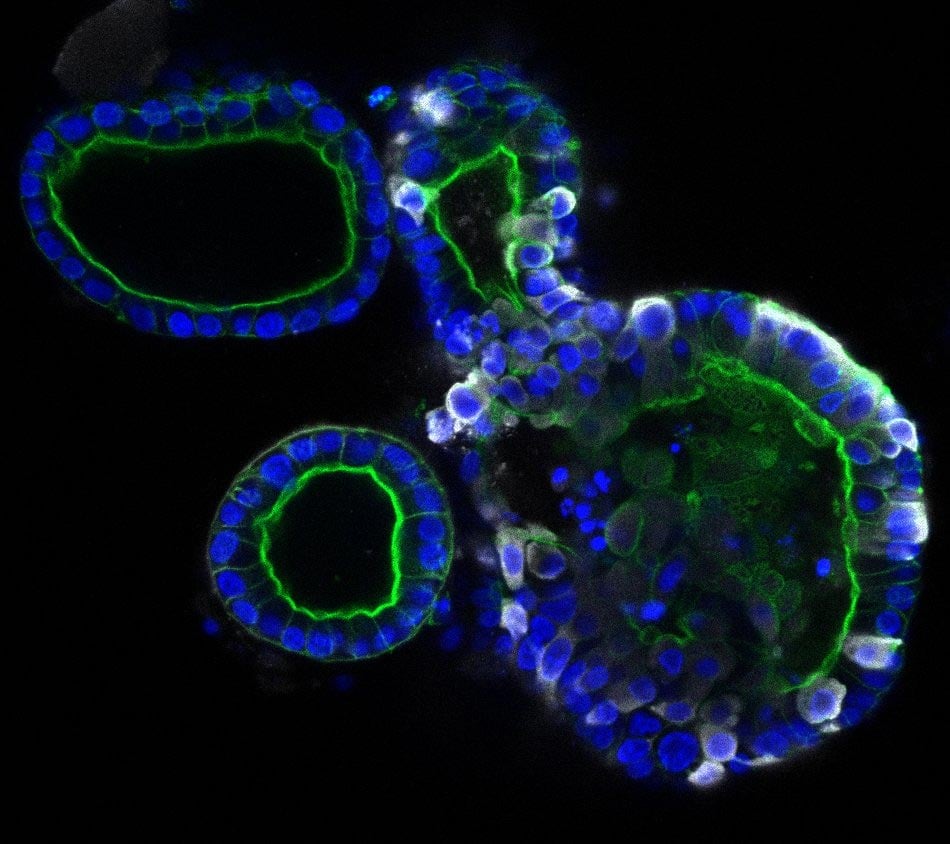
Intestinal organoids, the right one infected with coronavirus SARS-CoV-2. The coronavirus is colored white, the organoids themselves are colored blue and green. Credit: Joep Beumer, copyright Hubrecht Institue
Researchers from the Hubrecht Institute in Utrecht, Erasmus MC University Medical Center Rotterdam, and Maastricht University in the Netherlands have found that the coronavirus SARS-CoV-2, which causes COVID-19, can infect cells of the intestine and multiply there. Using state-of-the-art cell culture models of the human intestine, the researchers have successfully propagated the virus in vitro, and monitored the response of the cells to the virus, providing a new cell culture model for the study of COVID-19. These findings could explain the observation that approximately one third of COVID-19 patients experience gastrointestinal symptoms such as diarrhea, and the fact that the virus often can be detected in stool samples. The results of this study were published in the scientific journal Science on the 1st of May 2020.
Patients with COVID-19 show a variety of symptoms associated with respiratory organs – such as coughing, sneezing, shortness of breath, and fever – and the disease is transmitted via tiny droplets that are spread mainly through coughing and sneezing. One third of the patients however also have gastrointestinal symptoms, such as nausea and diarrhea. In addition, the virus can be detected in human stool long after the respiratory symptoms have been resolved. This suggests that the virus can also spread via so-called “fecal-oral transmission.”
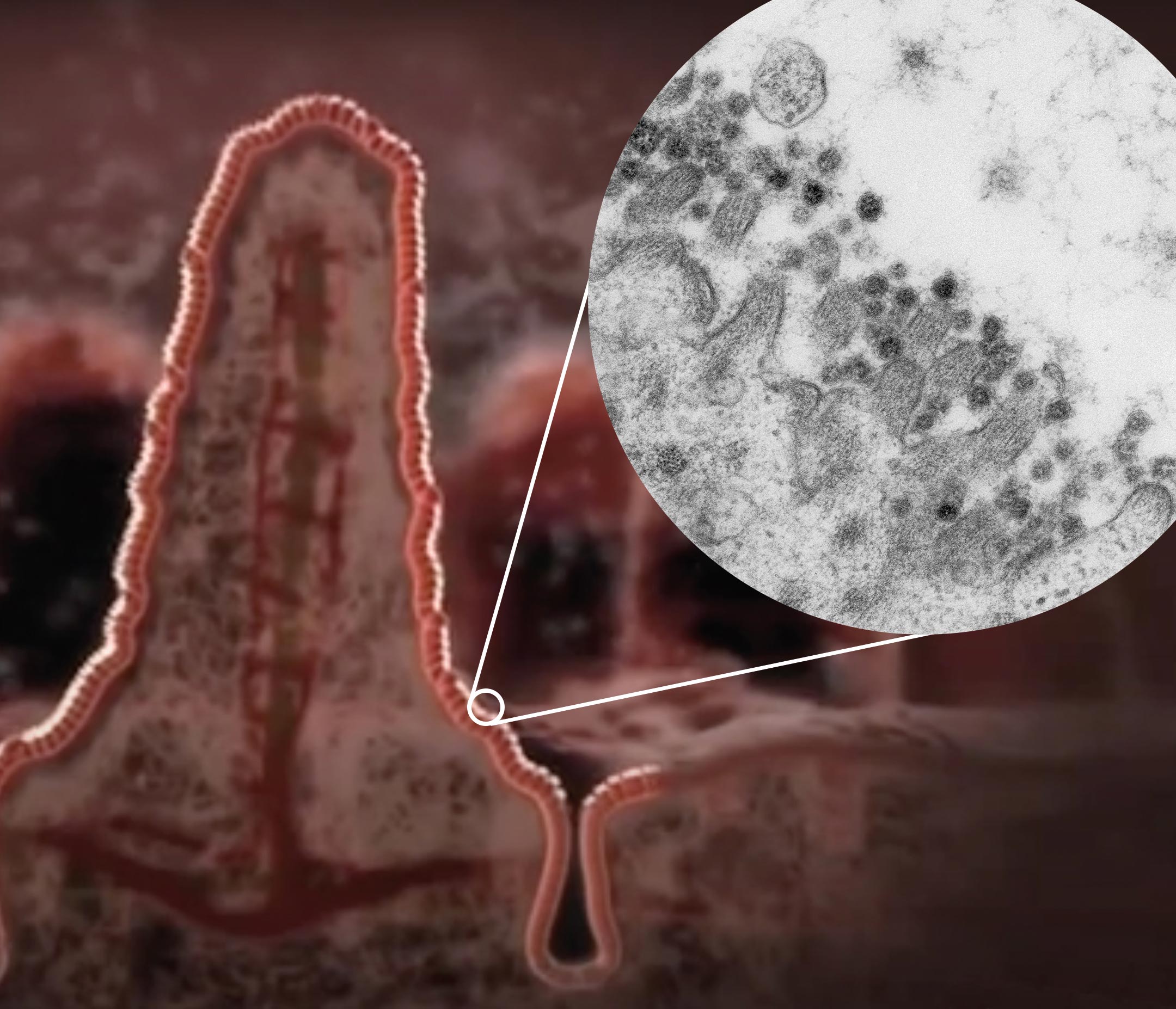
Illustration of a villus in the intestine with a zoom-in to an electron microscopy image of coronavirus SARS-CoV-2 (dark circles) at the edge of an intestinal cell. Credit: Kèvin Knoops, Raimond Ravelli and Maaike de Backer, copyright: Maastricht University
Though the respiratory and gastrointestinal organs may seem very different, there are some key similarities. A particularly interesting similarity is the presence of the ACE2 receptor, the receptor through which the COVID-19 causing SARS-CoV-2 virus can enter the cells. The inside of the intestine is loaded with ACE2 receptors. However, until now it was unknown whether intestinal cells could actually get infected and produce virus particles.
Intestinal organoids
Researchers from the Hubrecht Institute, Erasmus MC and Maastricht University set out to determine whether the SARS-CoV-2 virus can directly infect the cells of the intestine, and if so, whether it can replicate there as well. They used human intestinal organoids: tiny versions of the human intestine that can be grown in the lab. Hans Clevers (Hubrecht Institute): “These organoids contain the cells of the human intestinal lining, making them a compelling model to investigate infection by SARS-CoV-2.”
Infection of intestinal cells
When the researchers added the virus to the organoids, they were rapidly infected. The virus enters a subset of the cells in the intestinal organoids, and the number of cells that are infected increases over time. Using electron microscopy, an advanced way to visualize different components of the cell in great detail, the researchers found virus particles inside and outside the cells of the organoids. Peter Peters (Maastricht University): “Due to the lockdown, we all studied virtual slides of the infected organoids remotely from home.”
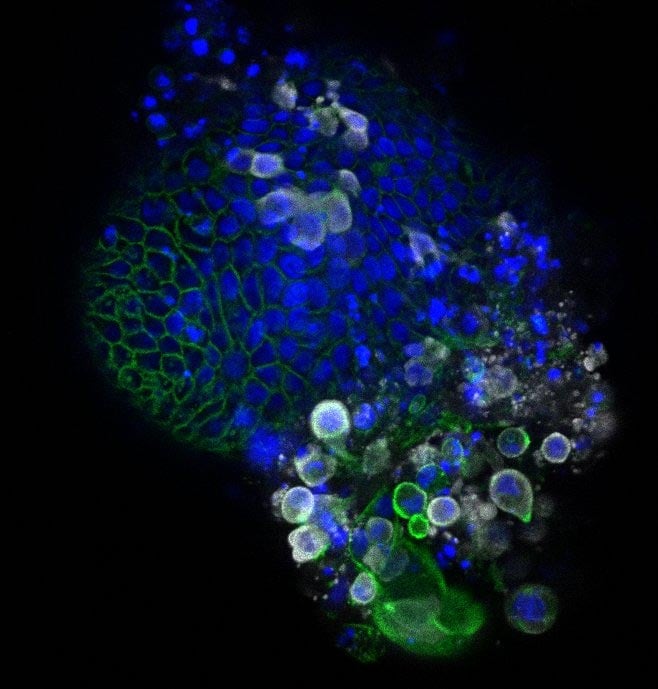
Intestinal organoid infected with coronavirus SARS-CoV-2. The coronavirus is colored white, the organoids themselves are colored blue and green. Credit: Joep Beumer, copyright: Hubrecht Institute
The researchers investigated the response of the intestinal cells to the virus with RNA sequencing, a method to study which genes are active in the cells. This revealed that so-called interferon stimulated genes are activated. These genes are known to combat viral infection. Future work will focus on these genes more carefully, and on how they could be used to develop new treatments.
The researchers also cultured the organoids in different conditions that result in cells with higher and lower levels of the ACE2 receptor, through which SARS-CoV-2 can enter the cells. To their surprise, they found that the virus infected cells with both high and low levels of the ACE2 receptor. Ultimately, these studies may lead to new ways to block the entry of the virus into our cells.
Implications
Bart Haagmans (Erasmus MC): “The observations made in this study provide definite proof that SARS-CoV-2 can multiply in cells of the gastrointestinal tract. However, we don’t yet know whether SARS-CoV-2, present in the intestines of COVID-19 patients, plays a significant role in transmission. Our findings indicate that we should look into this possibility more closely.” The current study is in line with other recent studies that identified gastrointestinal symptoms in a large fraction of COVID-19 patients and virus in the stool of patients free of respiratory symptoms. Special attention may be needed for those patients with gastrointestinal symptoms. More extensive testing using not only nose and throat swabs, but also rectal swabs or stool samples may thus be needed.
In the meantime, the researchers are continuing their collaboration to learn more about COVID-19. They are studying the differences between infections in the lung and the intestine by comparing lung and intestinal organoids infected with SARS-CoV-2.
Reference: “SARS-CoV-2 productively Infects Human Gut Enterocytes” by Mart M. Lamers, Joep Beumer, Jelte van der Vaart, Kèvin Knoops, Jens Puschhof, Tim I. Breugem, Raimond B.G. Ravelli, J. Paul van Schayck, Anna Z. Mykytyn, Hans Q. Duimel, Elly van Donselaar, Samra Riesebosch, Helma J.H. Kuijpers, Debby Schipper, Willine J. van de Wetering, Miranda de Graaf, Marion Koopmans, Edwin Cuppen, Peter J. Peters, Bart L. Haagmans and Hans Clevers, 1 May 2020, Science.
DOI: 10.1126/science.abc1669
This study was a collaboration between the Hubrecht Institute in Utrecht, the Erasmus MC University Medical Center Rotterdam, Maastricht University, the UMC Utrecht and Single Cell Discoveries in the Netherlands. The microscopy data are publicly available via the Image Data Resource (idr0083 – with help from the University of Dundee and the European Bioinformatics Institute) and the genomic data are publicly available via the Gene Expression Omnibus (GSE149312), to ensure efficient sharing of data related to COVID-19 between researchers all across the world.
Hans Clevers is principal investigator at the Hubrecht Institute and the Princess Máxima Center for Pediatric Oncology, professor of Molecular Genetics at the UMC Utrecht and Utrecht University, and Oncode Investigator.
Bart Haagmans is a principal investigator at the Viroscience department at the Erasmus MC University Medical Center Rotterdam.
Peter Peters is director and principal investigator at the Maastricht Multimodal Molecular Imaging Institute (M4i) and professor of Nano Biology at the Maastricht University and Maastricht University Medical Center.
https://www.google.com/imgres?imgurl=https%3A%2F%2Fscitechdaily.com%2Fimages%2FIntestinal-Organoids-Infected-With-Coronavirus-SARS-CoV-2.jpg&imgrefurl=https%3A%2F%2Fscitechdaily.com%2Fcoronavirus-sars-cov-2-infects-cells-of-the-intestine-and-multiplies-there%2F&tbnid=8gu3Z-_YVCv_nM&vet=12ahUKEwiOm-fcs9vsAhXXBzQIHeqWD7kQMygbegUIARCEAQ..i&docid=_mSKVIAhGPPt4M&w=950&h=844&q=bacteria%20cell%20vs%20coronavirus&ved=2ahUKEwiOm-fcs9vsAhXXBzQIHeqWD7kQMygbegUIARCEAQ


https://www.ncbi.nlm.nih.gov/pmc/articles/PMC7417263/
Direct COVID-19 Infection of Enterocytes: The Role of Hypochlorhydria
Introduction
Diarrhea and changes in taste are among the most prevalent gastrointestinal (GI) symptoms of COVID-19 disease and can occur in nearly 50% of patients1 , 2. Clinical and virological aspects of enteric COVID-19 disease have been reviewed, with authors suggesting the need for study of possible fecal-oral transmission1 , 3. Such studies are justified by observed GI symptoms and detection of positive stool samples. In children, initial GI symptoms may be mild and transient4, but a case has been reported of positive fecal tests occurring in the absence of positive nasopharyngeal tests or respiratory symptoms5. The purposes of this brief report are to emphasize the importance of testing stool samples under certain conditions and to suggest a novel route of direct enterocyte infection by COVID-19 in cases of developmental or acquired hypochlorhydria.
Hypochlorhydria and Oral Infection
Many defenses exist in the upper parts of the GI system to protect against infection by ingested pathogens. The low pH (1.5-3.0) of gastric acid is a particularly important one. In cases of hypochlorhydria (low stomach acid), the gastric environmental pH is raised to pH 3-5. For this reason, hypochlorhydria is associated with an increased risk for enteric infection6 , 7. A large proportion of the human population suffers from hypochlorhydria. For example, gastric acid secretion is often depressed in the elderly6, a high-risk population for contracting COVID-19 disease. Acquired H. pylori infection and the use of proton pump inhibitors (PPI) are also associated with low stomach acid7, as is stress8.
COVID-19 virus may not survive normal gastric acid pH levels of 1.5-3, but there is evidence that it can survive a pH level of 3 or above9. If COVID-19 virus can resist the pH levels of 3-5 typical of hypochlorhydria, it would have a route from mouth to intestine, where the virus could directly infect ACE2-bearing enterocytes there1.
Although there is observational evidence that long-term or high-level use of PPI is associated with an increased risk of testing positive for COVID-1910, certain histamine-2 receptor antagonists (H2RA) and a PPI have been observed to improve disease outcome in patients already infected with COVID-19 virus11. This improvement in disease outcome is reportedly due to negative effects of the drugs on viral replication or on viral enzyme activity11. Thus, roles of both PPI and H2RA in COVID-19 disease merit further study.
To date, COVID-19 transmission through ingestion of contaminated food is not considered a concern. However, the route of virus delivery that results in GI symptoms and fecal shedding might still be oral. The fact that changes in taste can be an early symptom of COVID-19 infection2 suggests that the virus does enter and infect the mouth. During exercise, occupational exertion, eating, drinking, or vocalizing, the mouth could be the recipient of infected droplets or aerosols. Thus, oral delivery of virus may occur, particularly in those not wearing masks at the time of exposure.
In fecal-oral transmission, the organism initially enters the body through the mouth. For COVID-19, evidence that the gut is infected directly, and not secondarily to respiratory infection, is provided by negative nasopharyngeal tests in the presence of positive fecal samples collected simultaneously5. Escape through the compromised gastric acid defense system of hypochlorhydria could give COVID-19 virus access to intestinal enterocytes. Hypothetically, the initial infection of an individual could occur there.
Significance of COVID-19 Detection in Stool
COVID-19 viral RNA has been detected in stool samples1 , 3, 4, 5, as has intact virus12. Infectivity of a fecal isolate in Vero E cell culture has been described13. Actual transmission of COVID-19 disease to another person through the fecal-oral route has not been reported. SARS-CoV-1, a coronavirus with 80% genomic nucleotide identity to COVID-19 virus1, was also detected in patient stool samples1 , 3 , 14. In the case of SARS-CoV-1, fecal virus was shown to remain viable for 4 days as demonstrated by infection of Vero E cells in culture14. Certainly, being infectious in cell culture is no indication that fecal virus is a contagion threat to people, but it does suggest that all of the viral RNA detected in stool was and is not simply excreted nucleic acid remnants. Definitive proof that fecal COVID-19 RNA represents infective virus must await basic research. A recent review of our current understanding of COVID-19 viral transmission15 is recommended to interested readers.
It should be noted that widespread fecal testing of all COVID-19 patients with diarrhea is neither warranted nor prudent. There are many potential causes of diarrhea in hospitalized COVID-19 patients. Among them are the alterations in intestinal microflora associated with antiviral or antibiotic drug treatments, with non-enteric nutrition, or with pre-existing GI illness16. Evidence of direct cytopathic effects on enterocytes should be explored before testing for COVID-19 viral markers16. The indiscriminate use of fecal testing would be a waste of resources needed elsewhere and false positive results could lead to inappropriate conclusions or non-productive recommendations. Potential other causes of diarrhea in patients should be explored before stool testing for COVID-19 viral markers is initiated.
Conclusions
The significance of COVID-19 viral RNA detected in stool samples remains to be determined, but the observation raises the question of fecal-oral transmission. If such transmission occurs, a negative test result for virus of respiratory origin might not mean that recovering patients are no longer contagious. Patients with no evidence of respiratory shedding could still be contagious by fecal shedding and oral transmission. If individuals with hypochlorhydria are susceptible to infection by oral exposure, the prevalence of low stomach acid in the population could lead to further transmission. Fecal-oral transmission would be in addition to the airborne transmission already identified. Thus, hypochlorhydria may lead to less efficient, but equally dangerous, transmission of COVID-19 disease.

- relating to or occurring in the intestines."the complexity of the enteric nervous system"


No comments:
Post a Comment
Note: Only a member of this blog may post a comment.