
When you grow up poor, you have to figure out different ways to do things.
There is some really important information about COVID-19 that most people are completely unaware of, so I am doing what I can to bring these facts to light. As we're heading into the 5th month of Shelter In Place, my heart has been sinking to the point where it's starting to feel cold.
I am not one of these people who thinks the lockdown is a conspiracy. I don't believe (or at least, don't want to believe) this whole thing was planned. I wear a mask, not because I think I should have to, but because I think it's the considerate thing to do, when you walk into a place where workers are having to put their lives on the line, by serving the public.
 Last night, I needed to buy cat food, and walked to Safeway (instead of driving) because I didn't want to give up my killer parking spot. On the way there, I saw the inside of the Starbucks in my neighborhood. It looked more like a parking garage, than a place where people could go to relax and caffeinate. How long are we supposed to keep living like this?
I appreciate that this is for our own protection, and yes I do think we should all use social distancing and wear masks until we ALL know of a way to beat this virus. But given how much research I've seen, that shows there's a LOT we can do to keep COVID-19 from taking us down... this whole COVID-19 lockdown feels like a bad joke that has gone on for way too long.
I am 100% convinced that there ARE simple things we can do, to keep this virus from spreading and harming us. And the things I'm going to tell you about are so dirt cheap and simple, you wouldn't think it could actually work, until you saw the research... which in my opinion is pretty compelling - to the point where I'm not sure how anyone could dispute it. If you can dispute it, please... bring it on.
I'm partly doing this post as an experiment - I'm curious to see what will happen when there's a good chance it will be flagged, blocked, or removed. I've seen really informative videos about baking soda and lime juice (that can be validated with research) getting removed (or hidden) from YouTube.
I think the videos are mainly being flagged by:
1) People who think a baking soda recipe sounds way to easy and simple to work. I get it. It definitely does not sound like something that would work. I think a lot of people also believe that, if something like that worked so well, then every doctor in the country be prescribing it! There was a time when I naively believed traditional western doctors would tell me if there was something better or more effective, even if it was cheaper. I've since come to understand, doctors just can't do that, because if they did, they wouldn't be able to stay in business (and help people with other, major things that only they can fix). What would happen if they couldn't pay their own bills, their staff's bills, and pay for the Hospital's bills? Doctors can get fired for recommending things outside of what they've been authorized to.... even if it works like a miracle.
2) People who have some kind of vested interest in other treatments, like Hydroxychloroquine, Remdesivir, or a vaccine.

 If you actually read the research on this page that shows strong evidence that there are things that can be done to keep people from dying from this, I want you to think about that before you try to go to sleep at night. If there is something that's easy and simple that could have been done to prevent this, it's just plain wrong, to prevent people from seeing it.
 Isaiah Garcia Naomi Esquivel
This post is going to contain information about the following topics:
Baking soda and lime (or lemon) juice
You'll be able to see a video that shows how to make the recipe, further down this page, and if it gets blocked again (it was already pulled off youtube once), it's going to be uploaded to Banned.video. This simple, cheap concoction strongly appears to have the ability to disarm the coronavirus, for the same simple reason that washing your hands will kill the virus. The combination of baking soda and lime juice creates a surfactant, and surfactants are said to kill the coronavirus better than alcohol! I realize baking soda and lime juice sounds WAY too simple to work, but please have a look at the research. Feel free to send me your own research that would prove why this wouldn't work.
Snopes
This site has a lot of information, but you cannot rely it to give you all the information you need.
Vitamin D3
About half of America is low on Vitamin D3. Did you know that in India, there was a study that showed that, with people who tested positive for COVID-19, when it came to those who were Vitamin D deficient, 99% of them died? In France, people who are diagnosed with COVID-19 are given 50,000 IU of Vitamin D!
Antioxidants
Antioxidants are critical for reducing the severity of a Cytokine Storm, which is the thing that appears to kill most people who get COVID-19. I'm going to post a LOT of information on the importance of Antioxidants (may have to make a separate page because there are so many research studies, putting them on here might make the page take too long to load).
As an added bonus, I will post a study led in part by the guy who's considered the Father of Viagra. If you don't already know, you'll see why a lack of antioxidants is associated with erectile dysfunction - and just about every chronic disease you could research on PubMed.
In my opinion, everyone should know about this baking soda and lime juice recipe. I'm not saying anything is a "cure" on this page. But it strongly appears that it could help a lot of people to simply feel better, if they get COVID-19. Hey, isn't that what we all want in life? To just feel a little better? Or at the very least... to not waste any precious moments, suffering or in pain, when life is way too short, as it is?
Again, anything I mention on this page should not be considered a "cure." COVID-19 is a life threatening virus, and you should still take precautions to use social distancing, stay safe, and protect the people around you. You're supposed to read the CDC's guidelines about what to do, if you think you have COVID-19. They do say you should call your medical provider regarding any other symptoms that are severe or concerning to you.

How hard is it, really, to kill the SARS-CoV2 Virus?
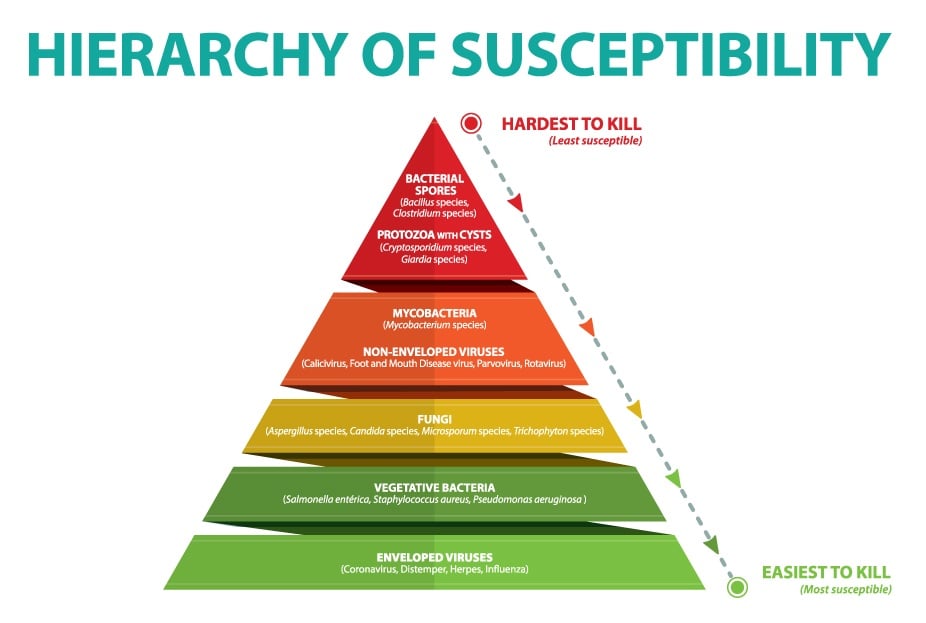
If baking soda and lime juice work so well, how come nobody's talking about it?


A lot of people go to Snopes because they just want a fast answer, and don't want to do their own research. I know Snopes has done a lot of good work, but it's scary to think of how many people actually see this site as the Ultimate Authority for fact-checking! This can easily prevent them from doing the kind of medical research that they really need to see.
In my opinion, they should have something on their page or site, that admits there could be gaps in their fact checking, and people should also do their own research, in case there's something they could have missed.
YouTuber Tom Coffey shows how Snopes doesn't always post accurate information. Now, I don't disagree with David Emery's post on Aretha Franklin (did she work for Donald Trump or not)? Donald Trump saying Aretha Franklin "worked for" him really does have a subservient tone that sounds like he's saying she was an employee, on payroll. So I like that Emery didn't just say this was a yes or no - he called it a mixture. But the next topic Coffey brings up, about the Trump hats, does illustrate a good point. Snopes can have some major gaps in their research. I appreciate that they can be a good resource for a lot of facts, but you definitely shouldn't rely on it as your only source of information.
OK so this video below (another by Tom Coffee) is not about Baking soda or Lime juice, but I thought it was worth sharing during this COVID crisis, because he gives some EYE OPENING facts.
He learned that people with dark skin are less able to absorb Vitamin D3 from the sun, than people with fair skin. Wow. I am guessing that most people don't know this either, so please share this information with others if you think it could help them. I thought I knew a lot about Vitamin D3, and have done a LOT of research on it, but I had never heard that.
I've been taking about 10,000 Vitamin D3 for seasonal affective disorder and back pain for over 10 years (it's works like a miracle for me). I took on a whim, thinking maybe it would help with Seasonal Affective Disorder, but couldn't believe how much it helped my lower back pain). I can't tell you what to do, or how much you should take, but I can tell you that I, personally, don't feel a change in my back stiffness unless I take at least 5,000 or 10,000 IU (2,000 just doesn't cut it for me, personally). The reason I went up to 10,000 IU is because I wanted to take the maximum amount that could be considered safe, and Dr. Andrew Weil says this on his page about Vitamin D3:
"No adverse effects have been seen with supplemental vitamin D intakes up to 10,000 IU daily"
I know about HALF of the people in the US are Vitamin D3 deficient, but I guessed it was just because people don't go outside enough, or because they use sunscreen more often. I had no idea it could be related to your skin. If you watch the video, you will see why many health practitioners urge people to make sure they aren't D3 deficient, during this COVID crisis (also keep in mind, that what it says to take on the bottle is not necessarily what you, personally, should take).
You may want to get your blood levels checked. You can read more about that, HERE. Dr. Weil wrote an article about COVID-19 and D3 supplementation, HERE.
Vitamin D deficiency and co-morbidities in COVID-19 patients – A fatal relationship?
https://www.ncbi.nlm.nih.gov/pmc/articles/PMC7276229/
1.2. Vitamin D and immune system
Vitamin D plays an essential role in the immune system [19]. Vitamin D interferes with the majority of the immune systems cells such as macrophages, B and T lymphocytes, neutrophils and dendritic cells, which express VDR (for details [20] and Fig. 3). Cathelicidin, a peptide formed by vitamin D stimulated expression, has shown antimicrobial activity against bacteria, fungi and enveloped viruses, such as corona viruses [21,22]. Furthermore Vitamin D inhibits the production of pro-inflammatory cytokines and increases the production of anti-inflammatory cytokines [23].
3. Conclusion
An inadequate supply of vitamin D has a variety of skeletal and non-skeletal effects. There is ample evidence that various non-communicable diseases (hypertension, diabetes, CVD, metabolic syndrome) are associated with low vitamin D plasma levels. These comorbidities, together with the often concomitant vitamin D deficiency, increase the risk of severe COVID-19 events. Much more attention should be paid to the importance of vitamin D status for the development and course of the disease. Particularly in the methods used to control the pandemic (lockdown), the skin's natural vitamin D synthesis is reduced when people have few opportunities to be exposed to the sun. The short half-lives of the vitamin therefore make an increasing vitamin D deficiency more likely. Specific dietary advice, moderate supplementation or fortified foods can help prevent this deficiency. In the event of hospitalisation, the status should be urgently reviewed and, if possible, improved.
Figuring I had nothing to lose, I clicked on the video (you'll be able to see this and several other videos about COVID-19, posted below).
A few months ago, I saw a YouTube recommendation for a video (which you can watch, further down the page), that was about baking soda, lime juice, and the coronavirus. The cynical side of me, that was raised on western medicine, said: There's no way that could work. I mean really... baking soda? That little orange, open box in your fridge, that's meant to block odors?
But it was hard to dismiss the video when I've personally had 16 different times in my life, where I (or a close friend or family member) was frustrated by some health issue, and tried western medicine or traditional pharmaceutical or OTC drugs... only to discover something relatively simple, natural and cheap, seemed to work even better! You can see some of those stories on this blog.
I was blown away by all the work this woman did, to research baking soda, and why it could possibly help people who contract the coronavirus.
But sadly, her video has become nearly INVISIBLE to the general public, because YouTube has been hiding it from search results. Videos about baking soda and lime juice are either being removed by YouTube, or they are made out to be extremely difficult to find in a search.
 If someone told me that important information about COVID-19 was being censored by Facebook and YouTube, I may not have believed it... until I saw it happen, with my own eyes. Shortly after watching Raphaela's video, I also watched a very convincing, eye-opening testimonial, uploaded by a man named Gabriel, who posted a baking soda and lime juice recipe OVER A YEAR AGO, before this whole pandemic started. He said that it really helped him and his family to feel much better, whenever they got sick. But the next day, the video was removed by YouTube!
Many people have been watching documentaries about the 1918 Spanish Flu, and learning that many people say they survived it by using baking soda. You can see a survivor of the Spanish Flu, talking about it, in this video (after you click the play button, she'll mention the baking soda about a minute after that). She said they were the only entire family that escaped having the Spanish Flu.
The COVID-19 pandemic started, many people began searching for a baking soda recipe that could possibly help them after they contracted the Coronavirus (I believe finding the video, making the recipe, and calling Gabriel to rave about how much better they felt. He explained that he records these calls because he gets a lot of scammer calls from other countries, and likes to toy with the callers as a way to prank them back.
Gabriel was called by a doctor in the UK, who raved about his recipe of baking soda and lime juice, after he contracted the Coronavirus from one of his patients. I was so impressed, I began to compose an email to send these videos to my friends and family.... but the next day, the link for the doctor's testimonial no longer worked! I kind of had a feeling that might happen, since he had mentioned in his video that his original video about baking soda and lime juice was removed by youtube.... so, I made a copy of most of the video. I planned to upload it or share it in a different format, but luckily, Gabriel has re-posted the videos on Facebook, so I don't have to.
You can see the video with him making his own recipe, HERE, and the video with the doctor's raving testimony, HERE. But keep in mind that Facebook is also censoring and removing a lot of videos, so I know it may be just a matter of time before those are removed, as well. I do believe that Facebook does appear to try to do the right thing, but the fact is, there are some big problems with their fact checking. To their credit, I think they are making more of an effort to do fact-checking now, but there is still a LOT of misinformation on facebook, and things that ARE accurate and true, are being censored. It would be hard for Facebook to be able to stay on top of ALL of this. "The Independent Fact Checking Network" - is
Because a lot of information about COVID-19 is being censored on Facebook and Youtube, these videos do not come up easily in searches.
Sodium bicarbonate and lime juice were used in medical practice, back in 1918, to treat people with the Spanish Flu. I found this article in the Journal of the American Medical Association, via Google Scholar: https://jamanetwork.com/journals/jama/article-abstract/219523
A review on probable Lysosomotropic properties of Sodium bicarbonate to restrain viral entry of Coronavirus 2 (SARS-CoV-2) Mudasir A. Mir1 *, Sheikh Mansoor2 , Abida Bhat3
https://www.ncbi.nlm.nih.gov/pmc/articles/PMC3848400/
CLICK HERE for the PDF version
This video below is a must-see. If you watch this video, you'll see why viruses are so easily killed with soap. We've all heard that by now, but few people are talking about the fact that soap is effective against the coronavirus because soap is a SURFACTANT, and there are surfactants that are safe to consume! You can easily make your own surfactant by combining baking soda with an acidic solution.... like lime or lemon juice!!
Sodium bicarbonate is powerful stuff
It's easy to overlook the importance of sodium bicarbonate (something that's made by your own body), because many of us just think of it as that old, orange box that's reducing the odors in your fridge. But did you know that Pfizer (not Arm & Hammer) is actually the leading manufacturer of sterile sodium bicarbonate?Sodium bicarbonate is regularly used in hospitals, to keep a patient's blood from becoming too acidic. If your blood gets too acidic, you can go into a coma, and die. It's used during heart surgery, and this stuff is so critical, that many surgeries were put on hold, when we had a Sodium Bicarbonate shortage in 2017.
Check out this excerpt from an article about the shortage:
"I can't imagine, being a former pharmacy director, not having access to sodium bicarbonate," said Chris Jones, director of pharmacy automation and technology for the group purchasing organization Premier. "There is no other substitute that can work as well and quickly as that can. It truly is a life-and-death kind of drug."
Providers often stock the drug on emergency crash carts for critical-care settings during advanced cardiac life support and as an antidote to some poisons. It is also used in some types of chemotherapy.
https://poseidon01.ssrn.com/delivery.php?ID=331005097121007065079012074104103090117046093006002049011113031091078000124071028002000030020015104116044126064029096004118004041026000040040122090029095007102070109034087000088079029119072115065094018081072106079011029101093028097088067117020112003068&EXT=pdf
You have probably already heard that they are easily killed by SOAP (as long as you wash your hands for 20 seconds). Soap works very well on the virus, because it is a surfactant.

The SARS-2 Coronavirus has a lipid bilayer that is easily dissolved by surfactants. You can see, in this video, how it works.
This is another video that does a really good job in showing why soap works so well against the SARS-2 Coronavirus.
Ian Mackay has a great page that shows why soap works so well. He gives a good explanation, below.
Why does soap work so well on the SARS-CoV-2, the coronavirus and indeed most viruses? Because it is a self-assembled nanoparticle in which the weakest link is the lipid (fatty) bilayer.

The soap dissolves the fat membrane and the virus falls apart like a house of cards and “dies”, or rather, we should say it becomes inactive as viruses aren’t really alive. Viruses can be active outside the body for hours, even days.
Disinfectants or liquids, wipes, gels and creams containing alcohol (and soap) have similar effects but are not really quite as good as normal soap.
Here's another good article. I'm pasting some of it below, so that I can highlight certain parts, but here's the link, to see the original page:
https://new.engineering.com/story/a-history-of-violencehow-soap-attacks-a-coronavirus
A History of Violence—How Soap Attacks a Coronavirus
How the COVID-19 virus is destroyed by something as handy as soap.
The SARS-CoV-2 virus, the cause of COVID-19, taking over the Earth like a zombie apocalypse, making us hide in our houses, is actually quite a bit easier to destroy than a zombie. Simple soap will tear it apart. You can use a host of other chemicals, too, many that you have lying around, like alcohol and bleach, but for the special way that soap works, there is no reason to look any further than your soap dispenser.
The SARS-CoV-2 virus, as contagious as it is, is not a hardy virus. Outside the body, in the wild, the SARS-CoV-2 is a wuss. It won’t survive for long outside a warm, moist environment, like the host cells in the human respiratory system, for which it has a special affinity. Unlike the other class of viruses called “naked” viruses, essentially dry particles with hard protein shells, coronaviruses belong to the class of enveloped viruses, which are covered by a bilipid (lipid =fat) layer that will suffer from desiccation. They are also extremely vulnerable to chemicals, such as surfactants (soap and detergents).
Naked and Not Afraid
Viruses can be broken down into two types: naked and enveloped.
Naked viruses, the simplest form of virus, are little more than a genome inside a protein shell called the capsid. Imagine a ruggedized, armored speck of dust. In its primitive state, armored against the world, it is protected against all manner of threat, such as solvents, acids (like stomach acids), changes in pH, surfactants, temperature and humidity fluctuation, or lack of moisture—even the rigors of time. Naked viruses can exist in their dormant state for a long time, perhaps forever. An ancient virus from 30,000 years ago was found in Siberia’s permafrost. Thawed, it was able to infect again.
Other viruses have the same genome and capsid but add an envelope made mostly of lipid. Lipids are best known by their common name: fats. When lipids are liquid, they are called oils. Your body fat is a lipid. So is olive oil.
An enveloped virus, its envelope consisting of a dual layer of lipid molecules with a few proteins stuck in it, is considered a more evolved type of virus. The envelope is said to cloak the virus from antibodies. The lipids and proteins in the envelope may be considered similar to the host’s cells, which are also composed of fats and proteins. This allows the enveloped virus to replicate undisturbed in the host. But the envelope also contributes to its vulnerability.
As anyone who has ever washed a dish is probably aware, soap and detergents dissolve fat and oils.
Surfactants, which include both soap and detergent, break down the lipid layer. Stripped of the envelope, the virus is now naked and exposed … and at the mercy of antibodies. In addition, its ability to replicate has been severely compromised. The protein spikes that stuck through the lipid bilayer, which are necessary to inject the viral genome into the host cell, have been uprooted and rendered useless.
How Soap Violently Attacks the Coronavirus
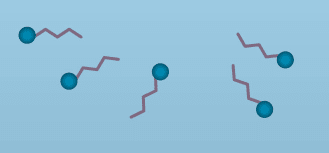
Bipolar. Soap molecules have a “head” that bonds with water and a tail that bonds with fat. (Image courtesy of the New York Times.)
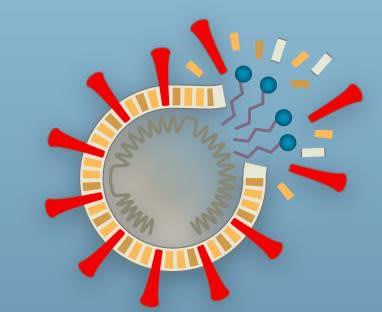
The fat-loving tails of soap molecules wedge into the SARS-CoV-2's largely lipid envelope. (Image courtesy of the New York Times.)
Surfactants work by creating polarized molecules, with one end that loves water (hydrophilic) and the other that loves fat (hydrophobic). In water, the molecules float around in water. If they encounter each other, they assemble in clusters, called micelles, with heads together and tails to the outside.
A coronavirus is no more than a “nano-sized grease ball,” said Palli Thordarson, PhD, and professor of chemistry at the University of Sydney, whose multipart Twitter treatise may have earned him the title of Dr. Soap. The fat-loving, water-hating ends of the soap molecule bury themselves into the bilipid layer of the coronavirus, prying it apart.
I love how this video shows how soap can dissolve the fatty lipid membrane (I've also heard it called a lipid bilayer of the coronavirus. Imagine those little sprinkles on the outside of these balls in the bowl in this video, below, are the spike)s sticking out of the viral envelope. If you can dissolve the fatty lipid bilayer, the spikes will simply fall off, because they're only being held on there by a very thin layer of fat. If you can add something that dissolves that lipid layer, the spikes just fall right off.
An enveloped virus, its envelope consisting of a dual layer of lipid molecules with a few proteins stuck in it, is considered a more evolved type of virus. The envelope is said to cloak the virus from antibodies. The lipids and proteins in the envelope may be considered similar to the host’s cells, which are also composed of fats and proteins. This allows the enveloped virus to replicate undisturbed in the host. But the envelope also contributes to its vulnerability.
As anyone who has ever washed a dish is probably aware, soap and detergents dissolve fat and oils.
Surfactants, which include both soap and detergent, break down the lipid layer. Stripped of the envelope, the virus is now naked and exposed … and at the mercy of antibodies. In addition, its ability to replicate has been severely compromised. The protein spikes that stuck through the lipid bilayer, which are necessary to inject the viral genome into the host cell, have been uprooted and rendered useless.
SARS-CoV-2 and the lessons we have to learn from it.
(SARS-CoV-2 is the virus. COVID-19 is the disease.)
This chart shown below is from this page:
https://medium.com/@edwardnirenberg/sars-cov-2-and-the-lessons-we-have-to-learn-from-it-e2017fd5d3c


Baking-Soda Ingredient May Lower Risk of Premature Death
https://www.livescience.com/53413-bicarbonate-blood-levels-lower-death-risk.html
Older people may be at increased risk of premature death if they have low levels of bicarbonate, a main ingredient in baking soda, in their blood, a new study suggests.
In the study, researchers examined nearly 3,000 relatively healthy adults ages 70 to 79 over a 10-year period. During this time, about half of these people died from natural causes. But the adults with low levels of bicarbonate in their blood were nearly 25 percent more likely than the adults with normal or high levels of bicarbonate in their blood to die during the study period, the researchers found.
The reason for the link isn't exactly clear, but it may have to do with the ill effects of having slightly acidic blood, the researchers said. Bicarbonate, a base, is a natural byproduct of metabolism that the body uses to regulate the pH level of the blood. Bicarbonate counters carbon dioxide and other acidic byproducts of eating and breathing to keep the blood at a neutral pH.
Another possible explanation is that the low levels might point to underlying (and undiagnosed) kidney problems, the researchers said. Given that it's easy to test for bicarbonate in the blood, it may be prudent for doctors to monitor bicarbonate levels in older adults to reduce their risk of premature death, the researchers said. [Extending Life: 7 Ways to Live Past 100]
The study, led by Dr. Kalani Raphael of the University of Utah in Salt Lake City, appears this week in the Clinical Journal of the American Society of Nephrology.
Acidic blood
Scientists have long understood the importance and basic mechanisms for regulating blood pH. As aerobic organisms, humans breathe in oxygen and use this chemical with food nutrients to create energy, with the byproduct being the slightly acidic chemical carbon dioxide. Digestion also produces acids such as sulfuric acid. Dangerous levels of acid could build up in the bloodstream without a mechanism to neutralize or eliminate it.
Many organs produce bicarbonate, which can buffer the acid, and the kidneys excrete excess acid through urine.
Dietary Acid, Age, and Serum Bicarbonate Levels among Adults in the United States
https://cjasn.asnjournals.org/content/8/12/2034


https://journals.sagepub.com/doi/abs/10.1177/0268355514534648?journalCode=phla
Interaction of detergent sclerosants with cell membranes


https://www.ncbi.nlm.nih.gov/pmc/articles/PMC4866878/
All enveloped viruses deliver their genomes into the cytoplasm of their host cell by fusing with a cellular membrane. Ari Helenius inaugurated and has had a continual impact on this field in three major ways. He and his coworkers provided the first evidence that viruses can productively enter cells following endocytosis and transport to endosomes 1, 2, 3, 4, 5. His group was among the first to demonstrate that low pH is necessary and sufficient to trigger the fusion activity of certain enveloped viruses that enter cells through endosomes 1, 2, 6, 7, 8, 9, 10. And, extensive work led by Helenius demonstrated that not only can enveloped viruses productively enter cells through endosomes (Figure (Figure1)1) but that most do so [for recent reviews, see 14, 15, 16]. The focus of this review is on enveloped virus fusion in endosomes, in particular on the diversity of endosomal cues that trigger virus fusion.
The SARS-CoV-2 virus, as contagious as it is, is not a hardy virus. Outside the body, in the wild, the SARS-CoV-2 is a wuss. It won’t survive for long outside a warm, moist environment, like the host cells in the human respiratory system, for which it has a special affinity. Unlike the other class of viruses called “naked” viruses, essentially dry particles with hard protein shells, coronaviruses belong to the class of enveloped viruses, which are covered by a bilipid (lipid =fat) layer that will suffer from desiccation. They are also extremely vulnerable to chemicals, such as surfactants (soap and detergents).
Surfactants, which include both soap and detergent, break down the lipid layer. Stripped of the envelope, the virus is now naked and exposed … and at the mercy of antibodies. In addition, its ability to replicate has been severely compromised. The protein spikes that stuck through the lipid bilayer, which are necessary to inject the viral genome into the host cell, have been uprooted and rendered useless.
How Soap Violently Attacks the Coronavirus
Surfactants work by creating polarized molecules, with one end that loves water (hydrophilic) and the other that loves fat (hydrophobic). In water, the molecules float around in water. If they encounter each other, they assemble in clusters, called micelles, with heads together and tails to the outside.
A coronavirus is no more than a “nano-sized grease ball,” said Palli Thordarson, PhD, and professor of chemistry at the University of Sydney, whose multipart Twitter treatise may have earned him the title of Dr. Soap. The fat-loving, water-hating ends of the soap molecule bury themselves into the bilipid layer of the coronavirus, prying it apart.
Here's an article about endosomes in viral fusion, from 2008:
SARS coronavirus entry into host cells through a novel clathrin- and caveolae-independent endocytic pathway

Because the Coronavirus is extremely contagious, please practice social distancing and be sure to wear a mask, to protect the people around you.
While I have seen research that appears to support the idea that the things mentioned in the videos on this page, I am not a doctor, and can't give any medical recommendations. However, if there is something out there, that actually makes a person feel better, for whatever reason, and it appears to be safe, then I absolutely think it's worth sharing with others. The information on this page is not intended to treat, diagnose or cure any condition, and if you think you have contracted COVID-19, you should seek help from a medical professional, and follow the CDC's guidelines.
I think it's important to share information like this because the reality is, not everyone lives right next to a hospital, and not everyone has a car or transportation. So there are going to be people out there who can't get to a hospital right away. If I lived an hour or more away from a hospital and suspected I had COVID-19, I would use this recipe to try to at least help myself to feel better, on my way to the hospital. Then (I have to say) you should get tested for COVID-19.
You should be aware that, it is estimated that up to 20% of covid cases are actually caught while a person was in a hospital. And in case you haven't seen these videos of nurses detailing some of the things they've witnessed, you should definitely click HERE and HERE (please note, I realize that most hospitals may not operate in this way, but you still have the right to know some of the things that have been reported, before you go). There is growing evidence that a ventilator may not be a person's best option. But I am still supposed to say: You're supposed to go to a hospital.
I watched an incredible video with a car mechanic named Gabriel, who uploaded an incredible testimony by a doctor who called him from the UK, raving
This woman below describes being 3 years old and being very worried because his father was so sick from the spanish flu, they thought he was going to die. But he never went to the hospital, and he recovered.
Drinking baking soda could be an inexpensive, safe way to combat autoimmune disease
https://www.sciencedaily.com/releases/2018/04/180425093745.htm
https://www.ncbi.nlm.nih.gov/pmc/articles/PMC4866878/
All enveloped viruses deliver their genomes into the cytoplasm of their host cell by fusing with a cellular membrane. Ari Helenius inaugurated and has had a continual impact on this field in three major ways. He and his coworkers provided the first evidence that viruses can productively enter cells following endocytosis and transport to endosomes 1, 2, 3, 4, 5. His group was among the first to demonstrate that low pH is necessary and sufficient to trigger the fusion activity of certain enveloped viruses that enter cells through endosomes 1, 2, 6, 7, 8, 9, 10. And, extensive work led by Helenius demonstrated that not only can enveloped viruses productively enter cells through endosomes (Figure (Figure1)1) but that most do so [for recent reviews, see 14, 15, 16]. The focus of this review is on enveloped virus fusion in endosomes, in particular on the diversity of endosomal cues that trigger virus fusion.
Here's why coronavirus is easy to kill and how you can do it at home
Survival of Enveloped and Non-Enveloped Viruses on Inanimate Surfaces
Chapter 41Structure and Classification of Viruses
https://www.ncbi.nlm.nih.gov/books/NBK8174/
by J Li - 2018 - Cited by 7 - Related articles
Jul 9, 2018 - Cellular lipid cell content of 494 mg g−1 and lipid productivity of 44.5 mg ... Whereas the optimal pH for cell growth was 8.5 for 160 mM NaHCO3 cultures. ... contains a rigid microfibrillar layer composed of glucosamine [30] ...
While the liposomes at a pH of 7.4 (control) released only 15% of the encapsulated dye in 2 h, at a pH of 5, the release increased to 55% (Figure (Figure3).3). When we encapsulated sodium bicarbonate in the liposomes (instead of ammonium bicarbonate), the amount of the content release decreased. In 2 h, we observed that the sodium bicarbonate encapsulated liposomes released 40% of the encapsulated dye (at pH = 5.0; Supporting Information, Figures S3 and S4). For both of these liposomal formulations, the rate of contents release decreased considerably after 2 h. In 3 h at pH 5.0, the ammonium bicarbonate encapsulated liposomes released 75% of the contents, and the sodium bicarbonate encapsulated liposomes released 44% of the contents (Figure (Figure4A).4A). Decreasing the amount of encapsulated ammonium bicarbonate (from 400 mM to 200 mM) also reduced the amount of contents release from the liposomes (Figure (Figure44B).
around 9-10

Search Results
Featured snippet from the web
https://www.google.com/search?q=is+baking+soda+a+surfactant&rlz=1C1CHBD_enUS903US903&oq=is+baking+soda+a+surfactant&aqs=chrome..69i57.7396j0j7&sourceid=chrome&ie=UTF-8
pH of Vinegar:
pH of limes:
pH of Vinegar:
around 2.5
pH of limes:
Search Results
Featured snippet from the web
about 2.8
Other treatments include bleach, hydrogen peroxide, Tsunami 100, sodium bicarbonate, and electrochemical inactivation (Beuchat andRyu 1997, Drees et al. 2003). Viruses do not have the lipid membrane of bacteria, and are therefore more resistant to disinfectants; however, in a study by Malik and Goyal (2006), sodium bicarbonate was found to reduce FCV on some environmental surfaces; although FCV is used as a norovirus surrogate, the authors note that it is not known how closely FCV mimics norovirus infections in humans, as FVC generally infects cats. Another study conducted by Gulati et al. (2001) tested a number of disinfectants for their effectiveness against caliciviruses and found that all eleven tested was ineffective in inactivating caliciviruses. ...
No comments:
Post a Comment
Note: Only a member of this blog may post a comment.