The DEADLY WEAPON against the Coronavirus, that's been RIGHT IN FRONT OF OUR EYES
I'm going to sum up what you need to know, from this page, in the quick bullet points below:
10 reasons I'm personally convinced it could be extremely helpful for a person who becomes infected with COVID-19, to try baking soda and lime juice (I'm not a doctor and can't say what you should or shouldn't do, or if it's safe for you personally... I can just tell you that I'd try it for sure, if I thought I had COVID).
Soap is widely considered, by doctors and scientists, to be the best tool there is, to KILL the coronavirus.
Soap is an anionic surfactant (the strongest type of the 4 surfactants). It uses a "charge" to disrupt the lipid bilayer on a membrane. I've seen multiple people say the membrane of the coronavirus is easy to damage, rendering the coronavirus useless. An anionic surfactant literally rips the coronavirus apart.
Baking Soda (sodium bicarbonate) plus Lime Juice (citric acid) creates an anionic surfactant.
People have tried to post videos about their VERY positive experiences with taking baking soda + lime juice for COVID-19, but they are being removed or censored (I know this because I tried to send some of these videos but suddenly they were removed).
Baking soda has been reported as what many people used to prevent the Spanish Flu in 1918.
This is a really important video to watch because it shows how a surfactant can literally rip a coronavirus apart!
Why does soap work so well on the SARS-CoV-2, the coronavirus and indeed most viruses? Because it is a self-assembled nanoparticle in which the weakest link is the lipid (fatty) bilayer.
The soap dissolves the fat membrane and the virus falls apart like a house of cards and “dies”, or rather, we should say it becomes inactive as viruses aren’t really alive. Viruses can be active outside the body for hours, even days.
Disinfectants or liquids, wipes, gels and creams containing alcohol (and soap) have similar effects but are not really quite as good as normal soap.
A History of Violence—How Soap Attacks a Coronavirus
How the COVID-19 virus is destroyed by something as handy as soap.
The SARS-CoV-2 virus, the cause of COVID-19, taking over the Earth like a zombie apocalypse, making us hide in our houses, is actually quite a bit easier to destroy than a zombie. Simple soap will tear it apart. You can use a host of other chemicals, too, many that you have lying around, like alcohol and bleach, but for the special way that soap works, there is no reason to look any further than your soap dispenser.
The SARS-CoV-2 virus, as contagious as it is, is not a hardy virus.Outside the body, in the wild, the SARS-CoV-2 is a wuss. It won’t survive for long outside a warm, moist environment, like the host cells in the human respiratory system, for which it has a special affinity. Unlike the other class of viruses called “naked” viruses, essentially dry particles with hard protein shells, coronaviruses belong to the class of enveloped viruses, which are covered by a bilipid (lipid =fat) layer that will suffer from desiccation. They are also extremely vulnerable to chemicals, such as surfactants (soap and detergents).
Naked and Not Afraid
Viruses can be broken down into two types: naked and enveloped.
Naked viruses, the simplest form of virus, are little more than a genome inside a protein shell called the capsid. Imagine a ruggedized, armored speck of dust. In its primitive state, armored against the world, it is protected against all manner of threat, such as solvents, acids (like stomach acids), changes in pH, surfactants, temperature and humidity fluctuation, or lack of moisture—even the rigors of time. Naked viruses can exist in their dormant state for a long time, perhaps forever. An ancient virus from 30,000 years ago was found in Siberia’s permafrost. Thawed, it was able to infect again.
Other viruses have the same genome and capsid but add an envelope made mostly of lipid. Lipids are best known by their common name: fats. When lipids are liquid, they are called oils. Your body fat is a lipid. So is olive oil.
An enveloped virus, its envelope consisting of a dual layer of lipid molecules with a few proteins stuck in it, is considered a more evolved type of virus. The envelope is said to cloak the virus from antibodies.The lipids and proteins in the envelope may be considered similar to the host’s cells, which are also composed of fats and proteins. This allows the enveloped virus to replicate undisturbed in the host. But the envelope also contributes to its vulnerability.
As anyone who has ever washed a dish is probably aware, soap and detergents dissolve fat and oils.
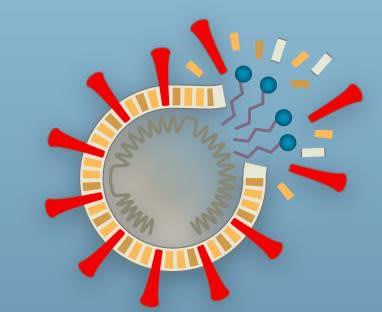
Surfactants, which include both soap and detergent, break down the lipid layer. Stripped of the envelope, the virus is now naked and exposed … and at the mercy of antibodies. In addition, its ability to replicate has been severely compromised. The protein spikes that stuck through the lipid bilayer, which are necessary to inject the viral genome into the host cell, have been uprooted and rendered useless.
How Soap Violently Attacks the Coronavirus
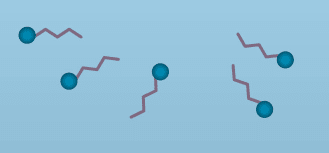
Bipolar. Soap molecules have a “head” that bonds with water and a tail that bonds with fat. (Image courtesy of the New York Times.)
The fat-loving tails of soap molecules wedge into the SARS-CoV-2's largely lipid envelope. (Image courtesy of the New York Times.)
Surfactants work by creating polarized molecules, with one end that loves water (hydrophilic) and the other that loves fat (hydrophobic). In water, the molecules float around in water. If they encounter each other, they assemble in clusters, called micelles, with heads together and tails to the outside.
A coronavirus is no more than a “nano-sized grease ball,” said Palli Thordarson, PhD, and professor of chemistry at the University of Sydney, whose multipart Twitter treatise may have earned him the title of Dr. Soap. The fat-loving, water-hating ends of the soap molecule bury themselves into the bilipid layer of the coronavirus, prying it apart.
I love how this video shows how soap can dissolve the fatty lipid membrane (I've also heard it called a lipid bilayer of the coronavirus. Imagine those little sprinkles on the outside of these balls in the bowl in this video, below, are the spike)s sticking out of the viral envelope. If you can dissolve the fatty lipid bilayer, the spikes will simply fall off, because they're only being held on there by a very thin layer of fat. If you can add something that dissolves that lipid layer, the spikes just fall right off.
In this video below, the narrator says,
"The corona protrudes from the glycoprotein membrane, an envelope of lipid molecules that coat the virus cells' body. This fatty layer of skin is very delicate, and it falls apart when it meets soap. And that's why, for now, soap is our best weapon against the virus, and why you should take your time washing your hands. After 20 seconds, soap penetrates the grease and grime on our hands enough to rip the virus membrane apart, killing it."
Coronavirus: Under the microscope | ABC News
At this point in the video below (same video as above), you can see an animation that shows how antibodies could surround a virus, covering the spikes and keeping them from infecting your own cells.
Well, if you read about Micelles, you'll notice how remarkably similar that layer of antibodies looks, to the micelles that are formed when you use a surfactant on a virus.
No comments:
Post a Comment
Note: Only a member of this blog may post a comment.


No comments:
Post a Comment
Note: Only a member of this blog may post a comment.