
The Lipid Bilayer
https://www.bioexplorer.net/phospholipid-bilayer.html/

6
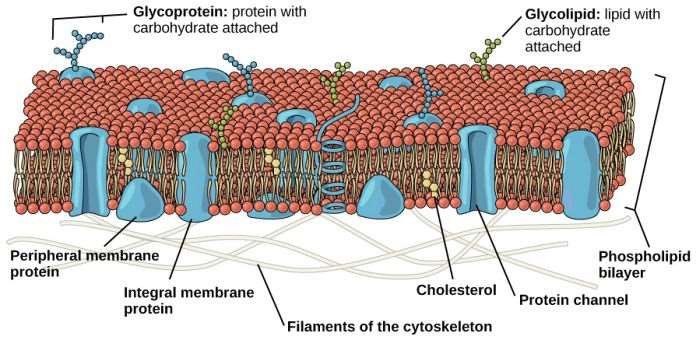
Phospholipid Bilayer: All cells are surrounded by the cell membranes, and this characteristic best portrayed by the Fluid Mosaic Model. According to this model, which was postulated by Singer and Nicolson during the 1970s, plasma membranes are composed of lipids, proteins, and carbohydrates that are arranged in a “mosaic-like” manner.
The fundamental structure of the plasma membrane is the phospholipid bilayer which act as a barrier and carry out other specific roles in the cell.
In particular, the main lipid component of the membrane are the phospholipids.
https://www.ck12.org/biology/phospholipid-bilayer/lesson/Phospholipid-Bilayers-BIO/
A Phospholipid Bilayer
The plasma membrane is composed mainly of phospholipids, which consist of fatty acids and alcohol. The phospholipids in the plasma membrane are arranged in two layers, called a phospholipid bilayer. As shown in the Figure below, each phospholipid molecule has a head and two tails. The head “loves” water (hydrophilic) and the tails “hate” water (hydrophobic). The water-hating tails are on the interior of the membrane, whereas the water-loving heads point outwards, toward either the cytoplasm or the fluid that surrounds the cell.
Molecules that are hydrophobic can easily pass through the plasma membrane, if they are small enough, because they are water-hating like the interior of the membrane. Molecules that are hydrophilic, on the other hand, cannot pass through the plasma membrane—at least not without help—because they are water-loving like the exterior of the membrane, and are therefore excluded from the interior of the membrane.
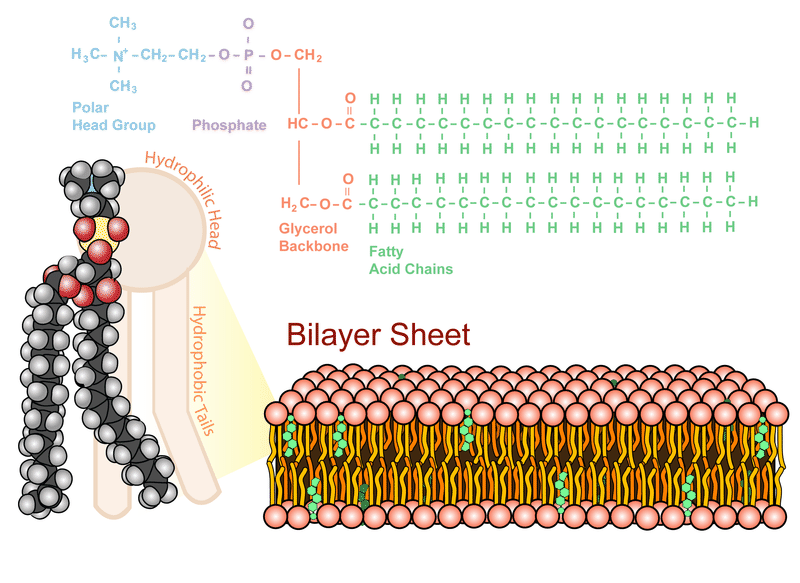
Phospholipid Bilayer. The phospholipid bilayer consists of two layers of phospholipids, with a hydrophobic, or water-hating, interior and a hydrophilic, or water-loving, exterior. The hydrophilic (polar) head group and hydrophobic tails (fatty acid chains) are depicted in the single phospholipid molecule. The polar head group and fatty acid chains are attached by a 3-carbon glycerol unit.[Figure2]
No comments:
Post a Comment
Note: Only a member of this blog may post a comment.