
From this page: https://www.fool.com/investing/2020/09/24/4-coronavirus-vaccine-stocks-the-bill-melinda-gate/
4 Coronavirus Vaccine Stocks the Bill & Melinda Gates Foundation Is Betting On
Are any of these stocks good bets for other investors?

No one has to tell Bill Gates to put his money where his mouth is. The billionaire Microsoft cofounder and his wife Melinda have been vocal proponents of fighting infectious diseases for decades. They've donated over $45 billion to charitable organizations since 1994, with much of that amount going to the Bill & Melinda Gates Foundation.
The Gates Foundation has been instrumental this year in funding coronavirus vaccine programs. But the foundation hasn't just handed money over to drugmakers; it's also invested in a few of them. Here are four coronavirus vaccine stocks that the Gates Foundation is betting on.
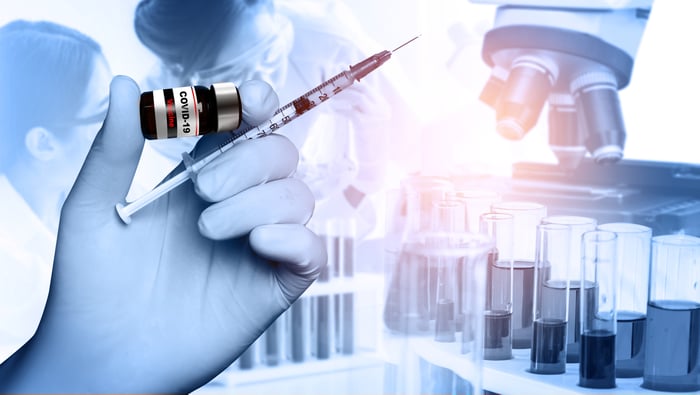
IMAGE SOURCE: GETTY IMAGES.
Pfizer
Bill Gates recently stated that he views Pfizer (NYSE:PFE) as the leader in the coronavirus vaccine race. In a CNBC interview, he said, "The only vaccine that, if everything went perfectly, might seek the emergency use license by the end of October, would be Pfizer."
The Gates Foundation also owns shares of the big drugmaker. However, this investment wasn't initiated because of Pfizer's coronavirus program. Actually, the foundation first bought a stake in Pfizer back in 2002 with the stated intention of "expand[ing] access to the pharmaceutical company's all-in-one injectable contraceptive, Sayana Press, giving women in the developing world an affordable option."
Gates is probably correct in assessing Pfizer as the coronavirus vaccine leader. The company expects to report initial results next month from a late-stage study of BNT162b2, the COVID-19 vaccine candidate that it's developing with BioNTech (NASDAQ:BNTX). If all goes well, BNT162b2 could very well become the first coronavirus vaccine available to Americans.
BioNTech
It's not surprising that the Bill & Melinda Gates Foundation also owns shares of BioNTech. Again, though, the nonprofit foundation didn't invest in the German biotech stock because of its coronavirus program.
The Gates Foundation first bought a position in BioNTech in September 2019, well before the COVID-19 pandemic hit. It invested $55 million in the biotech, with the potential for total funding to reach $100 million. The foundation's goal with this investment was to work with BioNTech to develop vaccines and immunotherapies for preventing HIV and tuberculosis (TB) infection.
BioNTech began developing its BNT162 COVID-19 vaccine program earlier this year. It had already made significant progress with this program when it announced a partnership with Pfizer in March.
CureVac
BioNTech wasn't the first German biotech to attract the attention of the Gates Foundation. In 2015, the foundation committed to investing $52 million in CureVac (NASDAQ:CVAC). In addition, the Gates Foundation agreed to provide separate funding for several projects to develop vaccines based on CureVac's messenger RNA (mRNA) platform.
CureVac listed its shares on the Nasdaq stock exchange in August 2020. The company is currently evaluating its mRNA COVID-19 vaccine in early stage clinical studies.
Vir Biotechnology
The Gates Foundation was one of the lead investors in Vir Biotechnology (NASDAQ:VIR) at the biotech's launch in late 2016 and early 2017. The foundation's goal with its position in Vir was to "support the development of affordable and accessible HIV and TB prophylactic vaccine programs, and support the development of a new partner in the infectious disease space."
Vir's pipeline now includes several coronavirus-focused programs. The company recently began a phase 2/3 clinical study with its partner, GlaxoSmithKline, evaluating an antibody therapy targeting COVID-19. Vir expects to initiate a phase 2 study of another COVID-19 antibody therapy, VIR-7832, later this year. VIR-7832 could potentially be used to treat COVID-19 and as a vaccine to prevent infection. In addition, the biotech is conducting preclinical studies of an inhaled therapy targeting COVID-19.
https://www.wsj.com/articles/SB1021577629748680000
Gates Foundation Buys Stakes in Drug Makers
The Bill and Melinda Gates Foundation has purchased shares in nine big pharmaceutical companies valued at nearly $205 million -- an investment likely to attract attention more for its symbolism than its size.
The foundation, the nation's largest with an endowment of $24.2 billion from Microsoft Corp. Chairman Bill Gates and his wife, already is a major force in international health issues, contributing $555 million in 2000 alone to global health programs. The organization has emerged as a prominent voice in the debate over how to supply cheaper drugs for AIDS and other diseases to poor countries. At times, it has assumed the role of a broker between poor nations and drug companies.
Now, as an investor in Merck & Co., Pfizer Inc., Johnson & Johnson and others, the Gates foundation has a financial interest in common with makers of AIDS drugs, diagnostic tools, vaccines and other drugs. The stock purchases are a new type of investment for the foundation: In the past it held primarily bonds and other nonequity investments.
Joe Cerrell, a spokesman for the Seattle-based Gates foundation, says the stock investments, reported this week in a Securities and Exchange Commission filing, are independent of the foundation's programs. The stocks were chosen by Michael Larson, a money manager who has considerable discretion in selecting investments for the foundation and for Mr. Gates personally, through an entity called Cascade Investment LLC. Mr. Larson, through a spokesman, declined to comment about the rationale.
The foundation's investments in "Big Pharma" could spur controversy, given Mr. Gates' staunch support of strict intellectual-property protections for drugs in poor countries. Mr. Gates' stance on intellectual property is as important to Microsoft's software business as it is to drugmakers.
"The impression people have, because of the types of projects Gates has funded and because of his Microsoft background, is that he has an ax to grind on the intellectual-property front," says James Love, director of the Consumer Project on Technology, who works with African officials to obtain low-cost drugs.
Poor countries have sometimes threatened to seize patents in order to produce affordable generic drugs for sick citizens, making the field of intellectual-property law a flash point between pharmaceutical companies and poor countries. At a meeting in Africa last year, Mr. Love says he was struck by fears of officials from Botswana and elsewhere that pressing for access to generic drugs could jeopardize their chances for contributions. "They thought it would alienate the Gates foundation and they thought that was a problem," Mr. Love says.
A report issued last year by the Commission on Macroeconomics and Health, chaired by economist Jeffrey Sachs, made a strong defense of intellectual-property protection as critical to continued investment in drug research and development. The Gates foundation was a major sponsor of the commission.
Other people involved with the issue say medical progress in poor countries depends on incentives for drug makers, and the Gates foundation is balancing the tradeoffs responsibly. "For every major killer of the poor, we need better drugs, better diagnostics and better vaccines," says Richard Feachem, director of the Institute for Global Health at the University of California, San Francisco. "That means massive investments in research and development. Much of that has to come from Big Pharma and biotech companies."
The foundation's Mr. Cerrell dismisses as "speculative" the suggestion of conflict between financing drugs and investing in stocks. He adds that pharmaceutical makers "play an important part in meeting our goals of providing equity and access and lifesaving vaccines and other advances in medicine to those who need it most."
Managing the foundation's multiplying ties with the drug industry could get tricky. For example, through its funding for the Global Alliance for Vaccines and Immunizations, the foundation pays for purchases of vaccines from some of the same pharmaceutical makers in which it now owns shares.
A Gates foundation representative sits on the 18-member board of the Global Fund to Fight AIDS, Tuberculosis and Malaria, which is expected to become a major buyer of drugs to fight those diseases. The foundation has pledged $100 million to the fund, which has so far collected $2.2 billion.
UC's Mr. Feachem, recently appointed to head the Geneva-based fund, argues that its massive buying power could create a strong "pull factor" spurring drug makers to develop inexpensive products. "For the industry, that would lead to the development of a high-volume, low-margin market, which could be a win for them as well," he says.
Mr. Gates has forged other ties with the industry. Last year, Microsoft named Raymond Gilmartin, chief executive of Merck, to its board. Mr. Gates worked with Mr. Gilmartin to launch the vaccine fund and also helped Merck with a program to supply discounted AIDS drugs in Botswana, where one in three people is infected with HIV.
The foundation's stock holdings include just two other stocks: Cox Communications Inc. and Waste Management Inc. The spokesman for Mr. Larson, the money manager, confirms that the drug investments represent a significant increase in the foundation's equity holdings, though they represent less than 1% of its total portfolio.
Write to David Bank at david.bank@wsj.com and Rebecca Buckman at rebecca.buckman@wsj.com
Here are some links from Google...
No comments:
Post a Comment
Note: Only a member of this blog may post a comment.