
Every country could learn a lot from Taiwan's success in beating the Coronavirus. Taiwan had a phenomenally low COVID infection rate, for the majority of this pandemic.... until they started their vaccine rollout.
This is Taiwan's vaccination timeline, from Wikipedia:
COVID-19 vaccination in Taiwan
COVID-19 vaccination in Taiwan is an ongoing immunization campaign against severe acute respiratory syndrome coronavirus 2 (SARS-CoV-2), in response to the ongoing pandemic in the country. Following the approval of the Oxford–AstraZeneca COVID-19 vaccine on 18 March 2021, vaccinations commenced on 22 March 2021, and will continue throughout the year with the goal of vaccinating 70% of the population by late October 2021.[3]
2021[edit]
March to May[edit]
On 3 March 2021 the first shipment of the Oxford–AstraZeneca COVID-19 vaccine was delivered. The 117,000 doses are part of the 10 million doses of the vaccine that the Taiwanese government had previously ordered.[4]
On 18 March the AstraZeneca vaccine was approved by the government,[5] and vaccinations commenced on 22 March 2021. The vaccine is free for all Taiwanese people and long-term residents.[6] Health workers, other frontline workers and seniors were the first to be inoculated with the vaccine.[7]
On 5 May the Moderna COVID-19 vaccine was approved for emergency use,[8] and the first batch of 150,000 doses was delivered on 28 May 2021.[9]
On 17 May 400,000 doses of the AstraZeneca vaccine that were ordered through COVAX arrived in the midst of Taiwan's largest COVID-19 pandemic.[10]
On 31 May Taiwan Centers for Disease Control announced that 10 million doses of domestically produced vaccines (Medigen and United Biomedical) had been pre-reserved. 5 million of each vaccine were reserved. They are expected to be approved and deployed sometime in July 2021.[11][12]
June[edit]
On 2 June Taiwan recorded the first case of blood clotting linked to the Oxford–AstraZeneca COVID-19 vaccination.[13]
On 4 June Japan donated 1.24 million doses of the Oxford–AstraZeneca COVID-19 vaccine to Taiwan.[14]
On 6 June three American senators who arrived in Taiwan announced that the United States will donate 750,000 vaccine doses to Taiwan, the brand of which is still currently unknown.[15] On 20 June 2.5 million Moderna vaccine doses arrived, which represented an increase from the 750,000 doses pledged. The doses arrived on a China Airlines flight from Memphis.[16]

Why Taiwan has become a problem for WHO
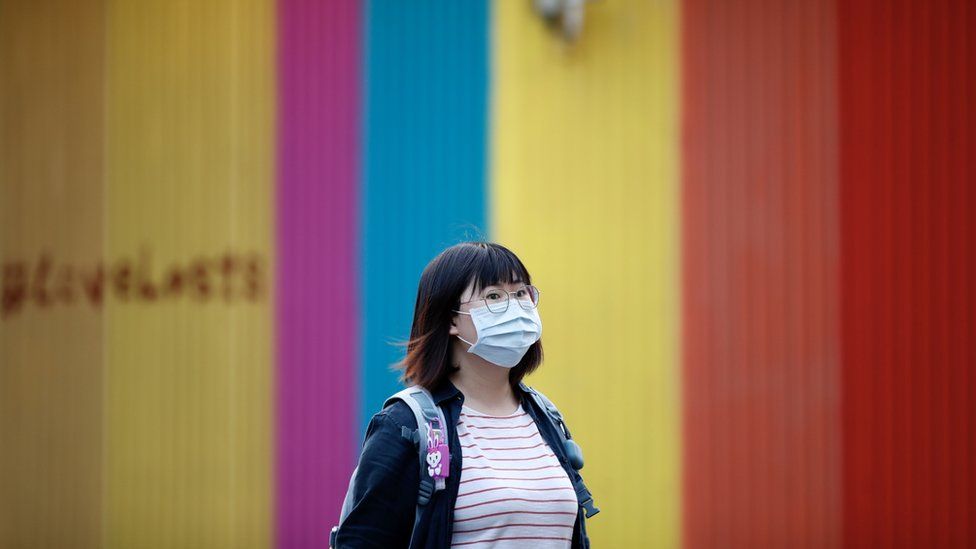
Taiwan is seen as one of the few places in the world which has successfully stemmed the spread of the coronavirus without resorting to draconian measures.
But despite its efforts, it is still effectively locked out of membership in the World Health Organization (WHO) due to its complex relationship with China.
This all exploded over the weekend when a top WHO official appeared to avoid questions about Taiwan in a TV interview that has gone viral, attracting criticism and even accusations of bias.
What happened?
On Saturday, Hong Kong broadcaster RTHK aired an interview with Bruce Aylward, the WHO assistant director-general, who spoke to journalist Yvonne Tong on a video call.

In the segment, Ms Tong asks if the WHO would reconsider letting Taiwan join the organisation. She is met with a long silence from Mr Aylward, who then says he cannot hear her and asks to move on to another question.
Ms Tong presses him again, saying she would like to talk about Taiwan. At this point, Mr Aylward appears to hang up on her.
When the journalist calls Mr Aylward again, she asks if he could comment on Taiwan's response to the coronavirus.
Mr Aylward then replies: "Well, we've already talked about China."
His last line appeared to mirror China's stance on Taiwan, which is that the island is a breakaway province. Taiwan, however, considers itself an independent country.
What is Taiwan's relationship with the WHO?
Aylward's reaction was widely seen as indicative of the awkward relationship the WHO has with Taiwan, which is not allowed to be a member state.
WHO membership is only given to countries that are members of the United Nations - which does not recognise Taiwan - or whose applications are approved by the World Health Assembly.
What this means is that Taiwan has been excluded from emergency meetings and important global expert briefings on the coronavirus pandemic. Taiwanese official Stanley Kao has also said the island has been denied permission to attend the World Health Assembly's annual meetings in recent years.
It also means the WHO lists Taiwan's coronavirus statistics together with China's, a move Mr Kao says denies the world of accurate and timely information on the pandemic.
The exclusion, coupled with the WHO's repeated praise of China's response to the outbreak - which public health experts have criticised - has led some to accuse the organisation of political bias towards China, a major contributor to the organisation.
The WHO is far from the only global body that excludes or does not officially recognise Taiwan - other major examples include the International Olympics Committee and the International Civil Aviation Organization.
But the BBC's Cindy Sui in Taipei says that of all these groups, the WHO is perhaps the most important to Taiwan, which prides itself on having one of the best healthcare systems in the world.
The island previously enjoyed good relations with Beijing, and in the past was an observer at the World Health Assembly, but it lost this status in recent years as tensions have increased between Taipei and Beijing.
Why is Taiwan's exclusion a problem?
Taiwan consistently raises objections every time it is excluded from a global body, saying it is unfair and discriminatory.
This time it has made the same point, adding that it should not be left out at a time where global cooperation is needed more than ever. Earlier this month, Taiwan accused the WHO of ignoring it when the government asked about person-to-person transmission at the very start of the outbreak in China, which it said put lives at risk.
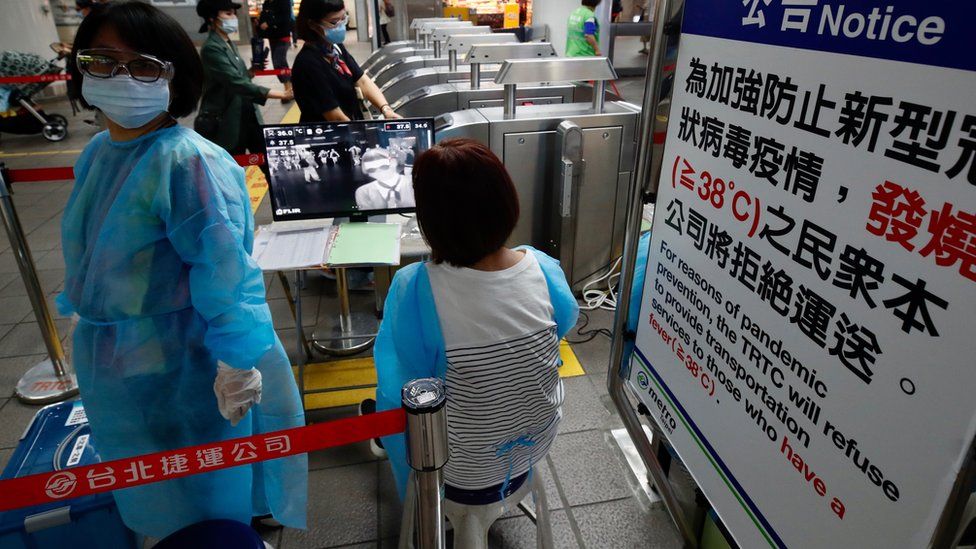
"We hope through the test of this epidemic, the WHO can recognise clearly that epidemics do not have national borders, no one place should be left out because any place that is left out could become a loophole… any place's strength shouldn't be neglected so that it can make contributions to the world," said Taiwan's health minister Chen Shih-chung at a recent press conference.
Taiwan has also pointed out that it learned many lessons from managing its coronavirus outbreak which could be shared with the world. The island has been praised for its swift and decisive handling of its epidemic, which has been relatively controlled and has seen few deaths.
The measures included drastically cutting inbound flights from China and imposing quarantines on travellers early on, which experts say was key in stopping the spread in the community, as well as strict surveillance measures on those in quarantine.
"They have also done focused testing on people suspected to have coronavirus, and also very good contact tracing and social distancing. I think they've done pretty well," said Professor Benjamin Cowling, an epidemiologist with Hong Kong University.
What's the response been like to the interview?
Following Mr Aylward's interview, the WHO said the question of Taiwanese membership was not for its staff to answer, saying that it is instead "up to WHO member states".
It also said it has been working with Taiwanese health experts and authorities to ensure speedy information flow and to share best practices.
Our correspondent says that while this is true, and Taiwan can access WHO information shares with members and share expertise through designated communications channels, it cannot communicate as efficiently or be heard as clearly as a member would be.
On Monday, President Tsai Ing-wen replied to the WHO statement saying she "hoped that all countries after experiencing this outbreak would better understand Taiwan's capabilities and areas of contribution, to seriously consider Taiwan's participation in the global response to the pandemic".
"Taiwan's stance has always been clear: it has the capability and willingness to work with countries in health protection, and is also willing to share useful experiences," she said.
But the foreign minister Joseph Wu has been less diplomatic, and over the weekend reposted Mr Aylward's interview in a tweet, saying: "Wow, can't even utter 'Taiwan' in the WHO?"
Others have also lambasted Mr Aylward and the WHO following the interview.
China is yet to officially comment on the issue, but on social media network Weibo many Chinese appeared to cheer Mr Aylward's response.
Beyond the political furore, Taiwan and China continue to battle the virus. Both are among a number of Asian locations facing a second wave of infections caused by returning residents from other regions such as Europe.
As of Monday, Taiwan with a population of about 24 million people has had more than 300 confirmed cases, of which the vast majority are imported cases, and only five deaths so far.
Other Asian places which have kept their outbreaks under tight control, such as Hong Kong and Singapore which are much smaller, have seen far higher rates of infection, though they have also conducted more extensive testing.
Reporting by Tessa Wong
White House cuts Taiwan feed at 'democracy summit'
IN BRIEF
Why Does the WHO Exclude Taiwan?
The world could learn from Taiwan’s success in responding to the coronavirus pandemic, yet it doesn’t have a seat at the World Health Organization.
Given Taiwan’s proximity and ties to mainland China, where the coronavirus first appeared, how has Taiwan kept its number of cases low?
Taiwan’s experience has been a rare positive example of how governments can contain the spread of the new coronavirus disease, known as COVID-19. As of April 9, Taiwan had 380 confirmed cases and 5 deaths, a stunningly low number for a population of 23.6 million. This is particularly impressive given the high level of travel between China and Taiwan.
Taiwan’s success should be attributed to early preparedness, health expertise, government competence, and popular alertness. On December 31, Taiwan’s government, alarmed by developments in Wuhan, the Chinese city where the virus first appeared, expressed concerns to the World Health Organization (WHO) about the virus’s potential for human-to-human transmission. But it received no reply. Instead, the WHO endorsed China’s denial of human-to-human transmission until January 21. While the WHO appeared to downplay the global threat, Taiwan adopted vigorous measures for screening, testing, contact tracing, and enforcing quarantines. These measures were aided by technology and big data, as well as the cooperation of citizens who remain highly vigilant due to their traumatic 2003 experience with Severe Acute Respiratory Syndrome (SARS).

Particularly important in Taiwan’s approach are transparency and open information. Taiwan’s Central Epidemic Command Center, established after SARS, releases information in daily briefings. This starkly contrasts with China’s initial cover-ups of the outbreak and its continued suppression of independent reporting. Taiwan’s experience rebuts the misleading narrative that only countries with draconian authoritarian powers can effectively combat the virus.
Why isn’t Taiwan a member of the WHO?
More on:
China, officially called the People’s Republic of China (PRC), refuses to allow that to happen. The PRC claims that Taiwan is a province of China, not an independent state. It says that only the PRC has the right to represent all of China in the United Nations and other international organizations, including the WHO, that limit membership to states.
Taiwan’s government, generally called the Republic of China on Taiwan, has all the elements of statehood required by international law and maintains diplomatic relations with fifteen countries. Yet due to the PRC’s great-power status, including its seat as a permanent UN Security Council member, Beijing has been able to impose its “One China” policy upon the world.
What is the U.S. position on Taiwan’s membership in the WHO?
The United States has attempted to maximize Taiwan’s involvement in international relations and has, without success, supported Taiwan’s “meaningful participation” in various institutions, including the World Health Assembly (WHA), the WHO’s highest decision-making body. In March 2020, the Donald J. Trump administration enacted the Taiwan Allies International Protection and Enhancement Initiative Act, aimed at supporting Taiwan’s international presence. U.S. Secretary of State Mike Pompeo said that the State Department would “do [its] best to assist” Taiwan’s “appropriate role” in the WHO.
While Beijing will never accept Taiwan’s formal entry into organizations that require statehood, lesser forms of participation are possible. For example, during the 2008–2016 political detente between Beijing and Taiwan’s Kuomintang (KMT) government, Taiwan was invited to be an observer at the WHA under the name “Chinese Taipei.” This invitation, however, had to be renewed annually with China’s approval, and Taiwan was blocked from most WHO technical meetings where important health information and decisions were discussed. Since Taiwan elected President Tsai Ing-wen of the Democratic Progressive Party (DPP)—which Beijing condemns—in 2016, Taiwan has not been able to return to the WHA.
If ever Taiwan is going to break through Beijing’s barriers to its participation in international organizations, now is the time and the WHO is the place. This is not a minor issue and it is directly related to the world’s preoccupation with the ongoing pandemic.
Why is Taiwan’s exclusion a problem, especially during the coronavirus pandemic?
Taiwan is an important stakeholder and a valuable partner in fighting this unprecedented crisis. Taiwan’s government is donating masks to countries in need and sharing its experience using technology to investigate outbreaks. It is also working with U.S. experts to develop more rapid diagnostic test kits and vaccines.
Despite Taiwan’s valuable input, the WHO continues to shun it. For example, when asked by a journalist about Taiwan’s exclusion and experience dealing with the pandemic during a recent interview, WHO senior advisor Bruce Aylward hung up the call after trying to avoid the questions. After this public relations disaster, the WHO claimed it was closely working with Taiwan experts, which Taiwan’s government refuted. Taiwan has continually shared coronavirus data with the WHO, but the WHO has never released this information to its members. Additionally, in a February coronavirus status report, the WHO misreported the number of cases in Taiwan based on information provided by China. It also continues to deceptively list Taiwan’s case numbers under China’s. Taiwan was snubbed by the WHO yet again when it was not invited to the organization’s emergency meetings in January. After repeated requests, in February, the WHO finally allowed two Taiwanese experts to attend an online forum. Such ludicrous limitations have rightly been scoffed at by many governments and critics.
The WHO’s exclusion of Taiwan from the global fight against the pandemic is a reckless dereliction of duty. WHO Director General Tedros Adhanom Ghebreyesus, whose election was due in large part to China’s support, has been widely criticized for actions that appeared to help China downplay the outbreak, delaying the international response as a result. Taiwan’s exclusion is an example of how the world’s health body puts politics before public health. Governments and concerned citizens must demand that the WHO fulfill its obligation—to represent the world’s health interests, not China’s—and hold the WHO accountable when it fails.
Yu-Jie Chen, a Taiwan lawyer, is a global academic fellow at Hong Kong University’s Faculty of Law and an affiliated scholar at New York University’s (NYU) US-Asia Law Institute. Jerome A. Cohen, an adjunct senior fellow at the Council on Foreign Relations, is professor of law at NYU and founding director of the US-Asia Law Institute.
No comments:
Post a Comment
Note: Only a member of this blog may post a comment.